
Vermont
Many state legislative sessions are wrapping up...
Fairness Matters: A Chart Book on Who Pays State and Local Taxes
April 11, 2024 • By ITEP Staff
State and local tax codes can do a lot to reduce inequality. But they add to the nation’s growing income inequality problem when they capture a greater share of income from low- or moderate-income taxpayers. These regressive tax codes also result in higher tax rates on communities of color, further worsening racial income and wealth divides.
State Rundown 3/28: Tax Cut Madness, But Our Brackets Bet on Tax Fairness
March 28, 2024 • By ITEP Staff
While madness is typically reserved for basketball in March, several high-profile, regressive tax cuts are making their way through state legislatures this week...
Every child deserves the opportunity to succeed in society – and tax policy has a huge role to play in making that happen. Better tax policy can help prepare our young children with skills to become successful and thriving adults.
These forward-thinking states are demonstrating the wide variety of options for policymakers who want to raise more from the wealthiest people, rein in corporate tax avoidance, create fair tax codes and build strong communities.
Vermont Lt. Gov David Zuckerman: Fair Share
March 14, 2024
Today, I have an exceptionally important topic to talk about: taxes! Taxes have become a dirty word, and in many ways for good reason. Since the 1980’s there has been a significant shift in how much everyday people pay in taxes. Wealthy and high-income individuals have seen their marginal tax rates drop precipitously, while working […]
ITEP’s Marco Guzman Testifies in Favor of Tax Fairness Bills in Connecticut
March 11, 2024
Good afternoon, Senator Fonfara, Representative Horn, and members of the Committee, and thank you for this opportunity to testify. My name is Marco Guzman and I'm a senior policy analyst with the Institute on Taxation and Economic Policy, or ITEP, and we’re a nonprofit research organization that focuses on state, local, and federal tax policy issues.
ITEP’s Kamolika Das Testifies on Pennsylvania’s Upside-Down Tax Code
March 4, 2024
Below is written testimony delivered by ITEP Local Policy Director Kamolika Das before the Pennsylvania House Finance Subcommittee on Tax Modernization & Reform on March 1, 2024. Good afternoon and thank you for this opportunity to testify. My name is Kamolika Das, I live in South Philly, and I’m the Local Tax Policy Director at […]
The ‘Low-Tax’ Lie: States Hyped for Low Taxes Usually Only Low-Tax for the Rich
February 20, 2024 • By Jon Whiten
It’s hard to go a week without seeing a politician or a news article hype up a state as the place that everyone is moving to – or should move to – because of low taxes. However, there’s a big problem with these proclamations: they aren’t true.
State Rundown 2/8: Flowers, Chocolates, and Tax Cuts for the Wealthy?
February 8, 2024 • By ITEP Staff
While we were hoping to get progressive tax policy wins for Valentine’s Day, many state lawmakers have another idea in mind...
Center on Budget and Policy Priorities: Vermont Can Invest in Brighter Future With Targeted Income Tax Measure
February 6, 2024
According to estimates from the Institute on Taxation and Economic Policy (ITEP), the proposal would fall almost exclusively on the state’s richest 1 percent of households, or those with average incomes of about $1.8 million a year.[2] The remainder of the state’s residents — who to be clear, already themselves contribute significant shares of revenue through existing taxes on income, sales, and property[3] — would see no change.
ITEP’s Carl Davis: Who Pays Vermont Taxes?
January 29, 2024
ITEP Research Director Carl Davis gave a presentation on Vermont’s tax system to that state’s Ways and Means Committee on January 25, 2024. Click here for the slide deck.
CBS News: Vermont Wants to Fix Income Inequality by Raising Taxes on the Rich
January 29, 2024
Across the U.S., the rich generally pay a lower share of their income in taxes than low earners, according to the Institute on Taxation and Economic Policy (ITEP). A recent analysis by the left-leaning think tank found that the average effective state and local tax rate paid by residents to their home state is 7.2% for the top 1% of earners; for the lowest-earning 20%, that rate tops 11%.
State Rundown 1/26: Wealth Taxes Drawing Interest Early in Legislative Sessions
January 26, 2024 • By ITEP Staff
Bills are moving and state legislative sessions are picking up across the country, giving elected officials the opportunity to consider two distinct paths when it comes to tax policy...
New York Times: Vermont Becomes Latest State to Propose Wealth Taxes
January 23, 2024
Lawmakers in Vermont are introducing legislation this week that would impose new taxes on the state’s wealthiest residents, joining a growing national campaign being pushed by Democrats who believe that the measures will gain traction as states reckon with post-pandemic budget squeezes
State Tax Watch 2024
January 23, 2024 • By ITEP Staff
Updated July 15, 2024 In 2024, state lawmakers have a choice: advance tax policy that improves equity and helps communities thrive, or push tax policies that disproportionately benefit the wealthy, drain funding for critical public services, and make it harder for low-income and working families to get ahead. Despite worsening state fiscal conditions, we expect […]

The findings of Who Pays? go a long way toward explaining why so many states are failing to raise the amount of revenue needed to provide full and robust support for our public schools.
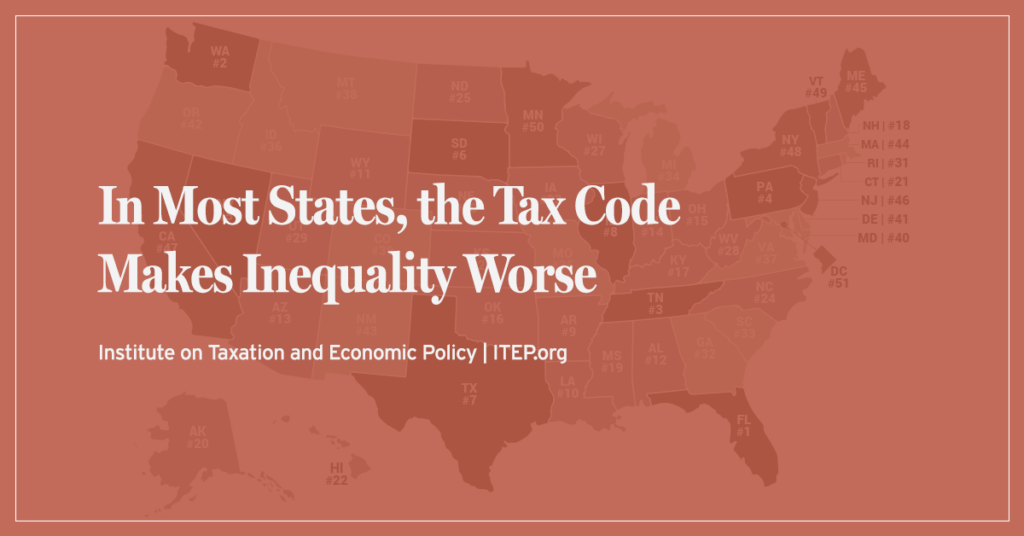
The vast majority of state and local tax systems are upside-down, with the wealthy paying a far lesser share of their income in taxes than low- and middle-income families. Yet a few states have made strides to buck that trend and have tax codes that are somewhat progressive and therefore do not worsen inequality.
Tax Systems in 44 States Exacerbate Inequality, In-Depth ‘Who Pays?’ Study Finds
January 9, 2024 • By ITEP Staff
The vast majority of state and local tax systems are upside-down, with the wealthy paying a far lesser share of their income in taxes than low- and middle-income families. That’s according to the latest edition of the Institute on Taxation and Economic Policy’s Who Pays?, the only distributional analysis of tax systems in all 50 states and the District of Columbia.
Vermont: Who Pays? 7th Edition
January 9, 2024 • By ITEP Staff
Vermont Download PDF All figures and charts show 2024 tax law in Vermont, presented at 2023 income levels. Senior taxpayers are excluded for reasons detailed in the methodology. Our analysis includes nearly all (99.7 percent) state and local tax revenue collected in Vermont. State and local tax shares of family income Top 20% Income Group […]
Hidden in Plain Sight: Race and Tax Policy in 2023 State Legislative Sessions
November 21, 2023 • By Brakeyshia Samms
Race was front and center in a lot of state policy debates this year, from battles over what’s being taught in schools to disagreements over new voting laws. Less visible, but also extremely important, were the racial implications of tax policy changes. What states accomplished this year – both good and bad – will acutely affect people and families of color.

States differ dramatically in how much they allow families to make choices about whether and when to have children and how much support they provide when families do. But there is a clear pattern: the states that compel childbirth spend less to help children once they are born.
State Tax Credits Have Transformative Power to Improve Economic Security
September 12, 2023 • By Aidan Davis
The latest analysis from the U.S. Census Bureau provides an important reminder of the compelling link between public investments and families’ economic well-being. Policy decisions can drastically reduce poverty and improve family economic stability for low- and middle-income families alike, as today’s data release shows.
States are Boosting Economic Security with Child Tax Credits in 2023
September 12, 2023 • By Aidan Davis, Neva Butkus

Fourteen states now provide Child Tax Credits to reduce poverty, boost economic security, and invest in children. This year alone, lawmakers in three states created new Child Tax Credits while lawmakers in seven states expanded existing credits. To maximize impact, lawmakers should consider making their credits fully refundable, not including an earnings requirement, setting a maximum amount per child instead of per household, setting state-specific phase-out ranges that target low- and middle-income families, indexing to inflation, and offering the option of advanced payments.
Boosting Incomes, Improving Equity: State Earned Income Tax Credits in 2023
September 12, 2023 • By Aidan Davis, Neva Butkus

Nearly two-thirds of states (31 plus the District of Columbia and Puerto Rico) have an Earned Income Tax Credit, an effective tool that boosts low-paid workers’ incomes and helps lower-income families achieve greater economic security. This year, 12 states expanded and improved EITCs.
