
Illinois

Sound Tax Policy Made a Comeback in 2017
• By ITEP Staff
2017 marked a sea change in state tax policy and a stark departure from the current federal tax debate as dubious supply-side economic theories began to lose their grip on statehouses. Compared to the predominant trend in recent years of emphasizing top-heavy income tax cuts and shifting to more regressive consumption taxes in the hopes […]
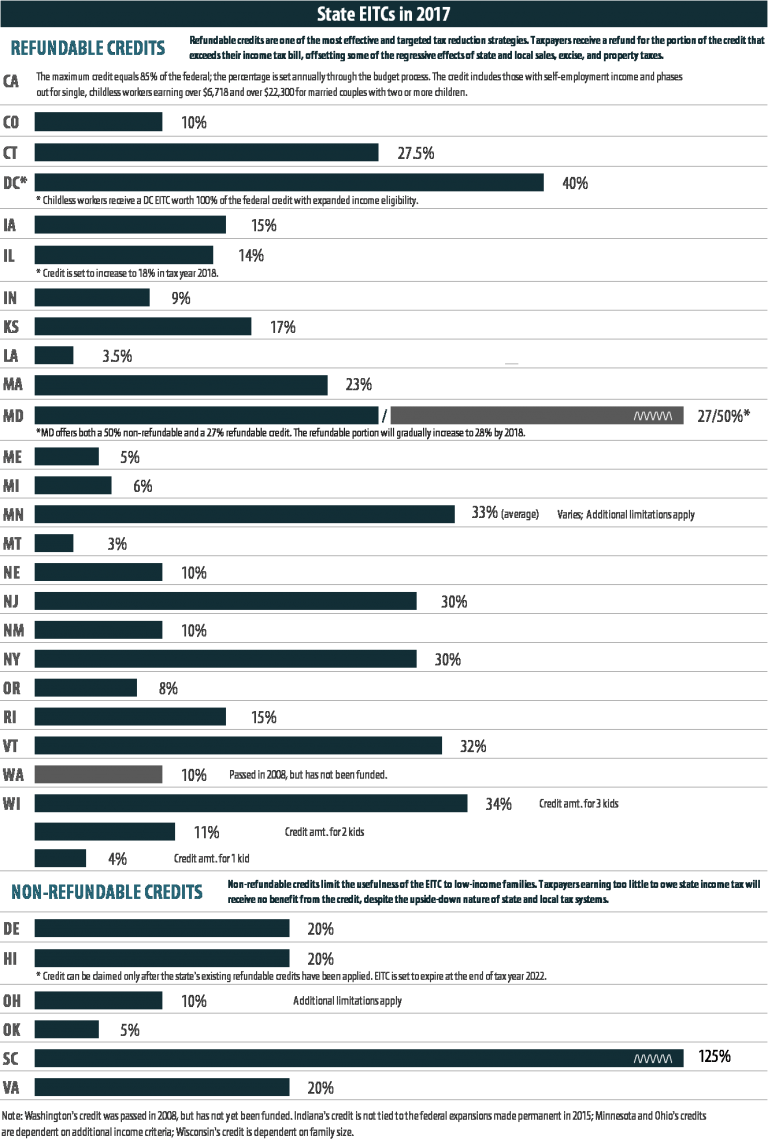
Rewarding Work Through State Earned Income Tax Credits
• By Aidan Davis
The Earned Income Tax Credit (EITC) is a policy designed to bolster the earnings of low-wage workers and offset some of the taxes they pay, providing the opportunity for struggling families to step up and out of poverty toward meaningful economic security. The federal EITC has kept millions of Americans out of poverty since its enactment in the mid-1970s. Over the past several decades, the effectiveness of the EITC has been magnified as many states…
Trump’s $4.8 Trillion Tax Proposals Would Not Benefit All States or Taxpayers Equally
• By Matthew Gardner, Steve Wamhoff
The broadly outlined tax proposals released by the Trump administration would not benefit all taxpayers equally and they would not benefit all states equally either. Several states would receive a share of the total resulting tax cuts that is less than their share of the U.S. population. Of the dozen states receiving the least by this measure, seven are in the South. The others are New Mexico, Oregon, Maine, Idaho and Hawaii.
Trump Tax Proposals Would Provide Richest One Percent in Illinois with 56.1 Percent of the State’s Tax Cuts
• By ITEP Staff
Earlier this year, the Trump administration released some broadly outlined proposals to overhaul the federal tax code. Households in Illinois would not benefit equally from these proposals. The richest one percent of the state’s taxpayers are projected to make an average income of $2,726,200 in 2018. They would receive 56.1 percent of the tax cuts that go to Illinois’s residents and would enjoy an average cut of $134,270 in 2018 alone.
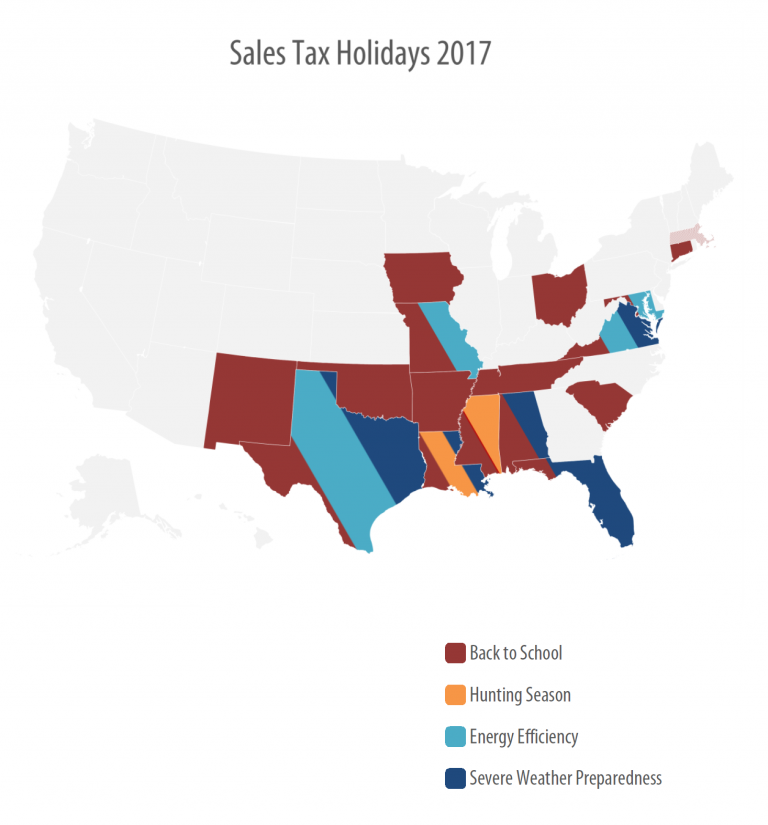
Sales Tax Holidays: An Ineffective Alternative to Real Sales Tax Reform
• By ITEP Staff
Sales taxes are an important revenue source, composing close to half of all state tax revenues. But sales taxes are also inherently regressive because the lower a family’s income, the more the family must spend on goods and services subject to the tax. Lawmakers in many states have enacted “sales tax holidays” (at least 16 states will hold them in 2017), to provide a temporary break on paying the tax on purchases of clothing, school…
State Rundown 7/11: Some Legislatures Get Long Holiday Weekends, Others Work Overtime
• By ITEP Staff
Illinois and New Jersey made national news earlier this month after resolving their contentious budget stalemates. But they weren’t the only states working through (and in some cases after) the holiday weekend to resolve budget issues.
State Rundown 6/28: States Scramble to Finish Budgets Before July Deadlines
• By ITEP Staff
This week, several states attempt to wrap up their budget debates before new fiscal years (and holiday vacations) begin in July. Lawmakers reached at least short-term agreement on budgets in Alaska, New Hampshire, Rhode Island, and Vermont, but such resolution remains elusive in Connecticut, Delaware, Illinois, Maine, Pennsylvania, Washington, and Wisconsin.
Chicago Magazine: What Can Illinois Learn from Other States’ Budget Disasters
June 1, 2017
In 2012, Kansas would go on to enact tax cuts that the Institute on Taxation and Economic Policy called ”among the largest” enacted by any state. Under the leadership of recently elected Governor Sam Brownback, the state dropped the top income tax rate by one-fourth, nixed taxes on “pass through” business profits (business profits passed directly to the […]
State Rundown 5/31: Budget Woes Spurring Special Legislative Sessions
• By ITEP Staff
This week, special legislative sessions featuring tax and budget debates are underway or in the works in Kentucky, Minnesota, New Mexico, and West Virginia, as lawmakers are also running up against regular session deadlines in Illinois, Kansas, and Oklahoma. Meanwhile, a legislative study in Wyoming and an independent analysis in New Jersey are both calling for tax increases to overcome budget shortfalls.
Crain’s Chicago Business: How Much Do Illinois Companies Pay in Taxes?
April 28, 2017
Illinois’ Fortune 500 companies are paying less and less in state corporate taxes—and sometimes, almost nothing at all. A new report by the Institute on Taxation and Economic Policy found certain corporations are finding ways to shelter much of their profit from state taxes. The eight-year study looked at 240 Fortune 500 companies from 2008 […]
3 Percent and Dropping: State Corporate Tax Avoidance in the Fortune 500, 2008 to 2015
• By Aidan Davis, Matthew Gardner, Richard Phillips
The trend is clear: states are experiencing a rapid decline in state corporate income tax revenue. Despite rebounding and even booming bottom lines for many corporations, this downward trend has become increasingly apparent in recent years. Since our last analysis of these data, in 2014, the state effective corporate tax rate paid by profitable Fortune 500 corporations has declined, dropping from 3.1 percent to 2.9 percent of their U.S. profits. A number of factors are…

New State Corporate Study: 3 Percent and Dropping
• By Aidan Davis
States are experiencing a rapid decline in state corporate income tax revenue, and the downward trend has become increasingly pronounced in recent years. Despite rebounding bottom lines for many corporations, a new ITEP report, 3 Percent and Dropping: State Corporate Tax Avoidance in the Fortune 500, 2008 to 2015,finds that effective tax rates paid by […]
The Register-Mail: Change ‘tax avoidance’ laws
March 22, 2017
However, the practice isn’t unusual. About $2.5 trillion has been held offshore in about 10,000 tax-haven subsidiaries by more than 350 of Fortune-500 companies, according to another report, “Offshore Shell Games 2016,” from the Public Interest Research Group, the Institute on Taxation and Economic Policy, and Citizens for Tax Justice. Companies such as Apple and […]
Quad City-Times: Embrace immigrant past, be welcoming community
March 13, 2017
Immigrants are more likely to start a business than native-born Americans and are particularly over-represented in Main Street business — retail, restaurants and neighborhood services — that are crucial to local economies. They also contribute to local tax bases. Even unauthorized immigrants paid $11.74 billion in state and local taxes in 2014 ($758 million just […]
Undocumented Immigrants’ State & Local Tax Contributions
• By Lisa Christensen Gee, Meg Wiehe, Misha Hill
Public debates over federal immigration reform, specifically around undocumented immigrants, often suffer from insufficient and inaccurate information about the tax contributions of undocumented immigrants, particularly at the state level. The truth is that undocumented immigrants living in the United States paybillions of dollars each year in state and local taxes. Further, these tax contributions would increase significantly if all undocumented immigrants currently living in the United States were granted a pathway to citizenship as part…
Tax Justice Digest: The Problems with a Border Adjustment Tax
• By ITEP Staff
In the Tax Justice Digest we recap the latest reports, blog posts, and analyses from Citizens for Tax Justice and the Institute on Taxation and Economic Policy. Here’s a rundown of what we’ve been working on lately. Regressive and Loophole-Ridden: Issues with the House GOP Border Adjustment Tax Proposal In recent weeks, the Republican congressional […]
Combined Reporting of State Corporate Income Taxes: A Primer
• By Dylan Grundman O'Neill, Meg Wiehe
Over the past several decades, state corporate income taxes have declined markedly. One of the factors contributing to this decline has been aggressive tax avoidance on the part of large, multi-state corporations, costing states billions of dollars. The most effective approach to combating corporate tax avoidance is combined reporting, a method of taxation currently employed in more than half of the states that tax corporate income. The two most recent states to enact combined reporting…

State Rundown 2/23: Regressive Tax Proposals Multiplying
• By ITEP Staff
This week saw a nearly successful attempt to right the fiscal ship in Kansas; regressive tax proposals introduced in WestVirginia, Georgia, and Missouri; ongoing gas tax fights in Indiana, South Carolina, and Tennessee; and further tax and budget wrangling in Illinois, New Mexico, Oklahoma, and beyond. — Meg Wiehe, ITEP State Policy Director, @megwiehe Both […]

What to Watch in the States: Modernizing Sales Taxes for a 21st Century Economy
• By Misha Hill
This is the fourth installment of our six-part series on 2017 state tax trends. The introduction to this series is available here. State lawmakers often find themselves looking for ways to raise revenue to fund vital public services, fill budget gaps, or pay for the elimination or weakening of progressive taxes. Lately, that search has […]
State Rundown 2/15: Tax Overhauls Debated Around the Country
• By ITEP Staff
This week we are following a number of significant proposals being debated or introduced including reinstating the income tax in Alaska and eliminating the tax in West Virginia, establishing a regressive tax-cut trigger in Nebraska, restructuring the Illinois sales tax, moving New Mexico to a flat income tax and broader gross receipts tax, and updating […]

State Rundown 2/1: 2017 State Tax Debates Getting Real
• By ITEP Staff
This week’s Rundown brings news of tax cuts passed in Arkansas and advanced in Idaho, proposals to exempt feminine hygiene products from sales taxes in Nevada and Michigan, revenue shortfalls forcing tough choices in Louisiana and Maine, and more governors’ state of the state addresses and budget proposals setting the stage for yet more tax […]
State Tax & Revenue Information
• By ITEP Staff
Below is a list of notable resources for information on state taxes and revenues: Alabama Alabama Department of Revenue Alabama Department of Finance – Executive Budget Office Alabama Department of Revenue – Tax Incentives for Industry Alabama Legislative Fiscal Office Alaska Alaska Department of Revenue – Tax Division Alaska Office of Management & Budget Alaska […]
What to Watch in the States Series: Tax Policy 2017
• By Lisa Christensen Gee
Over the next few weeks we will be blogging about what we’re watching in state tax policy during 2017 legislative sessions. In this “What to Watch in the States” series, we will look at the following: State responses to short- and long-term revenue deficits Boosting funding for infrastructure, though sometimes at the expense of other […]
Fairness Matters: A Chart Book on Who Pays State and Local Taxes
• By Carl Davis, Meg Wiehe
When states shy away from personal income taxes in favor of higher sales and excise taxes, high-income taxpayers benefit at the expense of low- and moderate-income families who often face above-average tax rates to pick up the slack. This chart book demonstrates this basic reality by examining the distribution of taxes in states that have pursued these types of policies. Given the detrimental impact that regressive tax policies have on economic opportunity, income inequality, revenue…

State Rundown 1/25: Revenue Shortfalls and How to Avoid Them
• By ITEP Staff
This week brings more news of states facing budget crunches, a new state looking to eliminate income taxes, and plans to raise gas taxes to fund transportation projects. Be sure to check out the What We’re Reading section for a look at how repealing federal health reform could add to those crunches and a review […]
