
Recent Work by ITEP
Testimony to Senate Budget Committee on Ending a Rigged Tax Code: The Need To Make the Wealthiest People and Largest Corporations Pay their Fair Share of Taxes
March 25, 2021 • By Amy Hanauer
Following is testimony of ITEP Executive Director Amy Hanauer before the Senate Budget Committee to consider “Ending a Rigged Tax Code: The Need To Make the Wealthiest People and Largest Corporations Pay their Fair Share of Taxes” “Chairman Sanders and Ranking Member Graham, thank you for the opportunity to speak to this committee. My name […]
It was a relatively quiet week in state fiscal policy, likely partly due to states waiting for federal guidance on some of the details in the American Rescue Plan. As they await those details, lawmakers in Mississippi and West Virginia continue to wrangle over whether to recklessly eliminate their income taxes, while leaders in states including Connecticut and New York considered more productive and progressive reforms. And in the meantime, groundbreaking work on the intersection of race and tax policy is now available.

Zoom Video Communications, the company providing a platform used by remote workers and school children across the country during the pandemic, saw its profits increase by more than 4,000 percent last year but paid no federal corporate income tax on those profits.
State Rundown 3/17: Momentum for Sound Progressive Tax Reforms Continues to Build
March 17, 2021 • By ITEP Staff
We wrote last week that the inclusion of fiscal relief for states and localities in Congress’s American Rescue Plan should free up state lawmakers’ time and attention to focus on the comprehensive reforms needed to address upside-down and inadequate tax codes, and some states are already doing just that.
Trickle-Down Myths Swamp Tax Policy Debates in Mississippi and West Virginia
March 15, 2021 • By Aidan Davis

Recent proposals in both Mississippi and West Virginia seek to pare back, and ultimately eliminate, each state’s income tax while shifting the responsibility of funding services even more onto low- and middle-income taxpayers through increased consumption taxes. The states are moving forward with this tax experiment even though a similar experiment notoriously and immediately sent Kansas into a financial tailspin.
State and Local Cannabis Tax Revenue Jumps 58%, Surpassing $3 Billion in 2020
March 15, 2021 • By Carl Davis
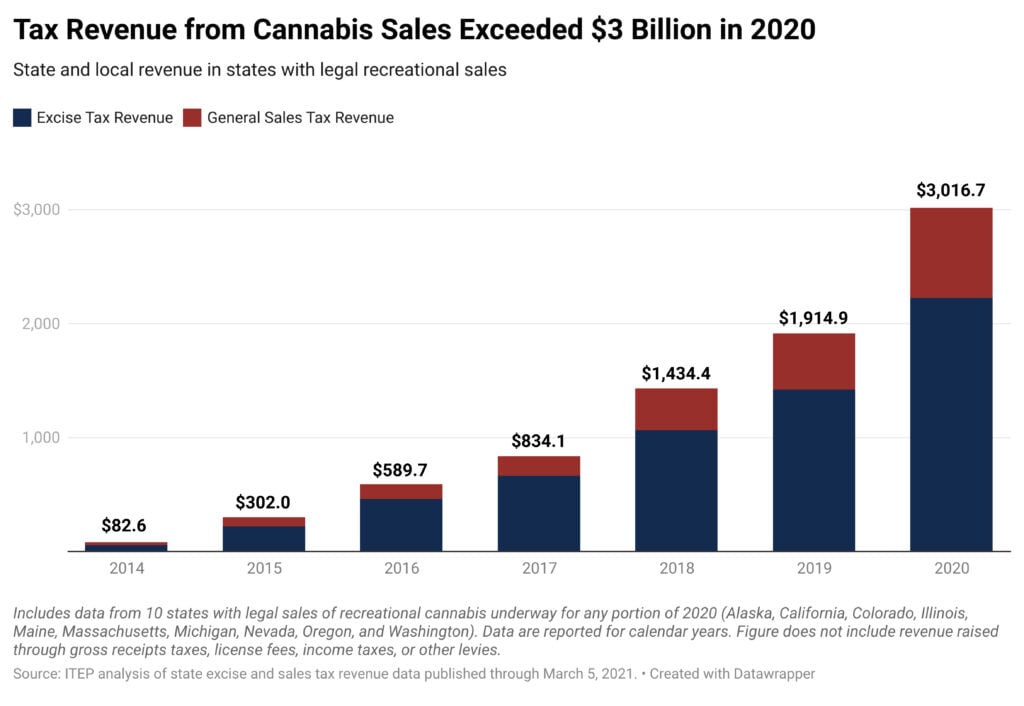
Cannabis taxes are a small part of state and local budgets, clocking in at less than 2 percent of tax revenue in the states with legal adult-use sales. But they’re also one of states’ fastest-growing revenue sources. Powered by an expanding legal market and a pandemic-driven boost in cannabis use, excise and sales taxes on […]
Rep. Doggett and Sen. Whitehouse Introduce Bill to Crack Down on Offshore Corporate Tax-Dodging
March 11, 2021 • By Steve Wamhoff

The 2017 tax law simply replaced one set of loophole-ridden rules that favored offshore profits over domestic profits with a new set of loophole-ridden rules doing the same thing. A bill introduced today by Rep. Lloyd Doggett and Sen. Sheldon Whitehouse would finally fix this to follow a simple principle: we should tax the offshore profits and domestic profits of our corporations the same way.
State Rundown 3/10: Federal Pandemic Aid Means States Can Focus on the Big Picture
March 10, 2021 • By ITEP Staff
State and local policymakers will be preoccupied for a short time with celebrating and deciphering the federal pandemic relief package approved today, but ultimately the federal aid should free them to focus on even bigger concerns such as tax codes that often fail to adequately fund core priorities even in good years and exacerbate the economic and racial inequities that this pandemic has laid bare.
Targeted Relief and the American Rescue Plan in Five Charts
March 10, 2021 • By Stephanie Clegg
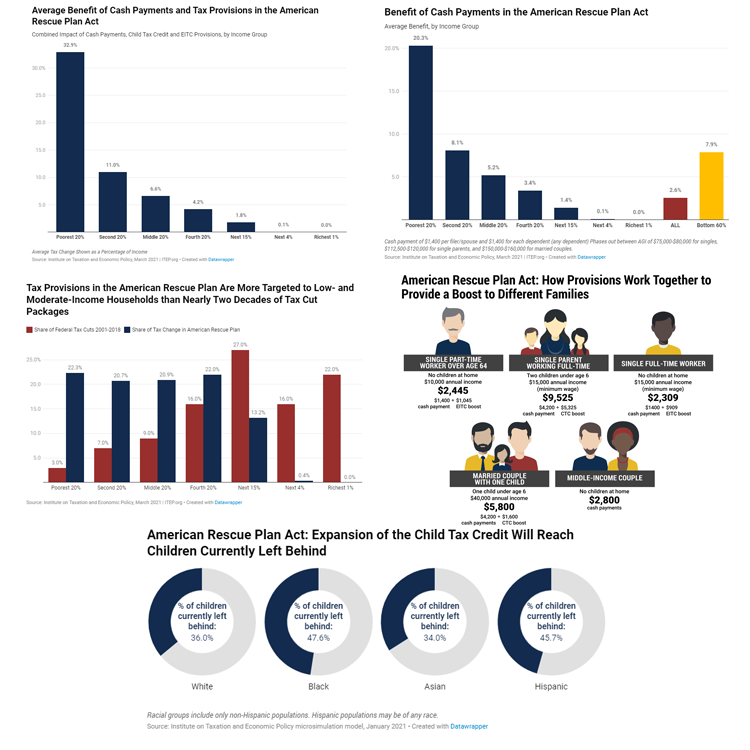
The American Rescue Plan Act is unique in that it employs the tax code to deliver relief to those struggling most. These five charts provide a glimpse of how the plan helps families across the income spectrum and also targets economic relief to low- and moderate-income families in the form of cash payments and expansions to the Child Tax Credit and Earned Income Tax Credit.
Estimates of Cash Payment and Tax Credit Provisions in American Rescue Plan
March 7, 2021 • By Steve Wamhoff

Update: On March 10, the House passed the Senate version of the COVID relief bill, called the American Rescue Plan Act, and sent it to President Biden for his signature. This means that the Senate version of the bill described herein is the final legislation enacted into law.
ITEP in the News
Wall Street Journal: Coke Takes on IRS With $20 Billion at Stake
Reuters: Hawaii Considers Gasoline Tax Suspension as Pump Prices Soar
Time: Trump Demands Israel and Iran 'Stop Shooting’ as World Leaders Urge Restraint Amid Renewed Hostilities
The Oklahoman: GOP Candidates Say Income Tax Cuts Would End Oklahoma's Corporate Exodus
NPR: Trump Wants a Gas Tax Holiday. There's a Much Bigger Problem Looming.
ITEP Work in Action
The Arizona Center for Economic Progress: As America250 Approaches, Arizona’s Story Must Include All of Us
Wall Street Journal: Coke Takes on IRS With $20 Billion at Stake
Public Citizen: The Current Price of Zero
Reuters: Hawaii Considers Gasoline Tax Suspension as Pump Prices Soar
Time: Trump Demands Israel and Iran 'Stop Shooting’ as World Leaders Urge Restraint Amid Renewed Hostilities

Institute on Taxation
and Economic Policy
ITEP is a non-profit, non-partisan tax policy organization. We conduct rigorous analyses of tax and economic proposals and provide data-driven recommendations to shape equitable and sustainable tax systems.
Subscribe to ITEP Emails
Tax research and policy news in your inbox.
Promote Fair Tax Policy
Your gift to ITEP promotes tax justice. With your help, we do research that supports taxing millionaires and billionaires, taxing big corporations and raising revenue for the things our people, our communities and our planet need.
Together, we can create a country with more economic justice, more racial justice, more climate justice… and more tax justice.