
Reports
428 posts
After Two Rounds of Trump Tax Cuts, Corporate America Paid Less Than Ever in 2025
• By Matthew Gardner, Steve Wamhoff, Joe Hughes, Spandan Marasini
In 2025, 706 major American corporations collectively paid a federal income tax rate of just 10.4% on $1.88 trillion in U.S. profits. This is the lowest effective rate that ITEP has uncovered in over 40 years of analyzing corporate income taxes.
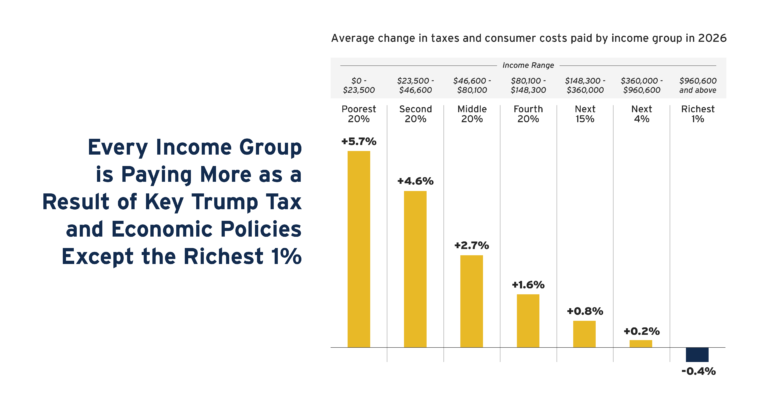
Impact of Key Trump Policies on Taxes and Costs: National and State Estimates
• By Steve Wamhoff
The major tax and economic policies of President Trump’s second term have increased taxes and household costs for most Americans except the richest 1%.

How the 50 Largest American Cities Raise Revenue and What That Means for Tax Equity
• By Rita Jefferson, Nick Johnson, Galen Hendricks
Large cities have the technical capacity, the economic base, and often more political might than smaller localities and governments that local officials should utilize to design fairer tax systems.

Congress Should Reject Proposed Tax Breaks for Crypto
• By Steve Wamhoff
Crypto provides no clear benefit and instead harms society in several ways. Even if crypto was useful in some way that outweighed the harms it causes, there is no reason to make exceptions that treat it more generously than other types of assets or transactions.
State-by-State Tax Expenditure Reports
• By ITEP Staff
Below is a list of tax expenditure reports published in the states.
Tax the Rich, Fund Our Communities: Local Options for Progressive Revenue
• By Rita Jefferson, Nick Johnson, Angelo Pis-Dudot
The task for local elected officials in this moment is therefore clear: use available tools to make the wealthy pay their fair share to fund the essential public goods that allow our communities to live safe, healthy, and thriving lives.

A Resilient Framework for Corporate Tax Reform
• By Steve Wamhoff
The next time Congress is serious about making the wealthiest pay their fair share in federal taxes, they will need to make three key changes to the federal corporate income tax so that it applies effectively to all the businesses that generate their income.

Taxing Advertising Would Modernize State Sales Tax Bases for the Information Age
• By Nick Johnson
Most states questionably exempt advertising from sales taxes. States that extend their sales taxes to advertising and/or enact an excise tax stand to raise billions in revenue while correcting a structural bias in their tax codes that implicitly subsidizes some of the most profitable corporations in human history.

New EITC Proposal Would Help Families Dealing with Rising Costs
• By Joe Hughes
A new proposal in Congress to expand the Earned Income Tax Credit (EITC) would help families with the costs of raising children. The Working Parents Tax Relief Act is one of the latest approaches to help working-class families deal with an ongoing affordability crisis.

At Least 88 Profitable U.S. Corporations Paid Zero Federal Income Tax in 2025
• By Matthew Gardner, Spandan Marasini
At least 88 of the largest corporations in America paid $0 in federal income tax for 2025. Corporate tax avoidance has increased at least in part due to President Trump's “One Big Beautiful Bill Act” and the 2017 Tax Cuts and Jobs Act.
Year One of Trump-Republican Tax Policy: The Consequences
• By Michael Ettlinger
President Trump has dramatically increased tariff taxes, enacted large tax cuts that primarily benefit the wealthy and corporations, dramatically curtailed IRS enforcement, and issued legally problematic regulations.

The Child Tax Credit Leaves Out Millions of Children in 2026. There Are Better Alternatives.
• By Joe Hughes
The 2025 Trump tax law slightly increased the Child Tax Credit in a way that benefits virtually none of the children who most need help.

Local Vacancy Taxes: A Tool but Not a Panacea
• By Rita Jefferson
Vacancy taxes will not single-handedly solve problems in cities, but they are worth considering to address housing shortages, land use, and building thriving communities.

The Wealth Proceeds Tax: A Simple Way for States to Tax the Wealthy
• By Sarah Austin, Carl Davis
Taxing the proceeds generated by wealth through a new Wealth Proceeds Tax is a simple way for states to raise billions in new revenue and improve the fairness of their tax systems.

The Potential of Local Child Tax Credits to Reduce Child Poverty
• By Kamolika Das, Aidan Davis, Galen Hendricks, Rita Jefferson
Local governments have a critical role to play in reducing child poverty. Local Child Tax Credits could provide large tax cuts to families at the bottom of the income scale, lessening the overall regressivity of state and local tax systems.

How Will the Trump Megabill Change Americans’ Taxes in 2026?
• By Steve Wamhoff, Michael Ettlinger, Carl Davis, Jon Whiten
The megabill will raise taxes on the poorest 40 percent of Americans, barely cut them for the middle 20 percent, and cut them tremendously for the wealthiest Americans next year.

Anti-Tax Revolts Backfire: What We’ve Learned from 50 Years of Property Tax Limits
• By Rita Jefferson
Across-the-board property tax cuts create less fair local tax systems in the long run. State legislators and local governments should prioritize the residents who can least afford their property taxes, not the residents and businesses who can.

There Were Far Cheaper and Fairer Options Than the Trump Megabill
• By Steve Wamhoff, Joe Hughes, Jessica Vela
Congress and the president could have spent less than half that much money on a tax bill that does more for working-class and middle-class households.
Analysis of Tax Provisions in the Trump Megabill as Signed into Law: National and State Level Estimates
• By Steve Wamhoff, Carl Davis, Joe Hughes, Jessica Vela
President Trump has signed into law the tax and spending “megabill” that largely favors the richest taxpayers and provides working-class Americans with relatively small tax cuts that will in many cases be more than offset by Trump's tariffs.
Analysis of Tax Provisions in the Senate Reconciliation Bill: National and State Level Estimates
• By Carl Davis, Jessica Vela, Joe Hughes, Steve Wamhoff
Compared to its House counterpart, the Senate bill makes certain tax provisions more generous, including corporate tax breaks that it makes permanent rather than temporary. But the bottom line for both is the same. Both bills give more tax cuts to the richest 1 percent than to the entire bottom 60 percent of Americans, and both bills particularly favor high-income people living in more conservative states.
Analysis of Tax Provisions in the House Reconciliation Bill: National and State Level Estimates
• By Carl Davis, Jessica Vela, Joe Hughes, Steve Wamhoff
The poorest fifth of Americans would receive 1 percent of the House reconciliation bill's net tax cuts in 2026 while the richest fifth of Americans would receive two-thirds of the tax cuts. The richest 5 percent alone would receive a little less than half of the net tax cuts that year.

Federal Tax Policy: What Should It Accomplish?
• By Steve Wamhoff
The U.S. needs a tax code that is more adequate, meaning any major tax legislation should increase revenue, not reduce it. The U.S. also needs a tax code that is more progressive, meaning any significant tax legislation should require more, not less, from those most able to pay.

Shelter Skelter: How the Educational Choice for Children Act Would Use Tax Avoidance to Fuel School Privatization
• By Carl Davis
The Educational Choice for Children Act of 2025 would ostensibly provide a tax break on charitable donations to organizations that give out private K-12 school vouchers. Most of the so-called “contributions,” however, would be made by wealthy people solely for the tax savings, as those savings would typically be larger than their contributions.

A Revenue Impact Analysis of the Educational Choice for Children Act of 2025
• By Carl Davis
The Educational Choice for Children Act of 2025 would provide donors to nonprofit groups that distribute private K-12 school vouchers with a dollar-for-dollar federal tax credit in exchange for their contributions. In total, the ECCA would reduce federal and state tax revenues by $10.6 billion in 2026 and by $136.3 billion over the next 10 years. Federal tax revenues would decline by $134 billion over 10 years while state revenues would decline by $2.3 billion.

High-Rent, Low-Wealth: Addressing the Racial Wealth Gap through a Federal Renter Credit
• By Brakeyshia Samms, Emma Sifre, Joe Hughes
While the federal tax code has some policies focused on raising income of low earners, it contains fewer provisions designed specifically to address wealth inequality. A renter tax credit offers a simple, administratively practical means of reaching low-wealth populations through the federal tax code without requiring a comprehensive measurement of every household’s wealth.

Institute on Taxation
and Economic Policy
ITEP is a non-profit, non-partisan tax policy organization. We conduct rigorous analyses of tax and economic proposals and provide data-driven recommendations to shape equitable and sustainable tax systems.
Subscribe to ITEP Emails
Tax research and policy news in your inbox.
Promote Fair Tax Policy
Your gift to ITEP promotes tax justice. With your help, we do research that supports taxing millionaires and billionaires, taxing big corporations and raising revenue for the things our people, our communities and our planet need.
Together, we can create a country with more economic justice, more racial justice, more climate justice… and more tax justice.