
Indiana
State Rundown 10/18: Ballot Initiative Efforts Being Finalized
October 18, 2017 • By ITEP Staff
Ballot initiatives relating to taxes made news around the country this week, with Oregon voters to consider reversing new health care taxes, Washingtonians to vote on improving education funding, and Nebraskans to potentially vote on a state tax credit for school property taxes. Meanwhile, multiple states are finalizing their proposals to lure Amazon to build a new headquarters in their state, often through the use of massive tax subsidies. And in our "What We're Reading" section we have sobering news from Moody's Investors Service on states' struggles to fund their infrastructure and save for the next recession.
Washington Examiner: Indiana’s Tax Cuts Haven’t Led to Higher Paychecks
October 17, 2017
Carl Davis for the Institute on Taxation and Economic Policy: In announcing a tax cut framework in Indianapolis that was negotiated with House and Senate leaders, President Trump said, “Indiana is a tremendous example of the prosperity that is unleashed when we cut taxes and set free the dreams of our citizens … In Indiana, […]
Select State News Coverage of ITEP’s 50-State Analysis of the GOP Tax Proposal
October 10, 2017
The Sentinel: Trump Tax Even in Harrisburg Will Feature Truckers The Columbus Dispatch: 15% of Ohioans Could See Tax Increase Under GOP Plan KGW Portland: Richest Oregonians Benefit Most from Proposed Tax Cuts Raleigh News & Observer: The Racial Wealth Divide Could Grow with Tax Changes Northwest Indiana Times: Hoosiers Would Lose in Trump Tax […]
Benefits of GOP-Trump Framework Tilted Toward the Richest Taxpayers in Each State
October 4, 2017 • By Steve Wamhoff
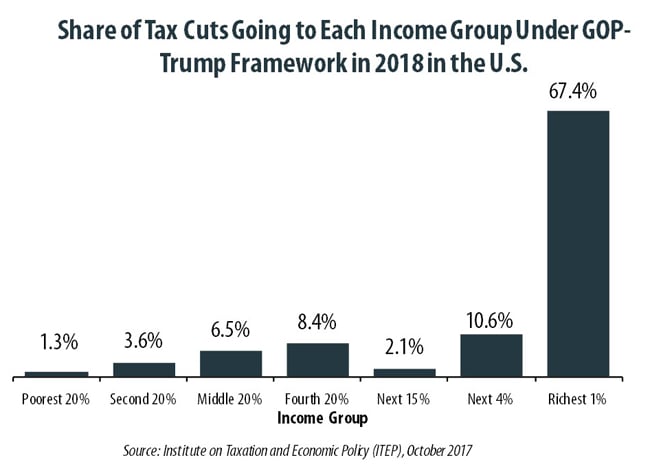
The “tax reform framework” released by the Trump administration and Congressional Republican leaders on September 27 would affect states differently, but every state would see its richest residents grow richer if it is enacted. In all but a handful of states, at least half of the tax cuts would flow to the richest one percent of residents if the framework took effect.
GOP-Trump Tax Framework Would Provide Richest One Percent in Indiana with 50.4 Percent of the State’s Tax Cuts
October 4, 2017 • By ITEP Staff
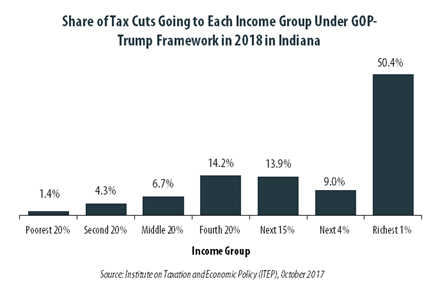
The “tax reform framework” released by the Trump administration and congressional Republican leaders on September 27 would not benefit everyone in Indiana equally. The richest one percent of Indiana residents would receive 50.4 percent of the tax cuts within the state under the framework in 2018. These households are projected to have an income of at least $500,500 next year. The framework would provide them an average tax cut of $54,510 in 2018, which would increase their income by an average of 3.5 percent.
Indiana’s Tax Cuts Under Mike Pence Are Not a Model for the Nation
September 29, 2017 • By Carl Davis
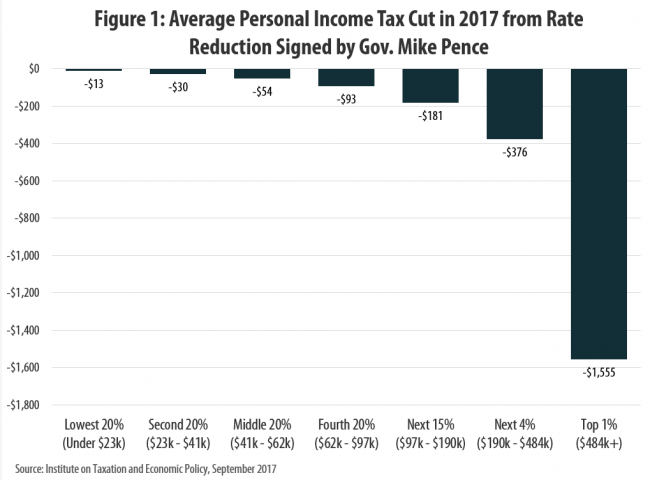
In announcing a new tax cut framework this week in Indianapolis that was negotiated with House and Senate leaders, President Trump claimed that “Indiana is a tremendous example of the prosperity that is unleashed when we cut taxes and set free the dreams of our citizens …. In Indiana, you have seen firsthand that cutting taxes on businesses makes your state more competitive and leads to more jobs and higher paychecks for your workers.”
State Rundown 9/13: The Year of Unprecedented State Budget Impasses Continues
September 13, 2017 • By ITEP Staff
This week, Pennsylvania lawmakers risk defaulting on payments due to their extremely overdue budget and Illinois legislators will borrow billions to start paying their backlog of unpaid bills. Governing delves into why there were more such budget impasses this year than in any year in recent memory. And Oklahoma got closure from its Supreme Court on whether closing special tax exemptions counts as "raising taxes" (it doesn't).
State Rundown 8/31: Modernizing Taxes is Sometimes a Sprint, Sometimes a Marathon
August 31, 2017 • By ITEP Staff
Tax and budget debates are progressing at different paces in different parts of the country this week. In Connecticut and Wisconsin, lawmakers hope to finally settle their budget and tax differences soon. In South Dakota, a court case that could finally enable states to enforce their sales taxes on online retailers inches slowly closer to the U.S. Supreme Court.
Nearly Half of Trump’s Proposed Tax Cuts Go to People Making More than $1 Million Annually
August 17, 2017 • By ITEP Staff
A tiny fraction of the U.S. population (one-half of one percent) earns more than $1 million annually. But in 2018 this elite group would receive 48.8 percent of the tax cuts proposed by the Trump administration. A much larger group, 44.6 percent of Americans, earn less than $45,000, but would receive just 4.4 percent of the tax cuts.
In Indiana 39.8 Percent of Trump’s Proposed Tax Cuts Go to People Making More than $1 Million
August 17, 2017 • By ITEP Staff
A tiny fraction of the Indiana population (0.4 percent) earns more than $1 million annually. But this elite group would receive 39.8 percent of the tax cuts that go to Indiana residents under the tax proposals from the Trump administration. A much larger group, 43.8 percent of the state, earns less than $45,000, but would receive just 5.6 percent of the tax cuts.
Indiana Institute for Working Families: Trump Tax Plan Would Shortchange Indiana, Middle Class & Working Families (But Would Let Them Eat Cake)
August 15, 2017
A new analysis of the Trump tax plan from the Institute for Taxation and Economic Policy shows that Indiana would only get an 87% share of tax cuts relative to the state’s ratio of the U.S. population. This is the 23rd-smallest share among states. In part because the plan is aimed at high-income households and Indiana is a poorer state, no matter how you slice it, Indiana gets shortchanged compared to the average state by Trump’s plan.
It’s a Fact: Voucher Tax Credits Offer Profits for Some “Donors”
August 9, 2017 • By Carl Davis
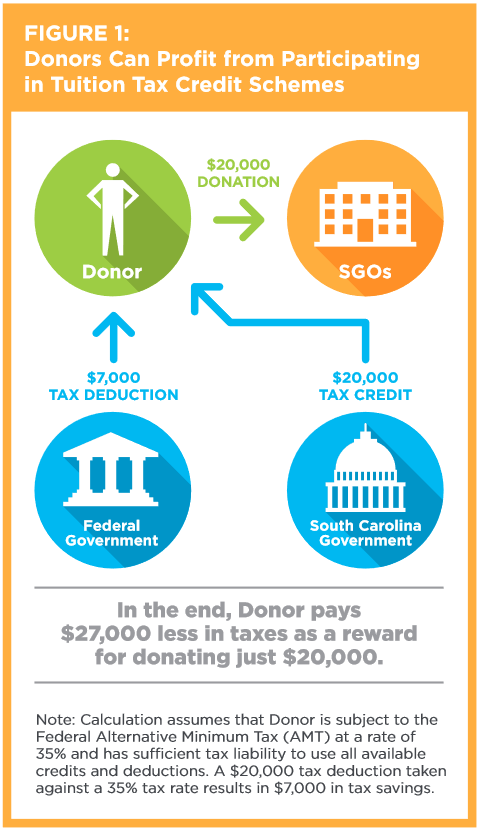
In nine states, tax rewards gained by donating to fund private K-12 vouchers are so oversized that “donors” can turn a profit. This is the shocking but true finding of a pair of studies released by ITEP over the last year.
State Rundown 7/27: State Legislative Debates Winding Down but Tax Talk Continues
July 27, 2017 • By ITEP Staff
While only a few states still remain mired in overtime budget debates, there is plenty of budget and tax news from around the country this week. Efforts are underway to repeal gas tax increases in California and challenge a local income tax in Seattle, Washington. And New Jersey legislators' law to modernize its tax code to tax Airbnb rentals has been vetoed for now.
2017 marked a sea change in state tax policy and a stark departure from the current federal tax debate as dubious supply-side economic theories began to lose their grip on statehouses. Compared to the predominant trend in recent years of emphasizing top-heavy income tax cuts and shifting to more regressive consumption taxes in the hopes […]
Trump Tax Proposals Would Provide Richest One Percent in Indiana with 46.1 Percent of the State’s Tax Cuts
July 20, 2017 • By ITEP Staff
Earlier this year, the Trump administration released some broadly outlined proposals to overhaul the federal tax code. Households in Indiana would not benefit equally from these proposals. The richest one percent of the state’s taxpayers are projected to make an average income of $1,511,600 in 2018. They would receive 46.1 percent of the tax cuts that go to Indiana’s residents and would enjoy an average cut of $95,940 in 2018 alone.
Trump’s $4.8 Trillion Tax Proposals Would Not Benefit All States or Taxpayers Equally
July 20, 2017 • By Matthew Gardner, Steve Wamhoff
The broadly outlined tax proposals released by the Trump administration would not benefit all taxpayers equally and they would not benefit all states equally either. Several states would receive a share of the total resulting tax cuts that is less than their share of the U.S. population. Of the dozen states receiving the least by this measure, seven are in the South. The others are New Mexico, Oregon, Maine, Idaho and Hawaii.
Sales Tax Holidays: An Ineffective Alternative to Real Sales Tax Reform
July 12, 2017 • By ITEP Staff
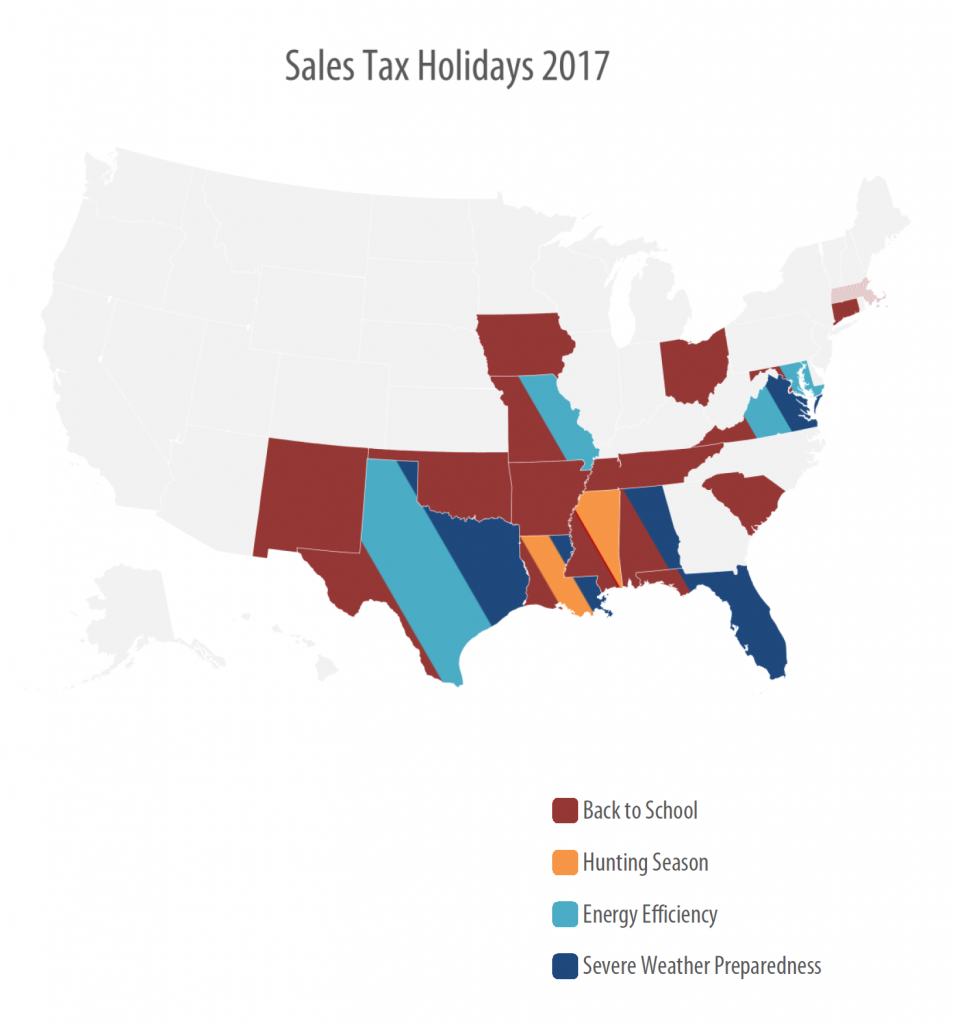
Sales taxes are an important revenue source, composing close to half of all state tax revenues. But sales taxes are also inherently regressive because the lower a family’s income, the more the family must spend on goods and services subject to the tax. Lawmakers in many states have enacted “sales tax holidays” (at least 16 states will hold them in 2017), to provide a temporary break on paying the tax on purchases of clothing, school supplies, and other items. While these holidays may seem to lessen the regressive impacts of the sales tax, their benefits are minimal. This policy brief…
Gas Taxes Will Rise in 7 States to Fund Transportation Improvements
June 28, 2017 • By Carl Davis

Summer gas prices are at their lowest level in twelve years, which makes right now a sensible time to ask drivers to pay a little more toward improving the transportation infrastructure they use every day. Seven states will be doing this on Saturday, July 1 when they raise their gasoline tax rates. At the same time, two states will be implementing small gas tax rate cuts.
The flawed design of federal and state gasoline taxes has made it exceedingly difficult to raise adequate funds to maintain the nation’s transportation infrastructure. Thirty states and the federal government levy fixed-rate gas taxes where the tax rate does not change even when the cost of infrastructure materials rises or when drivers transition toward more fuel-efficient vehicles and pay less in gas tax. The federal government’s 18.4 cent gas tax, for example, has not increased in over twenty-three years. Likewise, nineteen states have waited a decade or more since last raising their own gas tax rates.
State Rundown 6/14: Some States Wrapping Up Tax Debates, Others Looking Ahead to Next Round
June 14, 2017 • By ITEP Staff
This week lawmakers in California and Nevada resolved significant tax debates, while budget and tax wrangling continued in West Virginia, and structural revenue shortfalls were revealed in Iowa and Pennsylvania. Airbnb increased the number of states in which it collects state-level taxes to 21. We also share interesting reads on state fiscal uncertainty, the tax experiences of Alaska and Wyoming, the future of taxing robots, and more!
Kentucky Center for Economic Policy: Troubling Hints About Direction for Tax Reform
June 8, 2017
The corporate tax cuts described above mean profitable businesses chip in less for the public services that help them succeed. And the result of less reliance on income and inheritance taxes is clear (see graph below): those at the top in Tennessee and Indiana pay an even smaller share of their income in state and local taxes than the wealthiest Kentuckians do, and their lowest-income residents pay an even higher share than the poorest Kentuckians.
Investors and Corporations Would Profit from a Federal Private School Voucher Tax Credit
May 17, 2017 • By Carl Davis
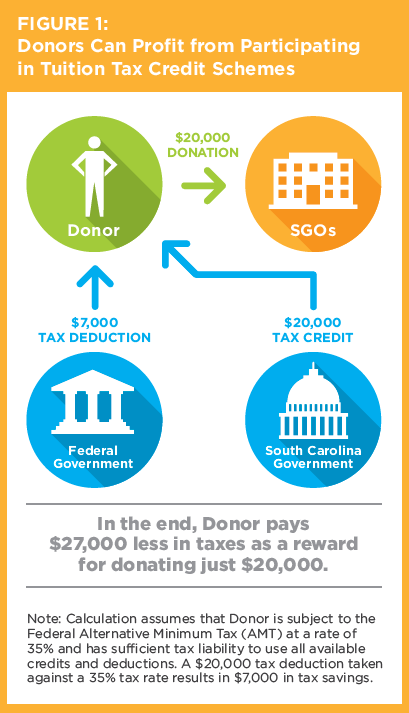
A new report by the Institute on Taxation and Economic Policy (ITEP) and AASA, the School Superintendents Association, details how tax subsidies that funnel money toward private schools are being used as profitable tax shelters by high-income taxpayers. By exploiting interactions between federal and state tax law, high-income taxpayers in nine states are currently able […]
Public Loss Private Gain: How School Voucher Tax Shelters Undermine Public Education
May 17, 2017 • By Carl Davis, Sasha Pudelski

One of the most important functions of government is to maintain a high-quality public education system. In many states, however, this objective is being undermined by tax policies that redirect public dollars for K-12 education toward private schools.
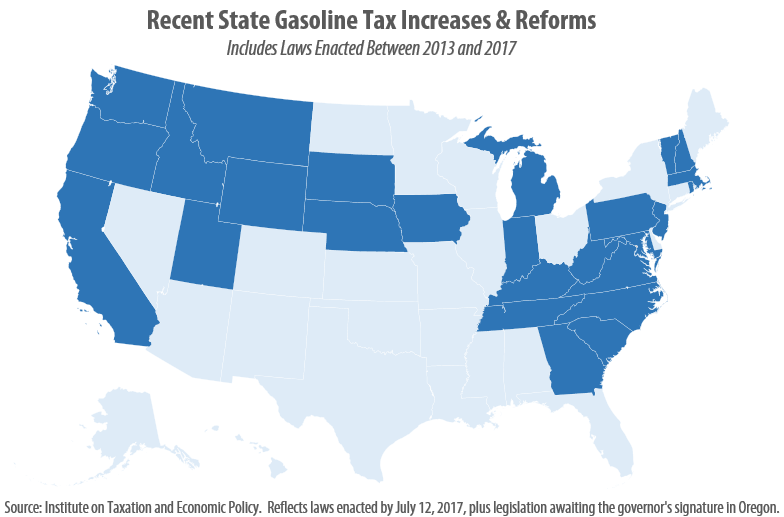
This post was updated July 12, 2017 to reflect recent gas tax increases in Oregon and West Virginia. As expected, 2017 has brought a flurry of action relating to state gasoline taxes. As of this writing, eight states (California, Indiana, Montana, Oregon, South Carolina, Tennessee, Utah, and West Virginia) have enacted gas tax increases this year, bringing the total number of states that have raised or reformed their gas taxes to 26 since 2013.
Governing: Raising the Gas Tax Is No Longer Taboo in Many States
May 7, 2017
Already this year, governors in California, Indiana and Tennessee signed laws to raise fuel taxes, meaning a total of 22 states have passed laws imposing higher gas taxes in the past five years. Chances are also good that the list will grow even longer this year. “It is such an unusual thing to see nearly […]

Institute on Taxation
and Economic Policy
ITEP is a non-profit, non-partisan tax policy organization. We conduct rigorous analyses of tax and economic proposals and provide data-driven recommendations to shape equitable and sustainable tax systems.
Subscribe to ITEP Emails
Tax research and policy news in your inbox.
Promote Fair Tax Policy
Your gift to ITEP promotes tax justice. With your help, we do research that supports taxing millionaires and billionaires, taxing big corporations and raising revenue for the things our people, our communities and our planet need.
Together, we can create a country with more economic justice, more racial justice, more climate justice… and more tax justice.