
Maine
State Rundown 7/27: State Legislative Debates Winding Down but Tax Talk Continues
July 27, 2017 • By ITEP Staff
While only a few states still remain mired in overtime budget debates, there is plenty of budget and tax news from around the country this week. Efforts are underway to repeal gas tax increases in California and challenge a local income tax in Seattle, Washington. And New Jersey legislators' law to modernize its tax code to tax Airbnb rentals has been vetoed for now.
Trump Touts Tax Cuts for the Wealthy as a Plan for Working People
July 26, 2017 • By Steve Wamhoff
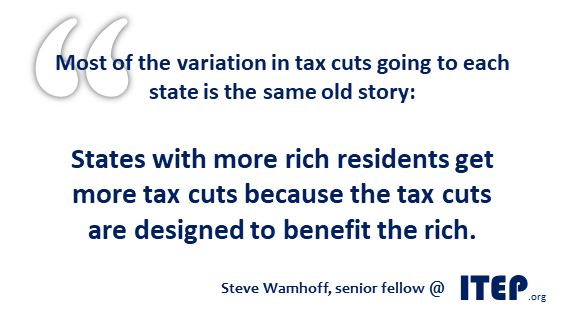
Unless the administration takes a radically different direction on tax reform from what it has already proposed, its tax plan would be a monumental giveaway to the top 1 percent. The wealthiest one percent of households would receive 61 percent of all the Trump tax breaks, and would receive an average of $145,400 in 2018 alone.
Maine Center for Economic Policy: Trump Tax Plan Would Give Richest Maine Taxpayers an Average $53,000 Tax Cut and Trigger Deep Cuts to Federal Dollars for Maine
July 20, 2017
A new analysis from the Institute on Taxation and Economic Policy reveals a federal tax reform plan based on President Trump’s April outline would fail to deliver on its promise of helping middle-class taxpayers, showering three out of every five dollars of the total tax cut on the richest 1 percent nationwide. In Maine, the top 1 percent of the state’s residents would receive an average tax cut of $53,000 compared with an average tax cut of $400 for the bottom 60 percent of taxpayers in the state.
50-State Analysis of Trump’s Tax Outline: Poorer Taxpayers and Poorer States are Disadvantaged
July 20, 2017 • By Alan Essig
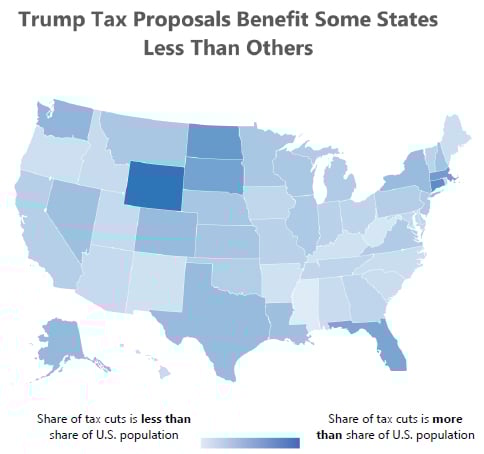
Not only would President Trump’s proposed tax plan fail to deliver on its promise of largely helping middle-class taxpayers, it also would shower a disproportionate share of the total tax cut on taxpayers in some of the richest states while southern and a few other states would receive a smaller share of the tax cut […]
Trump Tax Proposals Would Provide Richest One Percent in Maine with 33.9 Percent of the State’s Tax Cuts
July 20, 2017 • By ITEP Staff
Earlier this year, the Trump administration released some broadly outlined proposals to overhaul the federal tax code. Households in Maine would not benefit equally from these proposals. The richest one percent of the state’s taxpayers are projected to make an average income of $1,212,000 in 2018. They would receive 33.9 percent of the tax cuts that go to Maine’s residents and would enjoy an average cut of $53,220 in 2018 alone.
Trump’s $4.8 Trillion Tax Proposals Would Not Benefit All States or Taxpayers Equally
July 20, 2017 • By Matthew Gardner, Steve Wamhoff
The broadly outlined tax proposals released by the Trump administration would not benefit all taxpayers equally and they would not benefit all states equally either. Several states would receive a share of the total resulting tax cuts that is less than their share of the U.S. population. Of the dozen states receiving the least by this measure, seven are in the South. The others are New Mexico, Oregon, Maine, Idaho and Hawaii.
Bloomberg BNA: Low Tax Revenue Fuels State Deficits, Budget Battles
July 16, 2017
In more than a dozen other states, legislators fought down to the wire. Maine and New Jersey were forced into brief government shutdowns. Much press was given to New Jersey Gov. Chris Christie’s (R) time at the beach over the July 4th weekend when some stretches of state coastline were closed to beach-goers. “In some […]
Sales Tax Holidays: An Ineffective Alternative to Real Sales Tax Reform
July 12, 2017 • By ITEP Staff
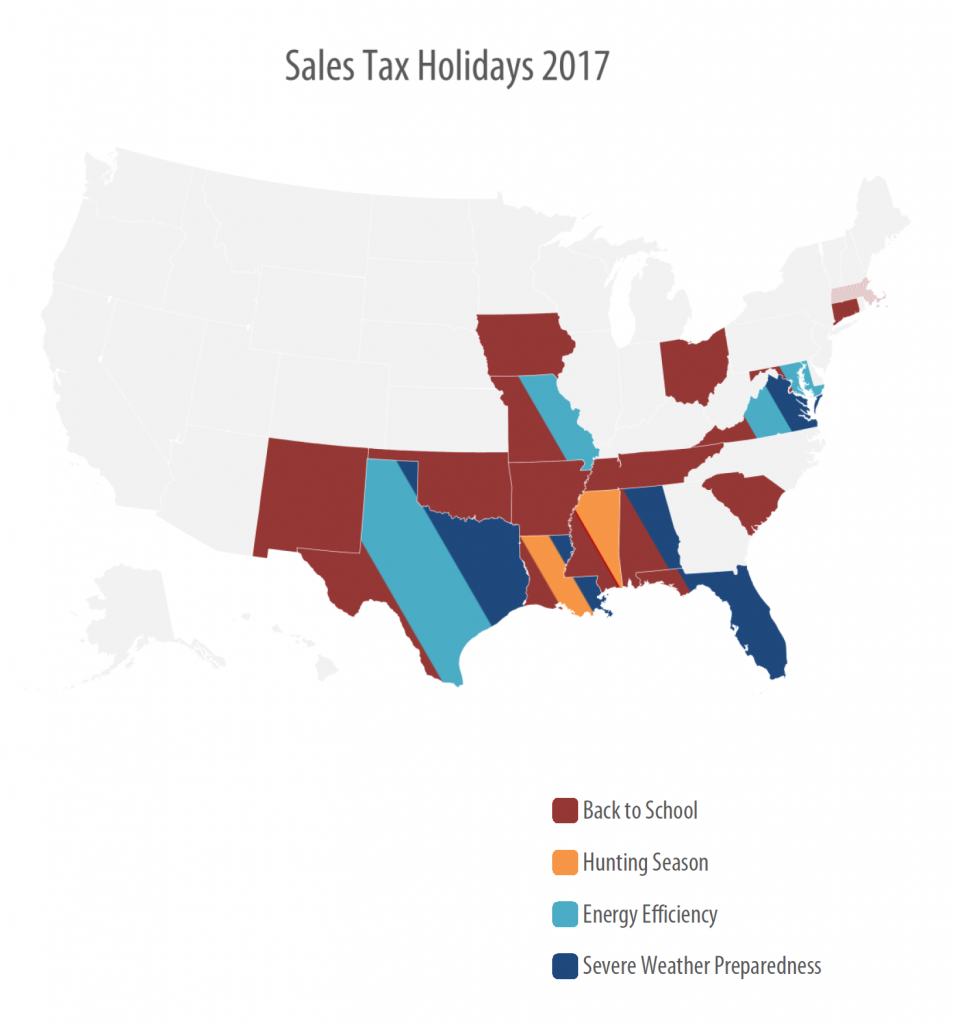
Sales taxes are an important revenue source, composing close to half of all state tax revenues. But sales taxes are also inherently regressive because the lower a family’s income, the more the family must spend on goods and services subject to the tax. Lawmakers in many states have enacted “sales tax holidays” (at least 16 states will hold them in 2017), to provide a temporary break on paying the tax on purchases of clothing, school supplies, and other items. While these holidays may seem to lessen the regressive impacts of the sales tax, their benefits are minimal. This policy brief…
State Rundown 7/11: Some Legislatures Get Long Holiday Weekends, Others Work Overtime
July 11, 2017 • By ITEP Staff
Illinois and New Jersey made national news earlier this month after resolving their contentious budget stalemates. But they weren’t the only states working through (and in some cases after) the holiday weekend to resolve budget issues.
Maine Center for Economic Policy: What Happens When Those with the Most Pay the Least Taxes?
July 7, 2017
With the 3 percent surcharge repealed, the state’s tax code is out of balance. Those with the most are asked to pay the least. This means a middle-class family keeps 91 cents on average after state and local taxes for each dollar earned, versus 93 cents kept by the wealthiest in the state. This preferential tax treatment of wealthy Maine household also comes at a cost to roads, public health, and quality education that low and middle income Mainers rely on the most to succeed.
State Rundown 6/28: States Scramble to Finish Budgets Before July Deadlines
June 28, 2017 • By ITEP Staff
This week, several states attempt to wrap up their budget debates before new fiscal years (and holiday vacations) begin in July. Lawmakers reached at least short-term agreement on budgets in Alaska, New Hampshire, Rhode Island, and Vermont, but such resolution remains elusive in Connecticut, Delaware, Illinois, Maine, Pennsylvania, Washington, and Wisconsin.
State Rundown 6/21: Crunch Time for Many States with New Fiscal Year on Horizon
June 21, 2017 • By Meg Wiehe
This week several states rush to finalize their budget and tax debates before the start of most state fiscal years on July 1. West Virginia lawmakers considered tax increases as part of a balanced approach to closing the state’s budget gap but took a funding-cuts-only approach in the end. Delaware legislators face a similar choice, […]
Maine Center for Economic Policy: Senate Republican Vote Defies Will of Voters, Compromises Current and Future School Funding to Give Tax Cuts to Wealthy
June 13, 2017
According to the Institute on Taxation and Economic Policy, repealing the citizen approved surcharge would give a $16,300 tax break on average to the top 1% of Maine households and cost the state over $300 million in school funding over current and future biennia.
In the Tax Justice Digest we recap the latest reports, blog posts, and analyses from Citizens for Tax Justice and the Institute on Taxation and Economic Policy. Here’s a rundown of what we’ve been working on lately. Corporations Offshore Cash Hoard Grows to $2.6 Trillion U.S. corporations now hold a record $2.6 trillion offshore, a […]
What to Watch in the States: State Earned Income Tax Credits (EITC) on the Move
March 24, 2017 • By Misha Hill
While every state’s tax system is regressive, meaning lower income people pay a higher tax rate than the rich, some states aim to improve tax fairness through a state Earned Income Tax Credit (EITC). Federal lawmakers established the in 1975 to bolster the earnings of low-wage workers, especially workers with children and offset some of […]
For decades, Amazon.com helped its customers dodge the sales taxes they owed to gain an advantage over its competitors. But as the company’s business strategy has changed, so has its tax collection. As recently as 2011, the nation’s largest e-retailer was collecting sales tax in just 5 states, home to 11 percent of the country’s […]
Maine Center for Economic Policy: MECEP Testifies Against Bills to Cut Taxes for the Wealthy at Expense of Maine’s Schools
March 20, 2017
Augusta, Maine (Monday, March 20, 2017) State legislators on the taxation committee will hold a public hearing today on several bills that would roll back the tax to pay for education enacted under Question 2, the ballot initiative passed by Maine voters in November 2016. As a result of Question 2, the state will have the capacity to provide 55% of school funding mandated by voters previously in 2004.
A growing number of Americans are getting rides or booking short-term accommodations through online platforms such as Uber and Airbnb. This is nothing new in concept; brokers have operated for hundreds of years as go-betweens for producers and consumers. The ease with which this can be done through the Internet, however, has led to millions of people using these services, and to some of the nation's fastest-growing, high-profile businesses. The rise of this on-demand sector, sometimes referred to as the "gig economy" or, by its promoters, the "sharing economy," has raised a host of questions. For state and local governments,…
Undocumented Immigrants’ State & Local Tax Contributions
March 1, 2017 • By Lisa Christensen Gee, Meg Wiehe, Misha Hill
Public debates over federal immigration reform, specifically around undocumented immigrants, often suffer from insufficient and inaccurate information about the tax contributions of undocumented immigrants, particularly at the state level. The truth is that undocumented immigrants living in the United States paybillions of dollars each year in state and local taxes. Further, these tax contributions would increase significantly if all undocumented immigrants currently living in the United States were granted a pathway to citizenship as part of comprehensive immigration reform. Or put in the reverse, if undocumented immigrants are deported in high numbers, state and local revenues could take a substantial…
Common Dreams: Taking on the Billionaires
February 22, 2017
The result has been to make state and local taxes, on the whole, regressive. The share of income paid by the poorest 20 percent is twice that of the richest 1 percent. Unsurprisingly, the disparity is widest in states without an income tax. The Institute on Taxation and Economic Policy reports that Washington’s working class […]
Maine Center for Economic Policy: Testimony in Opposition to Governor’s Proposed Budget, Parts D, E, and F
February 17, 2017
These proposed tax changes would stand in the way of building thriving communities and a strong Maine economy. There is a direct correlation between state resources and the ability to be proactive in making the kind of investments that lay the foundations for a strong economy. Cutting taxes for the rich at the expense of everyone […]
What to Watch in the States: Modernizing Sales Taxes for a 21st Century Economy
February 15, 2017 • By Misha Hill
This is the fourth installment of our six-part series on 2017 state tax trends. The introduction to this series is available here. State lawmakers often find themselves looking for ways to raise revenue to fund vital public services, fill budget gaps, or pay for the elimination or weakening of progressive taxes. Lately, that search has […]
State Rundown 2/8: Lessons of Kansas Tax-Cut Disaster Taking Hold in Kansas, Still Lost on Some in Other States
February 8, 2017 • By ITEP Staff
This week we bring news of Kansas lawmakers attempting to fix ill-advised tax cuts that have wreaked havoc on the state’s budget and schools, while their counterparts in Nebraska and Idaho debate bills that would create similar problems for their own states, as well as tax cuts in Arkansas that were proven unaffordable within one […]
Alternet: It’s Time to Take America’s Billionaire Class Head on
February 3, 2017
The result has been to make state and local taxes, on the whole, regressive. The share of income paid by the poorest 20 percent is twice that of the richest 1 percent. Unsurprisingly, the disparity is widest in states without an income tax. The Institute on Taxation and Economic Policy reports that Washington’s working class […]
What to Watch in the States: Further Attempts to Weaken or Eliminate Progressive Taxes
February 2, 2017 • By Aidan Davis
This is the third installment of our six-part series on 2017 state tax trends. The introduction to this series is available here. As we described last week, many states are gearing up for challenging budget debates this year. But the need to address revenue shortfalls has not stopped lawmakers in many states from pursuing harmful […]

Institute on Taxation
and Economic Policy
ITEP is a non-profit, non-partisan tax policy organization. We conduct rigorous analyses of tax and economic proposals and provide data-driven recommendations to shape equitable and sustainable tax systems.
Subscribe to ITEP Emails
Tax research and policy news in your inbox.
Promote Fair Tax Policy
Your gift to ITEP promotes tax justice. With your help, we do research that supports taxing millionaires and billionaires, taxing big corporations and raising revenue for the things our people, our communities and our planet need.
Together, we can create a country with more economic justice, more racial justice, more climate justice… and more tax justice.