
Maryland
Gas Taxes Will Rise in 7 States to Fund Transportation Improvements
June 28, 2017 • By Carl Davis

Summer gas prices are at their lowest level in twelve years, which makes right now a sensible time to ask drivers to pay a little more toward improving the transportation infrastructure they use every day. Seven states will be doing this on Saturday, July 1 when they raise their gasoline tax rates. At the same time, two states will be implementing small gas tax rate cuts.
Many state governments are struggling to repair and expand their transportation infrastructure because they are attempting to cover the rising cost of asphalt, machinery, and other construction materials with fixed-rate gasoline taxes that are rarely increased.
The flawed design of federal and state gasoline taxes has made it exceedingly difficult to raise adequate funds to maintain the nation’s transportation infrastructure. Thirty states and the federal government levy fixed-rate gas taxes where the tax rate does not change even when the cost of infrastructure materials rises or when drivers transition toward more fuel-efficient vehicles and pay less in gas tax. The federal government’s 18.4 cent gas tax, for example, has not increased in over twenty-three years. Likewise, nineteen states have waited a decade or more since last raising their own gas tax rates.
This week saw tax debates heat up in many states. Late-session discovered revenue shortfalls, for example, are creating friction in Delaware, New Jersey, and Oklahoma, while special sessions featuring tax debates continue in Louisiana, New Mexico, and West Virginia. Meanwhile the effort to revive Alaska's personal income tax has cooled off.
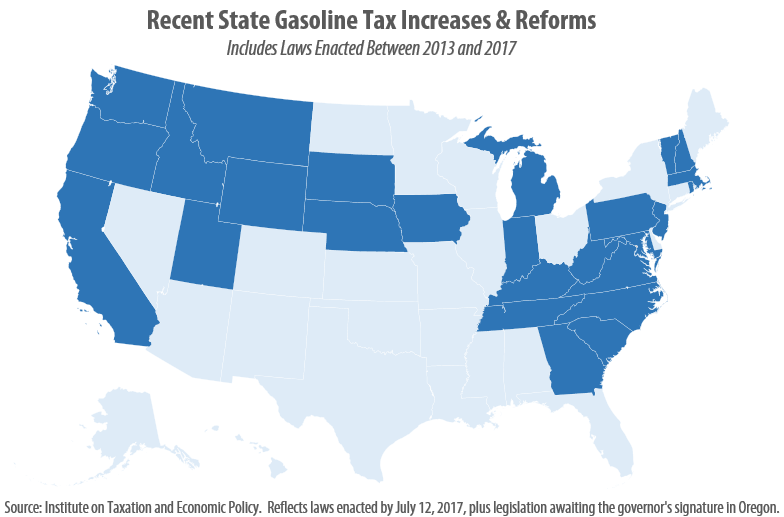
This post was updated July 12, 2017 to reflect recent gas tax increases in Oregon and West Virginia. As expected, 2017 has brought a flurry of action relating to state gasoline taxes. As of this writing, eight states (California, Indiana, Montana, Oregon, South Carolina, Tennessee, Utah, and West Virginia) have enacted gas tax increases this year, bringing the total number of states that have raised or reformed their gas taxes to 26 since 2013.
Representative John Delaney’s Bills Take the Wrong Approach on Funding Infrastructure
May 9, 2017 • By Richard Phillips

Lawmakers across the political spectrum recognize the need for additional spending to maintain and upgrade our nation’s transportation infrastructure. According to the Federal Highway Administration, there is a backlog of $836 billion in needed repairs and improvements to roads and bridges and an additional $90 billion backlog of public transit projects. Maryland Democratic Representative John […]
Maryland’s Money Matters: ‘Dreamers’ Make Important Contributions to Maryland
May 5, 2017
It is unclear, as of now, whether the Trump administration will choose to end protections for young adults who came to the U.S. as children and have legal status through the Deferred Action for Childhood Arrivals (DACA) program. If the administration elects to end the program, thousands of Marylanders could lose their jobs and ability to attend college, many business could lose valued workers, and Maryland could lose nearly $14 million annually in state and local tax revenue.
Matthew Gardner
April 21, 2017 • By ITEP Staff

Matt is a senior fellow at ITEP where he has worked since 1998. He previously served as ITEP’s executive director from 2006 to 2016. Mr. Gardner’s work focuses on federal, state and local tax systems, with a particular emphasis on the impact of tax policies on low- and moderate-income tax payers. He uses ITEP’s microsimulation model to produce economic projections and analyses on the effects of current and proposed federal and state tax and budget policies.
In the Tax Justice Digest we recap the latest reports, blog posts, and analyses from Citizens for Tax Justice and the Institute on Taxation and Economic Policy. Here’s a rundown of what we’ve been working on lately. Corporations Offshore Cash Hoard Grows to $2.6 Trillion U.S. corporations now hold a record $2.6 trillion offshore, a […]
State Rundown 3/29: More States Looking to Raise or Protect Revenues Amid Fiscal and Federal Uncertainty
March 29, 2017 • By ITEP Staff
This week we see West Virginia, Georgia, Minnesota, and Nebraska continue to deliberate regressive tax cut proposals, as the District of Columbia considers cancelling tax cut triggers it put in place in prior years, and lawmakers in Hawaii, Washington, Kansas, and Delaware ponder raising revenues to shore up their budgets. Meanwhile, gas tax debates continue […]
What to Watch in the States: State Earned Income Tax Credits (EITC) on the Move
March 24, 2017 • By Misha Hill
While every state’s tax system is regressive, meaning lower income people pay a higher tax rate than the rich, some states aim to improve tax fairness through a state Earned Income Tax Credit (EITC). Federal lawmakers established the in 1975 to bolster the earnings of low-wage workers, especially workers with children and offset some of […]
A growing number of Americans are getting rides or booking short-term accommodations through online platforms such as Uber and Airbnb. This is nothing new in concept; brokers have operated for hundreds of years as go-betweens for producers and consumers. The ease with which this can be done through the Internet, however, has led to millions of people using these services, and to some of the nation's fastest-growing, high-profile businesses. The rise of this on-demand sector, sometimes referred to as the "gig economy" or, by its promoters, the "sharing economy," has raised a host of questions. For state and local governments,…
State Rundown 3/1: Will Tax Cut Proposals Be “In Like a Lion, Out Like A Lamb”?
March 1, 2017 • By ITEP Staff
Tax cuts have been proposed in many states already this year, but amid so much uncertainty, it remains to be seen how successful those efforts will be. This week saw one dangerous, largely regressive tax cut proposal move in Georgia, new budget proposals in Louisiana and New Jersey, a new plan to close West Virginia‘s […]
Undocumented Immigrants’ State & Local Tax Contributions
March 1, 2017 • By Lisa Christensen Gee, Meg Wiehe, Misha Hill
Public debates over federal immigration reform, specifically around undocumented immigrants, often suffer from insufficient and inaccurate information about the tax contributions of undocumented immigrants, particularly at the state level. The truth is that undocumented immigrants living in the United States paybillions of dollars each year in state and local taxes. Further, these tax contributions would increase significantly if all undocumented immigrants currently living in the United States were granted a pathway to citizenship as part of comprehensive immigration reform. Or put in the reverse, if undocumented immigrants are deported in high numbers, state and local revenues could take a substantial…
Regressive and Loophole-Ridden: Issues with the House GOP Border Adjustment Tax Proposal
February 22, 2017 • By Matthew Gardner, Richard Phillips
In the summer of 2016, House Republicans released a blueprint for tax reform that is likely to be used as the starting point for major tax legislation in 2017.[1] One of the most radical provisions is a proposal to shift the corporate tax code from a residence-based to a destination-based system through applying a border adjustment on exports and imports. This proposal has major flaws that would make it a challenge to implement. Further, it is inherently regressive, rife with loopholes and would violate international agreements.
What to Watch in the States: Modernizing Sales Taxes for a 21st Century Economy
February 15, 2017 • By Misha Hill
This is the fourth installment of our six-part series on 2017 state tax trends. The introduction to this series is available here. State lawmakers often find themselves looking for ways to raise revenue to fund vital public services, fill budget gaps, or pay for the elimination or weakening of progressive taxes. Lately, that search has […]
Every state levies taxes on gasoline and diesel fuel, usually just called "gas taxes." These taxes are an important source of state revenue--particularly for transportation--but their poor design has resulted in sluggish revenue growth that fails to keep pace with state infrastructure needs. This ITEP Policy Brief explains how state gas taxes work, their importance as a transportation revenue source, the problems confronting gas taxes, and the types of gas tax reforms that are needed to overcome these problems.
What to Watch in the States: Further Attempts to Weaken or Eliminate Progressive Taxes
February 2, 2017 • By Aidan Davis
This is the third installment of our six-part series on 2017 state tax trends. The introduction to this series is available here. As we described last week, many states are gearing up for challenging budget debates this year. But the need to address revenue shortfalls has not stopped lawmakers in many states from pursuing harmful […]
This week’s Rundown brings news of tax cuts passed in Arkansas and advanced in Idaho, proposals to exempt feminine hygiene products from sales taxes in Nevada and Michigan, revenue shortfalls forcing tough choices in Louisiana and Maine, and more governors’ state of the state addresses and budget proposals setting the stage for yet more tax […]
Below is a list of notable resources for information on state taxes and revenues: Alabama Alabama Department of Revenue Alabama Department of Finance – Executive Budget Office Alabama Department of Revenue – Tax Incentives for Industry Alabama Legislative Fiscal Office Alaska Alaska Department of Revenue – Tax Division Alaska Office of Management & Budget Alaska […]
Fairness Matters: A Chart Book on Who Pays State and Local Taxes
January 26, 2017 • By Carl Davis, Meg Wiehe
When states shy away from personal income taxes in favor of higher sales and excise taxes, high-income taxpayers benefit at the expense of low- and moderate-income families who often face above-average tax rates to pick up the slack. This chart book demonstrates this basic reality by examining the distribution of taxes in states that have pursued these types of policies. Given the detrimental impact that regressive tax policies have on economic opportunity, income inequality, revenue adequacy, and long-run revenue sustainability, tax reform proponents should look to the least regressive, rather than most regressive, states in crafting their proposals.
This week brings more news of states facing budget crunches, a new state looking to eliminate income taxes, and plans to raise gas taxes to fund transportation projects. Be sure to check out the What We’re Reading section for a look at how repealing federal health reform could add to those crunches and a review […]
State Rundown 1/18: Revenue Woes Piling Up Faster Than Solutions
January 18, 2017 • By ITEP Staff
This week we continue to track revenue shortfalls, governors’ budget proposals, and other tax news around the country, finding most proposals to be focused on slashing taxes and reducing public investments despite public opinion and economic research showing the benefits of well-funded state services and progressive tax policies. — Meg Wiehe, ITEP State Policy Director, […]
The federal government and many states are unable to adequately maintain the nation's transportation infrastructure in part because the gasoline taxes intended to fund infrastructure projects are often poorly designed. Thirty states and the federal government levy fixed-rate gas taxes where the tax rate does not change even when the cost of infrastructure materials rises or when drivers transition toward more fuel-efficient vehicles and pay less in gas tax. The federal government's 18.4 cent gas tax, for example, has not increased in over twenty-three years. Likewise, more than twenty states have waited a decade or more since last raising their…
Maryland Center for Economic Policy:To Support a Strong Economy, All Marylanders Must Pay Their Fair Share in Taxes
January 10, 2017
Maryland’s success today is due to our past public investment in good schools, a strong transportation system and other building blocks of a prosperous economy. As another “tax day” rolls around, it’s worth remembering that the income taxes we pay help make these investments possible. Cutting state income taxes or corporate taxes would undermine […]

Institute on Taxation
and Economic Policy
ITEP is a non-profit, non-partisan tax policy organization. We conduct rigorous analyses of tax and economic proposals and provide data-driven recommendations to shape equitable and sustainable tax systems.
Subscribe to ITEP Emails
Tax research and policy news in your inbox.
Promote Fair Tax Policy
Your gift to ITEP promotes tax justice. With your help, we do research that supports taxing millionaires and billionaires, taxing big corporations and raising revenue for the things our people, our communities and our planet need.
Together, we can create a country with more economic justice, more racial justice, more climate justice… and more tax justice.