
Rhode Island

Gov. Cuomo Has the Right Idea on How to Tax Recreational Cannabis
• By ITEP Staff
Following is a statement by Carl Davis, research director at the Institute on Taxation and Economic Policy, regarding the cannabis tax structure unveiled by New York Gov. Andrew Cuomo.
State Rundown 1/10: States Should Resolve to Pursue Equitable Tax Options
• By ITEP Staff
This week we released a handy guide of policy options for Moving Toward More Equitable State Tax Systems, and are pleased to report that many state lawmakers are promoting policies that are in line with our recommendations. For example, Puerto Rico lawmakers recently enacted a targeted EITC-like credit for working families, and leaders in Virginia and elsewhere are working toward similar improvements. Arkansas residents also saw their tax code improve as laws reducing regressive consumption…
Economic Progress Institute: Rhode Island Standard of Need
• By ITEP Staff
The RISN calculates a household budget for families with two young children, and for single adults. The no-frills budget includes the costs of housing, food, transportation, health care, child care and other necessities including clothing, toiletries and telephone service. The RISN also demonstrates how work supports like food assistance, tax credits, and child care and health care subsidies help close the gap between income and basic need expenses. By taking all of these factors into…
Providence Business Journal: Study Finds the Wealthy Pay a Lesser Share of Their Income Taxes in R.I.
• By ITEP Staff
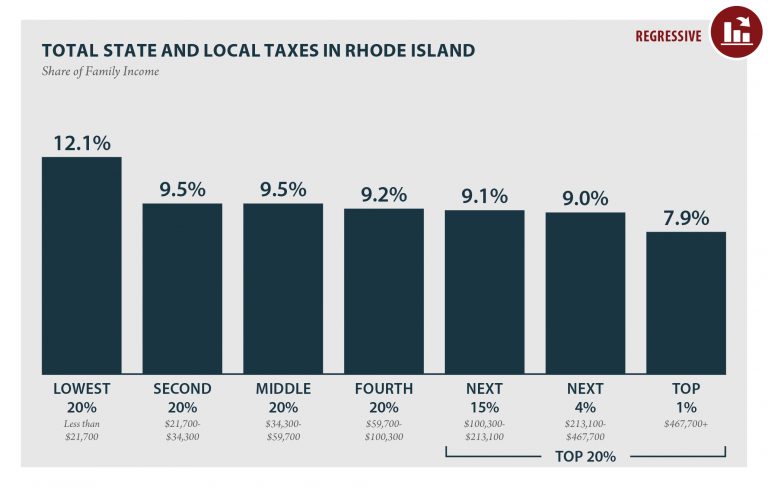
The greater your income in Rhode Island, the less of it you pay in state and local taxes, a new study finds. The top one percent of Rhode Islanders [those making more than $467,700 a year] pay 7.9 percent of their income in total state and local taxes, while the bottom 20 percent [those earning less than $21,700 a year] pay 12.1 percent of their income in such taxes.
Uprise RI: Low-income Taxpayers in Rhode Island Pay Over 50 Percent More in Taxes Than the Wealthiest
• By ITEP Staff
There’s a practical reason for Rhode Island and all states to be concerned about regressive tax structures, according to ITEP. If the nation fails to address growing income inequality, states will have difficulty raising the revenue they need over time. The more income that goes to the wealthy (and the lower a state’s overall tax rate on the wealthy), the slower a state’s revenue grows over time.
Rhode Island: Who Pays? 6th Edition
• By ITEP Staff
According to ITEP’s Tax Inequality Index, which measures the impact of each state’s tax system on income inequality, Rhode Island has the 32nd most unfair state and local tax system in the country. Incomes are more unequal in Rhode Island after state and local taxes are collected than before.
State Rundown 10/4: Ballot/Election Season in Full Swing
• By ITEP Staff
South Carolina lawmakers have finally passed a federal conformity bill in response to last year’s federal tax-cut legislation. Voters in many states are hearing a lot about tax-related questions they’ll see on the ballot in November, particularly residents of Florida, Montana, and Oregon, where corporate donors and other anti-tax interests are spending major sums to alter policy in their states. And states continue to work on ensuring they can collect online sales taxes and, in…
Twelve States Offer Profitable Tax Shelter to Private School Voucher Donors; IRS Proposal Could Fix This
• By Carl Davis
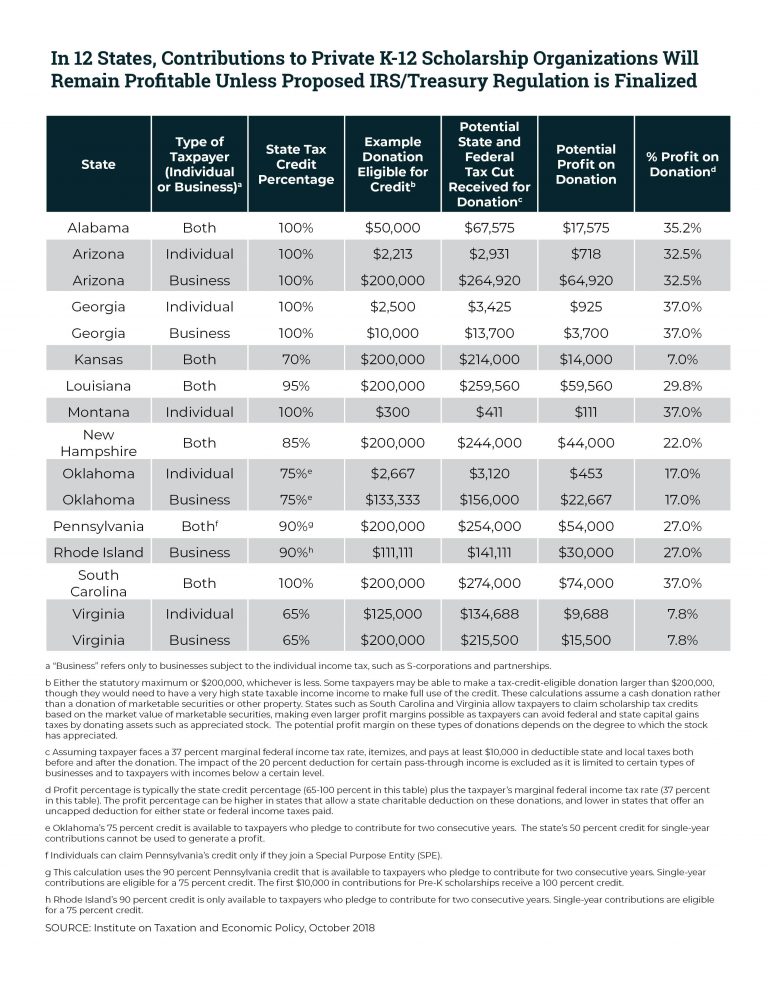
A proposed IRS regulation would eliminate a tax shelter for private school donors in twelve states by making a commonsense improvement to the federal tax deduction for charitable gifts. For years, some affluent taxpayers who donate to private K-12 school voucher programs have managed to turn a profit by claiming state tax credits and federal tax deductions that, taken together, are worth more than the amount donated. This practice could soon come to an end…
Tax Cuts 2.0 – Rhode Island
• By ITEP Staff
The $2 trillion 2017 Tax Cuts and Jobs Act (TCJA) includes several provisions set to expire at the end of 2025. Now, GOP leaders have introduced a bill informally called “Tax Cuts 2.0” or “Tax Reform 2.0,” which would make the temporary provisions permanent. And they falsely claim that making these provisions permanent will benefit […]
State Tax Codes as Poverty Fighting Tools: 2018 Update on Four Key Policies in All 50 States
• By Aidan Davis, Misha Hill
This report presents a comprehensive overview of anti-poverty tax policies, surveys tax policy decisions made in the states in 2018, and offers recommendations that every state should consider to help families rise out of poverty. States can jumpstart their anti-poverty efforts by enacting one or more of four proven and effective tax strategies to reduce the share of taxes paid by low- and moderate-income families: state Earned Income Tax Credits, property tax circuit breakers, targeted…
Reducing the Cost of Child Care Through State Tax Codes in 2018
• By Aidan Davis
Families in poverty contribute over 30 percent of their income to child care compared to about 6 percent for families at or above 200 percent of poverty. Most families with children need one or more incomes to make ends meet which means child care expenses are an increasingly unavoidable and unaffordable expense. This policy brief examines state tax policy tools that can be used to make child care more affordable: a dependent care tax credit…
Updating Sales and Excise Taxes to Reflect Today’s Economy
• By ITEP Staff
Consumers’ growing interest in online shopping and “gig economy” services like Uber and Airbnb has forced states and localities to revisit their sales taxes, for instance. Meanwhile new evidence on the dangers and causes of obesity has led to rising interest in soda taxes, but the soda industry is fighting back. Carbon taxes are being discussed as a tool for combatting climate change. And changing attitudes toward cannabis use have spurred some states to move…
State Rundown 6/28: Budget Deals Reached in Nick of Time
• By ITEP Staff
This week, lawmakers in Louisiana, Pennsylvania, Rhode Island, Vermont, and the District of Columbia wrapped up their budgets in time for the new fiscal year that starts July first in most states, with some of these resolutions coming after contentious debates and repeated special sessions. New Jersey's debate is not yet finished as leaders clash over spending priorities and the taxes on millionaires and corporations needed to fund them. Meanwhile, signature drives to put tax-related…
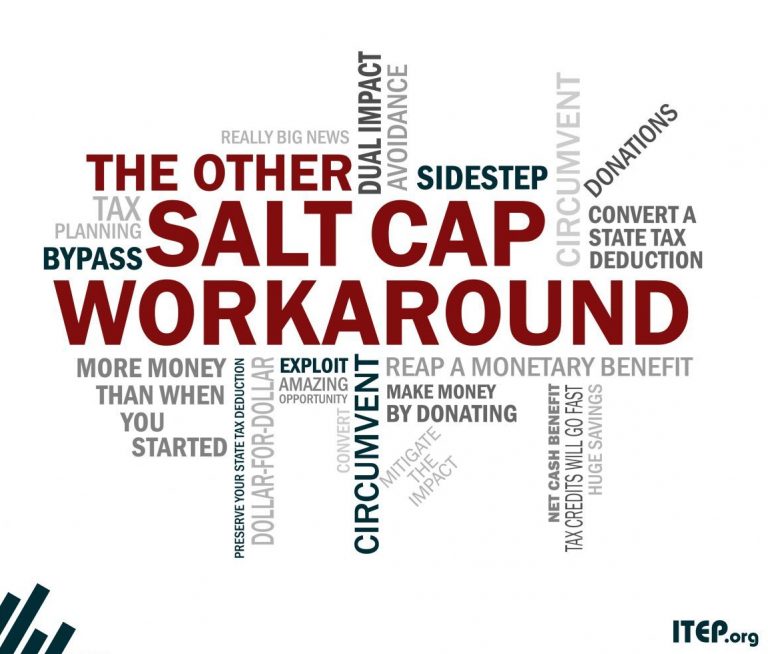
The Other SALT Cap Workaround: Accountants Steer Clients Toward Private K-12 Voucher Tax Credits
• By Carl Davis
On May 23, 2018, the IRS and Treasury Department announced that they “intend to propose regulations addressing the federal income tax treatment of certain payments made by taxpayers for which taxpayers receive a credit against their state and local taxes.” They made the announcement in response to new “workaround tax credits” enacted in New York […]
State Rundown 6/21: Wayfair Decision Is Way Fair
• By ITEP Staff
The U.S. Supreme Court made big news this morning by allowing states to collect taxes due on internet purchases, which will help put main-street and online retailers on an even playing field while also improving state and local revenues and the long-term viability of the sales tax as a revenue source. Many states remain focused on more local issues, however, as Louisiana's third special session of the year kicked off, Massachusetts won a living wage…

SALT/Charitable Workaround Credits Require a Broad Fix, Not a Narrow One
• By Carl Davis
The federal Tax Cuts and Jobs Act (TCJA) enacted last year temporarily capped deductions for state and local tax (SALT) payments at $10,000 per year. The cap, which expires at the end of 2025, disproportionately impacts taxpayers in higher-income states and in states and localities more reliant on income or property taxes, as opposed to sales taxes. Increasingly, lawmakers in those states who feel their residents were unfairly targeted by the federal law are debating…
Most States Have Raised Gas Taxes in Recent Years
• By Carl Davis
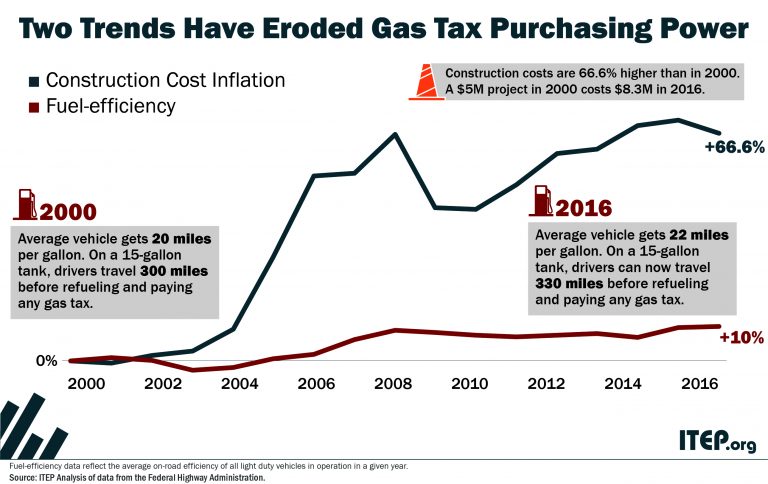
An updated version of this blog was published in April 2019. State tax policy can be a contentious topic, but in recent years there has been a remarkable level of agreement on one tax in particular: the gasoline tax. Increasingly, state lawmakers are deciding that outdated gas taxes need to be raised and reformed to fund infrastructure projects that are vital to their economies.
State Rundown 4/27: Arbor Day Brings Some Fruitful Tax Developments, Some Shady Proposals
• By ITEP Staff
This Arbor Day week, the seeds of discontent with underfunded school systems and underpaid teachers continued to spread, with walkouts occurring in both Arizona and Colorado. And recognizing the need to see the forest as well as the trees, the Arizona teachers have presented revenue solutions to get to the true root of the problem. In the plains states, tax cut proposals continue to pop up like weeds in Kansas and threaten to spread to…
State Rundown 12/31/9999: IRS Glitch and Legislative Impasses Extend Tax Season
• By ITEP Staff
This week the IRS website asked some would-be tax filers to return after December 31, 9999. State legislators don't have quite that much time, but are struggling to wrap up their tax debates on schedule as well. Iowa legislators, for example, are ironically still debating tax cuts despite having run out of money to cover their daily expenses for the year. Nebraska's session wrapped up, but its tax debate continues in the form of a…
Trends We’re Watching in 2018, Part 5: 21st Century Consumption Taxes
• By Misha Hill
We're highlighting the progress of a few newer trends in consumption taxation. This includes using the tax code to discourage consumption of everything from plastic bags to carbon and collecting revenue from emerging industries like ride sharing services and legalized cannabis sales.
Providence Journal: Hike Taxes to Invest in Rhode Island
April 20, 2018
The wealthiest Rhode Islanders have benefited enormously from recently enacted federal tax changes. The Institute on Taxation and Economic Policy reported this month that the wealthiest 5 percent of Rhode Island families would receive 45 percent of the total tax cuts in 2018. The Rhode Island tax code as currently structured is upside down — […]

What to Expect if the Supreme Court Allows for Online Sales Tax Collection
• By Carl Davis
Online shopping is hardly a new phenomenon. And yet states and localities still lack the authority to require many Internet retailers to collect the sales taxes that their locally based, brick and mortar competitors have been collecting for decades.
Economic Progress Institute: Changes in Federal Tax Law Will Cut Taxes for Many Rhode Islanders; Wealthiest Families and Corporations Benefit the Most
• By ITEP Staff
To help explain what the Act will mean for Rhode Island, the Economic Progress Institute released a paper entitled "Changes in federal tax law will cut taxes for many Rhode Islanders; wealthiest families and corporations benefit the most."
State Rundown 2/28: February a Long Month for State Tax Debates
• By ITEP Staff
February may be the shortest month but it has been a long one for state lawmakers. This week saw Arizona, Idaho, Oregon, and Utah seemingly approaching final decisions on how to respond to the federal tax-cut bill, while a bill that appeared cleared for take-off in Georgia hit some unexpected turbulence. Other states are still studying what the federal bill means for them, and many more continue to debate tax and budget proposals independently of…
Economic Progress Institute: Budget Matters: Making Rhode Island’s Tax Structure More Equitable and Adequate
• By ITEP Staff
For Rhode Island to achieve its potential as a first-class place to live and do business we need to ensure that we have the public services and amenities that enhance the quality of life and work in our state. Rhode Islanders make a collective investment through taxes, fees, and other forms of revenue to fund the services that businesses and residents count on.

Institute on Taxation
and Economic Policy
ITEP is a non-profit, non-partisan tax policy organization. We conduct rigorous analyses of tax and economic proposals and provide data-driven recommendations to shape equitable and sustainable tax systems.
Subscribe to ITEP Emails
Tax research and policy news in your inbox.
Promote Fair Tax Policy
Your gift to ITEP promotes tax justice. With your help, we do research that supports taxing millionaires and billionaires, taxing big corporations and raising revenue for the things our people, our communities and our planet need.
Together, we can create a country with more economic justice, more racial justice, more climate justice… and more tax justice.