
Blog
141 posts
New State Taxes on the Wealthy Raise Revenue and Rebalance Tax Codes, Advancing Racial Justice
• By Brakeyshia Samms
Taxing the rich is proven fiscal policy – it raises revenue for vital public services and makes tax codes fairer. But a part of the debate that rarely gets enough attention: taxing the rich is also one of the most effective tools available for advancing racial equity.

IRS Cuts Could Cruise on Autopilot; New Bill Aims to Restore Funding to Help Taxpayers and Fight Tax Cheats
• By Sarah C. G. Christopherson
This fall, Congress could allow billions of dollars in IRS funding to disappear on autopilot. However, the Stop CHEATERS Act would restore the multi-year mandatory funding rescinded from the IRA and account for recent cuts to the IRS’s base budget.

Why Corporations Must Pay More
• By Steve Wamhoff, Amy Hanauer
Corporate tax reforms could be more resilient than proposals to tax wealth or unrealized capital gains while achieving the same goal of more adequately taxing the income of billionaires.

Progressives Need a Slight Course Correction on Tax Policy
• By Steve Wamhoff
Corporate tax reforms should be the backbone of any progressive tax agenda and should be counted on to remain if other changes to our tax code are later thwarted by any of the three branches of government.

Musk-Trump Feud Shows Need to Tax the Rich
• By Amy Hanauer
Our tax policies enable people like Elon Musk and Donald Trump to accumulate more wealth than anyone could ever use in a lifetime. They then use it to steer elections and shape public policy to further enrich themselves and others like them. We should defeat the enormously destructive tax bill in Congress and instead craft tax policy that taxes the rich, makes our democracy more fair, and returns resources to the rest of the country.
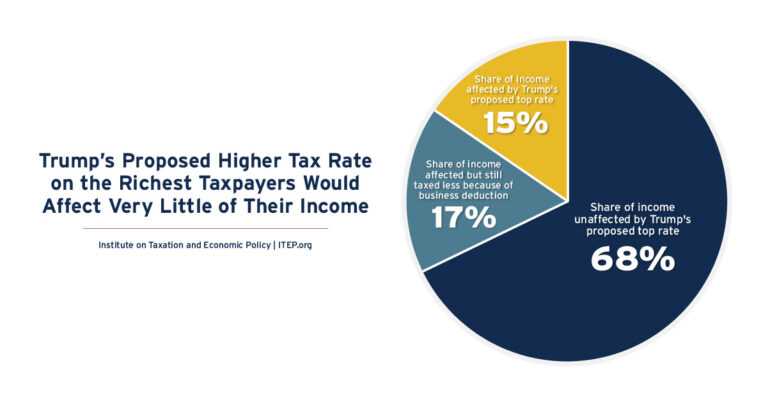
Trump’s Proposed Higher Tax Rate on the Richest Taxpayers Would Affect Very Little of Their Income
• By Carl Davis, Steve Wamhoff
President Donald Trump has proposed allowing the top rate to revert from 37 percent to 39.6 percent for taxable income greater than $5 million for married couples and $2.5 million for unmarried taxpayers. But many other special breaks in the tax code would ensure that most income of very well-off people would never be subject to Trump’s 39.6 percent tax rate.

Senate Republicans Rig Congressional Rules to Make Their Tax Cuts Appear Cost-Free
• By Steve Wamhoff
This week, members of Congress are arguing about whether extending Trump’s 2017 tax cuts would cost trillions of dollars over a decade or cost nothing.

Different Approaches to the Trump Tax Law’s Cap on Deductions for State and Local Taxes (SALT)
• By Steve Wamhoff
President Trump and the Republican majorities in the House and Senate may not extend the $10,000 cap on federal income tax deductions for state and local taxes (SALT), the one part of the 2017 law that significantly limits tax breaks for the rich. And, depending on which proposal they settle on, leaving out the existing cap on SALT deductions could add between $10 billion and over $100 billion each year to the total cost of…

Congress Could — But Won’t — Pass a Tax Package That Pays for Itself
• By Joe Hughes
If Republican lawmakers were serious about deficit-neutral tax reform, they would focus on increasing taxes for the ultra-wealthy and large corporations. The absence of such proposals in their plan reveals their true priority: delivering enormous tax cuts to the wealthiest Americans while average working families receive crumbs.
Tax Justice in the Crosshairs
• By Amy Hanauer
Billionaires and businesses have too much power in Washington. Tax revenue is needed to pay for things we all need. If we want economic justice, racial justice and climate justice, we must have tax justice.

Here’s a Tip: Keep the Taxation of Tips As-Is
• By Joe Hughes
The no tax on tips idea isn't a new one, but it's always been abandoned because it's practically impossible to do without creating new avenues for tax avoidance. Despite its embrace by the candidates from both major parties, this policy idea would do little to help the roughly 4 million people who work in tipped occupations while creating a host of problems.

Celebrating One Year Since the Landmark Inflation Reduction Act
• By Joe Hughes
The Inflation Reduction Act was a course correction from decades of tax cuts that primarily went to the richest Americans and left the rest of us with budget shortfalls that conservative lawmakers now seek to plug with cuts to Social Security and Medicare. For the first time in generations we are finally asking those who have benefited the most from our economy to contribute back.
The House’s Debt Ceiling Smoke Screen: The GOP Budget Plan Gives Cover for Tax Cuts for the Rich
• By Joe Hughes
While it isn’t reasonable in the first place for Congress to debate whether it will pay the bills it has already incurred, some of the same lawmakers who are holding the economy hostage to exact budget cuts have decided to make the conversation even more irrational by proposing to increase deficits with tax cuts that enrich the already rich.
Congress Should Raise Taxes on the Rich, But That’s a Totally Separate Issue from the Debt Ceiling
• By Steve Wamhoff
Congress absolutely should raise taxes on the rich and on corporations to generate revenue and improve the fairness of our tax code. President Biden has several proposals to do exactly that. But this is an entirely separate question from whether we should raise the debt ceiling to honor the debts the nation has already incurred and avoid an economic apocalypse.
The GOP is Finally Ready to Raise Taxes. (Or, When a Tax Hike is Not a Tax Hike.)
• By Joe Hughes
House Republicans recently voted to rescind the green energy and electric vehicle tax credits that were enacted last Congress as part of the Inflation Reduction Act. This newfound willingness to raise taxes stands in contrast to the recent position of almost the entire House Republican Caucus.

It’s the Revenue Shortfall, Stupid
• By Joe Hughes
Lawmakers have repeatedly stepped on the same rake of slashing tax rates and expecting revenues to magically go up. Now they want middle-class Americans to be the ones who get hit in the face. The con is getting tired. If Congress wants to reel in the debt then it’s time to raise taxes on the wealthy.
Worried About the Debt? Tax the Rich
• By Amy Hanauer
As one of the most prosperous countries in human history, we have enough resources for our collective needs. By better taxing corporations and the wealthiest, we can generate revenue to improve family security, strengthen our communities, and reduce the debt too.

Politifalse: A Fact-Checker Does Biden an Injustice on Taxes Paid by Billionaires
• By Michael Ettlinger
Most Americans pay more in Social Security and Medicare payroll taxes than they pay in federal personal income tax. So just looking at the personal income tax for comparison misses most of the taxes middle-income Americans pay. That is not true for billionaires because a much, much smaller proportion of their income is subject to the federal payroll taxes.
State of the Union Likely to Continue Progress on Tax Justice
• By Amy Hanauer
After decades of Presidents who ran away from taxes, it’s a sea change to have a chief executive who understands that the rich should pay their fair share, extremely profitable corporations should pay their fair share, and the public sector should have revenue to invest in problems – like climate change and healthcare – that will only be solved with pathbreaking public action.

“Fair Tax” Plan Would Abolish the IRS and Shift Federal Taxes from the Wealthy to the Rest of Us
• By Steve Wamhoff
The "Fair Tax" bill would impose a 30 percent federal sales tax on everything we buy – groceries, cars, homes, health care - and lead to a giant tax shift from the well-off to everyone else.
New House Rules: Low Taxes for the Wealthy on Cruise Control, Tax Credits for Working People Face Roadblock
• By Joe Hughes
Two new rules will hamper the new Congress’s ability to pass tax legislation in the next two years. One requires a supermajority for legislation that increases income tax rates, and the other requires cuts to mandatory spending programs—like Medicare, Social Security, veterans’ benefits or unemployment insurance—in exchange for changes to the Child Tax Credit or Earned Income Tax Credit that would mostly help low-income families.

Trump’s Tax Shenanigans Show Need for Real Reforms
• By Amy Hanauer
Congress should unite around a basic principle that Republican, Democratic, and independent voters support: the wealthiest, whether they are presidents, CEOs, or just rich heirs, should pay their fair share. Using Trump's tax maneuvering as a guidebook could make the tax code much fairer for all of us.
They Might Really Do It: The Senate Is About to Reform Our Tax Code
• By Steve Wamhoff
For now, the Senate is poised to reverse cuts to the IRS enforcement against wealthy tax evaders for the first time in a decade, crack down on tax-dodging by huge corporations for the first time since 1986, and finally address the method increasingly used by corporations to transfer income to shareholders to avoid federal taxes. The multi-decade winning streak of corporate lobbyists and special interests who have practically written many of our tax laws in…

The Tax Legislation Debated in Congress Would Reduce Inflation and Help Americans Deal with Rising Costs
• By Steve Wamhoff
Opposing a fully paid-for spending bill because of inflation concerns does not make any sense. Opposing a deficit-reducing bill because of inflation is absurd.

No Reason to Water Down the Tax Reforms in the Build Back Better Act
• By Steve Wamhoff
There is no justification for recently reported efforts to scale back the tax reforms in the Build Back Better Act, a bill passed by the House of Representatives in November that would raise significant revenue and make our tax code more progressive by enacting widely popular proposals. (See ITEP’s report on the BBBA.) Of course, […]
Blog Categories

Institute on Taxation
and Economic Policy
ITEP is a non-profit, non-partisan tax policy organization. We conduct rigorous analyses of tax and economic proposals and provide data-driven recommendations to shape equitable and sustainable tax systems.
Subscribe to ITEP Emails
Tax research and policy news in your inbox.
Promote Fair Tax Policy
Your gift to ITEP promotes tax justice. With your help, we do research that supports taxing millionaires and billionaires, taxing big corporations and raising revenue for the things our people, our communities and our planet need.
Together, we can create a country with more economic justice, more racial justice, more climate justice… and more tax justice.