
Illinois

State Rundown 5/29: In Taxes and Television, Endings Can Be Hard
• By ITEP Staff
Like certain recent controversially concluded television shows, tax and budget debates can end in many ways and often receive mixed reviews. Illinois leaders, for example, ended on a cliffhanger by approving a historic constitutional amendment to create a graduated income tax in the state, whose ultimate conclusion will be crowdsourced by voters next November. Arizona’s fiscal finale fell flat with many observers due to corner-cutting on needed investments and a heavy focus on tax cuts.…
State Rundown 5/22: (Some) State Lawmakers Can (Partly) Relax This Weekend
• By ITEP Staff
Lawmakers and advocates can enjoy their barbeques with only one eye on their work email this weekend in states that have essentially finished their budget debates such as Alaska, Minnesota, Nebraska, and Oklahoma, though both Alaska and Minnesota require special sessions to wrap things up. Getting to those barbeques may be a bumpy ride in Louisiana, Michigan, and other states still working to modernize outdated and inadequate gas taxes.

Gas Taxes Have Gone Up in Most States, but Decades-Long Procrastinators Remain
• By Carl Davis
The upcoming Memorial Day weekend marks the start of the traditional summer driving season. In most states, summer road-trippers are paying more gas tax than they did a few years ago and are benefiting from smoother and safer roads as a result. In total, 30 states have raised or reformed their gas taxes in the last six years.
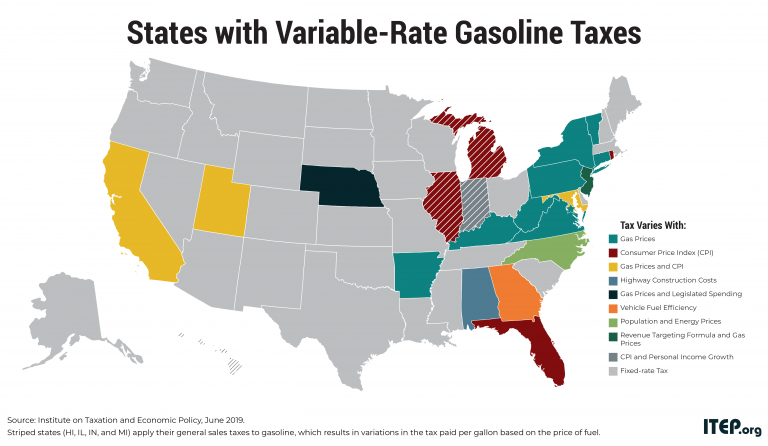
These States Abandoned Old Gas Tax Structures in Favor of More Sustainable Variable-Rate Gas Taxes
• By ITEP Staff
Because of these reforms, more than 193 million people (or 59 percent of the U.S. population) now live in places where the state gas tax rate automatically varies over time.
State Rundown 5/16: Tensions Remain High Over Budgets and School Finances in Several States
• By ITEP Staff
Tax and budget negotiations remain at standstills in Louisiana and Minnesota, as school funding debates and teacher protests again captured headlines in several states. Oregon lawmakers, for example, finally passed a mixed-bag tax package that won’t improve tax equity but will raise much-needed revenue for education. Meanwhile their counterparts in Nebraska continue to debate highly […]
State Rundown 5/9: Illinois Moves Closer to a Progressive Income Tax
• By ITEP Staff
Lawmakers in Illinois and Ohio have advanced major tax proposals but cannot rest just yet, as they must still get past the other legislative chamber. Their counterparts in Michigan, Minnesota, Nebraska, and Oregon, meanwhile, are all at impasses over education funding, as those in Texas left their school funding disagreement unresolved at least until they reconvene...in 2021. And in an era of many states pre-empting smaller jurisdictions by revoking local decision-making powers, leaders in Colorado…
State Rundown 4/18: It’s Peak Season for State Fiscal Debates
• By ITEP Staff
Tax and budget debates are now mostly complete in Alabama, Arkansas, and Colorado, but just starting or just getting interesting in several other states. Delaware and Massachusetts lawmakers, for example, are looking at progressive income tax increases on wealthy households, and New Hampshire may use a progressive tax on capital gains to simultaneously improve its upside-down tax code and invest in education. Nebraska and Texas, on the other hand, are also looking to improve school…
The Case for Extending State-Level Child Tax Credits to Those Left Out: A 50-State Analysis
• By Aidan Davis, Meg Wiehe
As of 2017, 11.5 million children in the United States were living in poverty. A national, fully-refundable Child Tax Credit (CTC) would effectively address persistently high child poverty rates at the national and state levels. The federal CTC in its current form falls short of achieving this goal due to its earnings requirement and lack of full refundability. Fortunately, states have options to make state-level improvements in the absence of federal policy change. A state-level…
State Rundown 4/11: An Estate Tax Win, Opioid Progress, and Teacher Uprising Updates
• By ITEP Staff
Hawaii made progress in pushing back against the increasing concentration of wealth and power by beefing up its estate tax. Delaware, New Jersey, and Rhode Island all took steps toward taxing opioid producers to raise funds to address the ongoing opioid crisis. Oregon lawmakers continue to try to address their chronic school underfunding with a $2 billion annual investment, in contrast to some of their counterparts in North Carolina who are responding to similar issues…

ICYMI: A Brief Summary of Our March Blogs and Reports
• By ITEP Staff
This month in tax policy news: Corporate profits soar while corporate tax collections plummet. Also inside: A look at regressive state tax policies and progressive remedies and the continued unpackaging of the Tax Cuts and Jobs Act. It's ITEP's March 2019 Monthly Digest.
State Rundown 3/14: Tax Fairness Proposed in Illinois
• By ITEP Staff
More than three billion dollars could be raised under a major progressive tax plan proposed by Illinois Gov. J.B. Pritzker this week, the point being to simultaneously improve the state’s upside-down tax code and address its notorious budget gap issues. One state, Utah, may already be looking at a special session to revisit the sales tax reform debate that ended this week without resolution, in contrast to Alabama and Arkansas, where leaders finally resolved years-long…
Crains Chicago: It’s Time to Tax Retirement Income, Illinois
March 11, 2019
On federal returns, income tax is paid on retirement resources that have not been previously taxed—defined-benefit pensions, 401(k)s, and traditional individual retirement accounts. Higher-income seniors also pay taxes on Social Security benefits. Among the states, policy varies. According to the Institute on Taxation & Economic Policy, 11 states tax some portion of Social Security benefits, […]
Gov. Pritzker’s Tax Proposal Is a Huge Step Toward Fairer Taxes
• By Lisa Christensen Gee
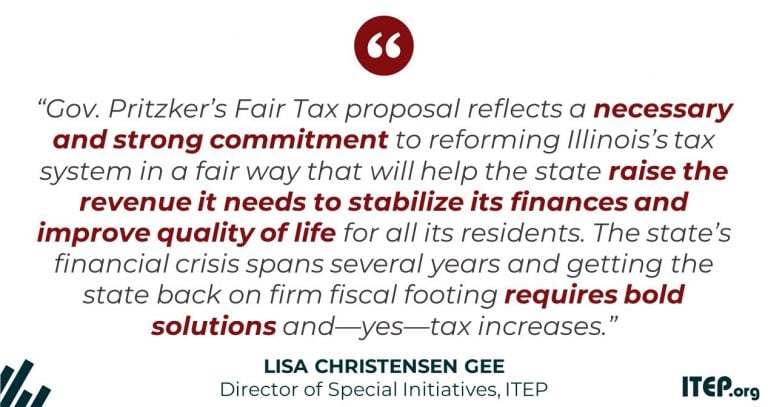
Gov. Pritzker’s Fair Tax proposal reflects a necessary and strong commitment to reforming Illinois’s tax system in a fair way that will help the state raise the revenue it needs to stabilize its finances and improve quality of life for all its residents. The state’s financial crisis spans several years and getting the state back on firm fiscal footing requires bold solutions and—yes—tax increases.
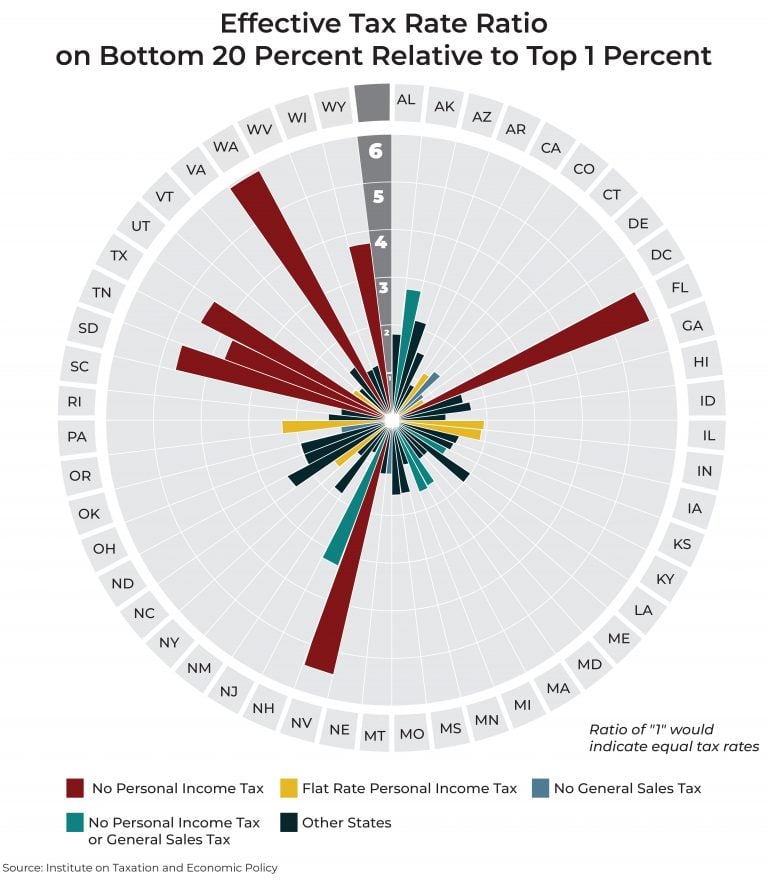
Fairness Matters: A Chart Book on Who Pays State and Local Taxes
• By ITEP Staff
There is significant room for improvement in state and local tax codes. State tax codes are filled with top-heavy exemptions and deductions and often fail to tax higher incomes at higher rates. States and localities have come to rely too heavily on regressive sales taxes that fail to reflect the modern economy. And overall tax collections are often inadequate in the short-run and unsustainable in the long-run. These types of shortcomings provide compelling reason to…
Reuters: Illinois Budget Debate Raises Key Questions on Taxing Retirement Income
February 28, 2019
But the policies of various states are all over the map. Data provided by the Institute on Taxation and Economic Policy shows that 11 states tax some portion of Social Security benefits, usually mirroring the federal formula. Many others tax pensions and tax-deferred accounts, although some have exemptions that protect lower-income, public sector workers and […]

Overdue Gas Tax Hikes are Back on the Agenda in Statehouses
• By Carl Davis
State tax policy can be a contentious topic, but one issue on which lawmakers largely agree is that higher gas tax rates are necessary to keep our nation’s infrastructure operating safely and efficiently. Lawmakers in 27 states have approved gas tax increases since 2013.

Chicago Resilient Families Task Force: Big Shoulders, Bold Solutions: Economic Security for Chicagoans
• By ITEP Staff
People with low and middle-incomes are financially savvy in ways that are often underestimated, but despite this are on thin ice financially. Despite doing all the right things, they are caught in a trap that is very hard to escape. Wages are falling behind and jobs are increasingly structured in ways that foster precariousness instead […]
State Rundown 2/20: February and Regressive Tax Cuts, The “Meanest Moons of Winter”
• By ITEP Staff
Tom Robbins called February “the meanest moon of winter, all the more cruel because it will masquerade as spring, occasionally for hours at a time, only to rip off its mask with a sadistic laugh and spit icicles into every gullible face, behavior that grows quickly old.” Observers of state fiscal debates might think he was writing about similarly tiresome regressive tax cut proposals, which recently succeeded in Arkansas and advanced in North Dakota despite…
State Rundown 2/14: We ♥ Taxes!
• By ITEP Staff
Happy Valentine’s Day to all lovers of quality research, sound fiscal policy, and progressive tax reforms! This week, some leaders in ARKANSAS displayed their infatuation with the rich by advancing regressive tax cuts, but others in the state are trying to show some love to low- and middle-income families instead. WISCONSIN lawmakers are devoted to tax reductions for the middle class but have not yet decided how to express those feelings. NEBRASKA legislators are playing…
Trends We’re Watching in 2019: Attempting to Double Down on Failed Trickle-Down Regressive Tax Cuts
• By Lisa Christensen Gee
It’s always troubling for those concerned with adequate and fair public finance systems when states prioritize tax cuts at the cost of divesting in important public priorities and exacerbating underlying tax inequalities. But it’s even more nerve-racking when it happens on the eve of what many consider to be an inevitable economic downturn.
Trends We’re Watching in 2019: Cannabis Tax Implementation and Reform
• By Carl Davis
Few areas of state tax policy have evolved as rapidly as cannabis taxation over the last few years. The first legal, taxable sale of recreational cannabis in modern U.S. history did not occur until 2014. Now, just five years later, a new ITEP report estimates that recreational cannabis is generating more than $1 billion annually in excise tax revenues and $300 million more in general sales tax dollars.
Trends We’re Watching in 2019: Raising Revenue and Spending Surpluses to Prioritize Critical Public Investments
• By Lisa Christensen Gee
A second notable trend in 2019 is states raising revenue to address longstanding needs and states allocating their surpluses to invest in critical public priorities such as early childhood programs, education and other human services.
State Rundown 1/31: Governors and Teachers Dominate Headlines, Much More in Fine Print
• By ITEP Staff
Gubernatorial addresses and the prospect of teacher strikes continued to take center stage in state fiscal news this week, as governors of Connecticut, Maryland, and Utah gave speeches that all included significant tax proposals. Meanwhile, teachers walked out in Virginia, and many other states debated school funding increases to avoid similar results. State policymakers have many other debates on their hands as well, including what to do with online sales tax revenue, how to cut…
Chicago Sun-Times: 47th Ward Candidate for Alderman
January 28, 2019
We need more progressive revenue sources to help address our pension obligations. Our state’s combination of a flat income tax, high sales taxes, and heavy local reliance on property taxes is the basis for the Institute on Taxation and Economic Policy ranking of Illinois as having the fifth most regressive tax system in the United […]
State Rundown 1/24: States Reflect on MLK’s Dream and Teacher Uprisings
• By ITEP Staff
This week, as Americans in every state celebrated Martin Luther King Jr. Day and reflected on his dream of peaceful protest and racial and economic justice, many eyes were on the teachers’ strike pressing for parts of this dream amid the “curvaceous slopes of California.” Governors and lawmakers in many states—including Arizona, Georgia, Indiana, Louisiana, Nevada, New Mexico, South Carolina, and Wisconsin—discussed ways to raise pay for teachers and/or enhance education investments generally.
