
Michigan

Options for a Less Regressive Sales Tax in 2017
• By ITEP Staff
Sales taxes are one of the most important revenue sources for state and local governments; however, they are also among the most unfair taxes, falling more heavily on low- and middle-income households. Therefore, it is important that policymakers nationwide find ways to make sales taxes more equitable while preserving this important source of funding for public services. This policy brief discusses two approaches to a less regressive sales tax: broad-based exemptions and targeted sales tax…
In Michigan 38.6 Percent of Trump’s Proposed Tax Cuts Go to People Making More than $1 Million
• By ITEP Staff
A tiny fraction of the Michigan population (0.2 percent) earns more than $1 million annually. But this elite group would receive 38.6 percent of the tax cuts that go to Michigan residents under the tax proposals from the Trump administration. A much larger group, 43.3 percent of the state, earns less than $45,000, but would receive just 4.2 percent of the tax cuts.
Nearly Half of Trump’s Proposed Tax Cuts Go to People Making More than $1 Million Annually
• By ITEP Staff
A tiny fraction of the U.S. population (one-half of one percent) earns more than $1 million annually. But in 2018 this elite group would receive 48.8 percent of the tax cuts proposed by the Trump administration. A much larger group, 44.6 percent of Americans, earn less than $45,000, but would receive just 4.4 percent of the tax cuts.

State Rundown 7/27: State Legislative Debates Winding Down but Tax Talk Continues
• By ITEP Staff
While only a few states still remain mired in overtime budget debates, there is plenty of budget and tax news from around the country this week. Efforts are underway to repeal gas tax increases in California and challenge a local income tax in Seattle, Washington. And New Jersey legislators' law to modernize its tax code to tax Airbnb rentals has been vetoed for now.
Trump Tax Proposals Would Provide Richest One Percent in Michigan with 53.2 Percent of the State’s Tax Cuts
• By ITEP Staff
Earlier this year, the Trump administration released some broadly outlined proposals to overhaul the federal tax code. Households in Michigan would not benefit equally from these proposals. The richest one percent of the state’s taxpayers are projected to make an average income of $1,621,600 in 2018. They would receive 53.2 percent of the tax cuts that go to Michigan’s residents and would enjoy an average cut of $120,010 in 2018 alone.
Trump’s $4.8 Trillion Tax Proposals Would Not Benefit All States or Taxpayers Equally
• By Matthew Gardner, Steve Wamhoff
The broadly outlined tax proposals released by the Trump administration would not benefit all taxpayers equally and they would not benefit all states equally either. Several states would receive a share of the total resulting tax cuts that is less than their share of the U.S. population. Of the dozen states receiving the least by this measure, seven are in the South. The others are New Mexico, Oregon, Maine, Idaho and Hawaii.
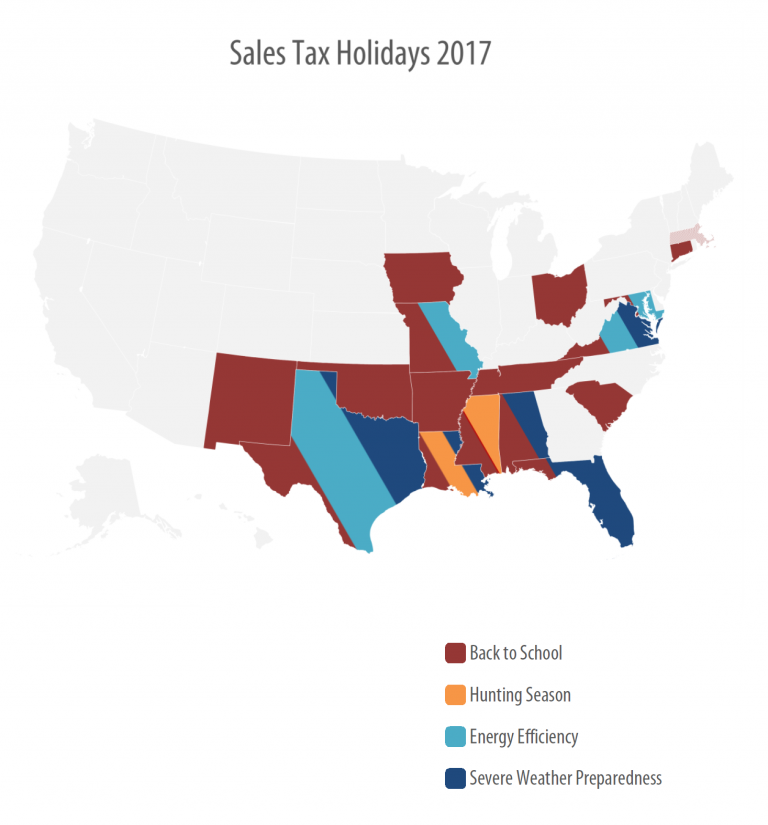
Sales Tax Holidays: An Ineffective Alternative to Real Sales Tax Reform
• By ITEP Staff
Sales taxes are an important revenue source, composing close to half of all state tax revenues. But sales taxes are also inherently regressive because the lower a family’s income, the more the family must spend on goods and services subject to the tax. Lawmakers in many states have enacted “sales tax holidays” (at least 16 states will hold them in 2017), to provide a temporary break on paying the tax on purchases of clothing, school…

Most Americans Live in States with Variable-Rate Gas Taxes
• By ITEP Staff
The flawed design of federal and state gasoline taxes has made it exceedingly difficult to raise adequate funds to maintain the nation’s transportation infrastructure. Thirty states and the federal government levy fixed-rate gas taxes where the tax rate does not change even when the cost of infrastructure materials rises or when drivers transition toward more fuel-efficient vehicles and pay less in gas tax. The federal government’s 18.4 cent gas tax, for example, has not increased…
State Rundown 6/14: Some States Wrapping Up Tax Debates, Others Looking Ahead to Next Round
• By ITEP Staff
This week lawmakers in California and Nevada resolved significant tax debates, while budget and tax wrangling continued in West Virginia, and structural revenue shortfalls were revealed in Iowa and Pennsylvania. Airbnb increased the number of states in which it collects state-level taxes to 21. We also share interesting reads on state fiscal uncertainty, the tax experiences of Alaska and Wyoming, the future of taxing robots, and more!
State Rundown 5/10: Spring Tax Debates at Different Stages in Different States
• By Meg Wiehe
This week saw a springtime mix of state tax debates in all stages of life. In West Virginia and Louisiana, debates over income tax reductions and comprehensive tax reform are full of vigor. Other debates that bloomed earlier are now settled, such as Florida‘s now-complete budget debate and the more florid debates over gas taxes […]
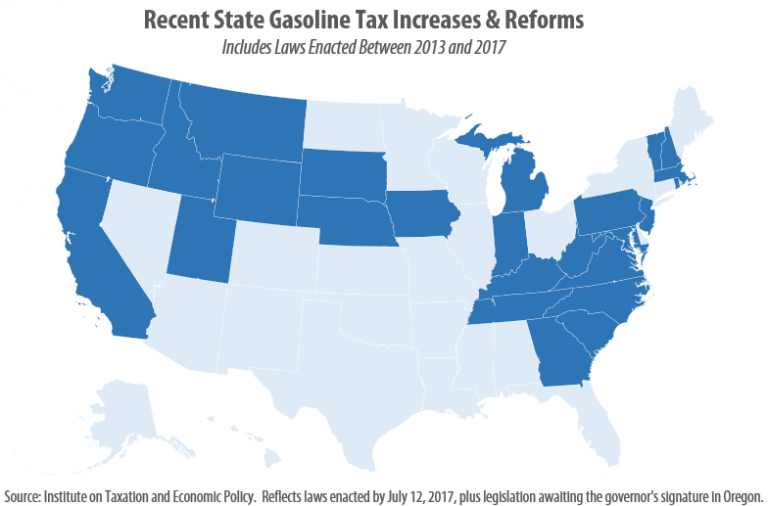
Gas Taxes Increases Continue to Advance in the States
• By Carl Davis
This post was updated July 12, 2017 to reflect recent gas tax increases in Oregon and West Virginia. As expected, 2017 has brought a flurry of action relating to state gasoline taxes. As of this writing, eight states (California, Indiana, Montana, Oregon, South Carolina, Tennessee, Utah, and West Virginia) have enacted gas tax increases this year, bringing the total number of states that have raised or reformed their gas taxes to 26 since 2013.
3 Percent and Dropping: State Corporate Tax Avoidance in the Fortune 500, 2008 to 2015
• By Aidan Davis, Matthew Gardner, Richard Phillips
The trend is clear: states are experiencing a rapid decline in state corporate income tax revenue. Despite rebounding and even booming bottom lines for many corporations, this downward trend has become increasingly apparent in recent years. Since our last analysis of these data, in 2014, the state effective corporate tax rate paid by profitable Fortune 500 corporations has declined, dropping from 3.1 percent to 2.9 percent of their U.S. profits. A number of factors are…
The Daily News: Lower Discusses Failed Effort to Cut Income Tax
March 8, 2017
According to Gilda Jacobs, executive director of the Michigan League for Public Policy, the tax relief for the lowest earners at less than $22,000 a year would be only $16 per year, while the wealthiest earners at more than $484,000 would get a tax benefit of $3,700 a year. The average Michigan worker with an […]
Undocumented Immigrants’ State & Local Tax Contributions
• By Lisa Christensen Gee, Meg Wiehe, Misha Hill
Public debates over federal immigration reform, specifically around undocumented immigrants, often suffer from insufficient and inaccurate information about the tax contributions of undocumented immigrants, particularly at the state level. The truth is that undocumented immigrants living in the United States paybillions of dollars each year in state and local taxes. Further, these tax contributions would increase significantly if all undocumented immigrants currently living in the United States were granted a pathway to citizenship as part…
State Rundown 2/23: Regressive Tax Proposals Multiplying
• By ITEP Staff
This week saw a nearly successful attempt to right the fiscal ship in Kansas; regressive tax proposals introduced in WestVirginia, Georgia, and Missouri; ongoing gas tax fights in Indiana, South Carolina, and Tennessee; and further tax and budget wrangling in Illinois, New Mexico, Oklahoma, and beyond. — Meg Wiehe, ITEP State Policy Director, @megwiehe Both […]
Regressive and Loophole-Ridden: Issues with the House GOP Border Adjustment Tax Proposal
• By Matthew Gardner, Richard Phillips
In the summer of 2016, House Republicans released a blueprint for tax reform that is likely to be used as the starting point for major tax legislation in 2017.[1] One of the most radical provisions is a proposal to shift the corporate tax code from a residence-based to a destination-based system through applying a border adjustment on exports and imports. This proposal has major flaws that would make it a challenge to implement. Further, it…
Detroit Free Press: House Panel Approves Gradual Elimination of Income Tax
February 15, 2017
And Gilda Jacobs, executive director of the Michigan League for Public Policy, said that according to a study by the Institute on Taxation and Economic Policy, the tax relief for the lowest earners–less than $22,000 a year–would be only $16 per year while the wealthiest earners–more than $484,000–would get a tax benefit of $3,700 a […]

State Gasoline Taxes: Built to Fail, But Fixable
• By Carl Davis
Every state levies taxes on gasoline and diesel fuel, usually just called "gas taxes." These taxes are an important source of state revenue--particularly for transportation--but their poor design has resulted in sluggish revenue growth that fails to keep pace with state infrastructure needs. This ITEP Policy Brief explains how state gas taxes work, their importance as a transportation revenue source, the problems confronting gas taxes, and the types of gas tax reforms that are needed…
State Rundown 2/8: Lessons of Kansas Tax-Cut Disaster Taking Hold in Kansas, Still Lost on Some in Other States
• By ITEP Staff
This week we bring news of Kansas lawmakers attempting to fix ill-advised tax cuts that have wreaked havoc on the state’s budget and schools, while their counterparts in Nebraska and Idaho debate bills that would create similar problems for their own states, as well as tax cuts in Arkansas that were proven unaffordable within one […]
Crain’s Detroit Business Journal: In bid to eliminate Michigan income tax, fears of another Kansas
February 3, 2017
Critics of these tax cuts note that states with no income tax tend to put a higher share of the tax burden on low-income residents. According to a 2015 report by the Institute on Taxation and Economic Policy, a nonpartisan research organization, five states with no income tax are ranked among the top 10 most […]
What to Watch in the States: Further Attempts to Weaken or Eliminate Progressive Taxes
• By Aidan Davis
This is the third installment of our six-part series on 2017 state tax trends. The introduction to this series is available here. As we described last week, many states are gearing up for challenging budget debates this year. But the need to address revenue shortfalls has not stopped lawmakers in many states from pursuing harmful […]

State Rundown 2/1: 2017 State Tax Debates Getting Real
• By ITEP Staff
This week’s Rundown brings news of tax cuts passed in Arkansas and advanced in Idaho, proposals to exempt feminine hygiene products from sales taxes in Nevada and Michigan, revenue shortfalls forcing tough choices in Louisiana and Maine, and more governors’ state of the state addresses and budget proposals setting the stage for yet more tax […]
Crain’s Detroit Business: In Bid to Eliminate Michigan Income Tax, Fears of Another Kansas
February 1, 2017
According to a 2015 report by the Institute on Taxation and Economic Policy, a nonpartisan research organization, five states with no income tax are ranked among the top 10 most regressive in tax structure. In reaching its conclusion, the report compared the share of personal income paid at different income levels in state and local […]
State Tax & Revenue Information
• By ITEP Staff
Below is a list of notable resources for information on state taxes and revenues: Alabama Alabama Department of Revenue Alabama Department of Finance – Executive Budget Office Alabama Department of Revenue – Tax Incentives for Industry Alabama Legislative Fiscal Office Alaska Alaska Department of Revenue – Tax Division Alaska Office of Management & Budget Alaska […]
An Overview of State Tax Trends in 2017
• By Meg Wiehe
Since the 2007-2009 economic crisis, rising income inequality and the role our public policies play in aiding or easing this trend have been an ongoing part of the public discourse. In spite of what we know about the growing gap between the rich and the rest of us, federal and state policymakers continue to sell […]

Institute on Taxation
and Economic Policy
ITEP is a non-profit, non-partisan tax policy organization. We conduct rigorous analyses of tax and economic proposals and provide data-driven recommendations to shape equitable and sustainable tax systems.
Subscribe to ITEP Emails
Tax research and policy news in your inbox.
Promote Fair Tax Policy
Your gift to ITEP promotes tax justice. With your help, we do research that supports taxing millionaires and billionaires, taxing big corporations and raising revenue for the things our people, our communities and our planet need.
Together, we can create a country with more economic justice, more racial justice, more climate justice… and more tax justice.