
Property Taxes
After the Dust Has Settled: How Progressive Tax Policy Fared in the General Election
November 30, 2020 • By Marco Guzman
While the results of the 2020 presidential election are all but set in stone—and a sign of life for progressive policy—the results of state tax ballot initiatives are more of a mixed bag. However, the overall fight for tax equity and raising more revenue to invest in people and communities is trending in the right direction.
Voters Have the Chance in 2020 to Increase Tax Equity in Arizona, Illinois, and California, And They Should
October 22, 2020 • By Marco Guzman

There’s a lot at stake in this election cycle: the nation and our economy are reeling from the effects brought on by the coronavirus pandemic and states remain in limbo as they weigh deep budget cuts and rush to address projected revenue shortfalls.
Californians are voting now on Proposition 15, which would require commercial and industrial property worth $3 million or more to be taxed based on an up-to-date assessment of full market value. Proposition 15 is sound tax policy that would raise much needed revenue and help to advance racial and economic justice.
State Tax Codes as Poverty Fighting Tools: 2019 Update on Four Key Policies in All 50 States
September 26, 2019 • By Aidan Davis
This report presents a comprehensive overview of anti-poverty tax policies, surveys tax policy decisions made in the states in 2019 and offers recommendations that every state should consider to help families rise out of poverty. States can jump start their anti-poverty efforts by enacting one or more of four proven and effective tax strategies to reduce the share of taxes paid by low- and moderate-income families: state Earned Income Tax Credits, property tax circuit breakers, targeted low-income credits, and child-related tax credits.
State lawmakers seeking to make residential property taxes more affordable have two broad options: across-the-board tax cuts for taxpayers at all income levels, such as a homestead exemption or a tax cap, and targeted tax breaks that are given only to particular groups of low- and middle-income taxpayers. This policy brief surveys the advantages and disadvantages of the circuit breaker approach to reducing property taxes.
One Tax System for Most Americans, and a Second System for the Wealthiest
August 16, 2019 • By Matthew Gardner

Last year, the Walton family's fortune grew by $100 million a day. This level of wealth is particularly obscene in the context of the Walmart Corporation’s dark store strategy. The company works nationwide to reduce its property tax assessments, which, when successful, deprives local communities of revenue necessary to fund education, libraries, parks, public health and other services.
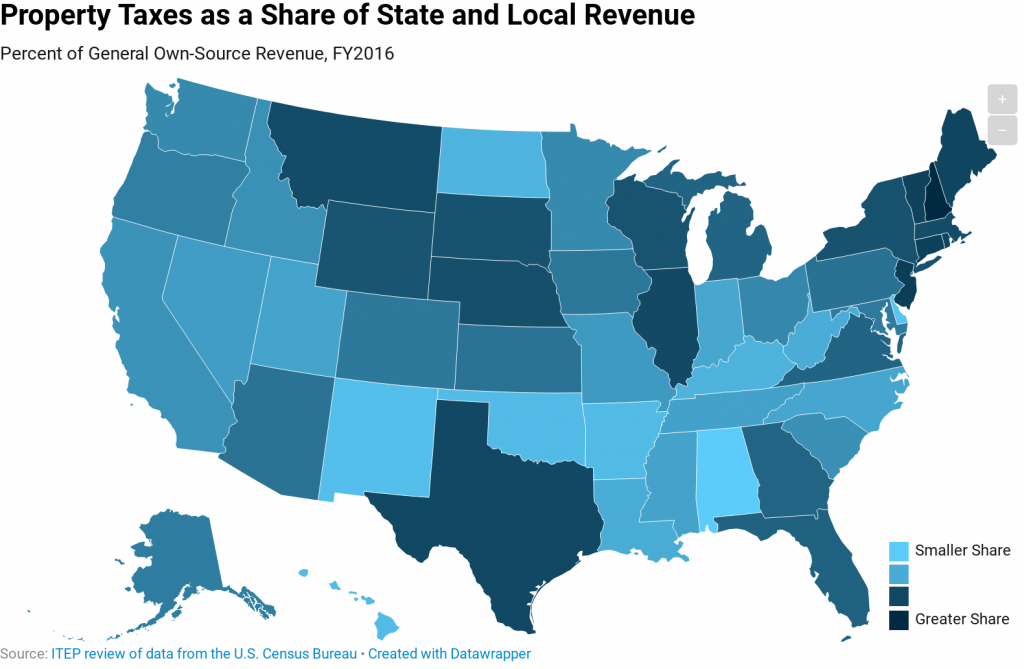
The property tax is the oldest major revenue source for state and local governments and remains an important mechanism for funding education and other local services. This map shows the share of state and local general revenue in each state that is raised through property taxes.

The Montana Senate this week stopped a bill to restructure the state's temporary tribal tax exemption program, making tribal governments the only sovereignties on which Montana levies a tax and making it more difficult for leaders to buy back illegally seized land. Still, the success of the bill in the House is troubling.
Indiana Association for Community Economic Development: Indiana Property Taxes: Is Property Tax Relief or Tax Restructuring the Solution?
January 15, 2013
Many Indiana communities are once again experiencing what is perceived to be a property tax “crisis.” However, by its most common definition, a crisis implies a situation that is characterized by unexpectedness and sudden change. Although the drastic increase in property tax bills is sudden for many homeowners, the implementation of Indiana’s property tax assessment […]
In the past half century, state lawmakers have explored a wide variety of approaches to scaling back property taxes. One such approach is the split roll property tax, also known as a classified property tax. Unlike a regular property tax system which taxes all types of real property at the same rate, a split roll property tax applies different tax rates to different types of property. This policy brief looks at the advantages and disadvantages of the split roll approach.
In response to what anti-tax advocates have branded as "out of control" property taxes, a number of states have decided to make use of tax "caps" to restrict the growth of local property taxes. California's Proposition 13 tax cap, approved in 1978, inspired numerous other states to enact similarly ill-conceived property tax caps. These caps can come in many forms, but all are poorly-targeted and costly. In most cases, these caps amount to a state-mandated restriction on the ability of local governments to raise revenue. While state lawmakers get to take credit for cutting taxes, local lawmakers are the ones…
The property tax is the oldest major revenue source for state and local governments. At the beginning of the twentieth century, property taxes represented more than eighty percent of state and local tax revenue. While this share has diminished over time as states have introduced sales and income taxes, the property tax remains an important mechanism for funding education and other local services. This policy brief discusses why property is taxed and how property taxes are calculated.

Institute on Taxation
and Economic Policy
ITEP is a non-profit, non-partisan tax policy organization. We conduct rigorous analyses of tax and economic proposals and provide data-driven recommendations to shape equitable and sustainable tax systems.
Subscribe to ITEP Emails
Tax research and policy news in your inbox.
Promote Fair Tax Policy
Your gift to ITEP promotes tax justice. With your help, we do research that supports taxing millionaires and billionaires, taxing big corporations and raising revenue for the things our people, our communities and our planet need.
Together, we can create a country with more economic justice, more racial justice, more climate justice… and more tax justice.