
Arizona
Scripps News Service: Money Diverted from Public Schools?
June 26, 2017
All the programs basically work this way: Individuals and businesses make cash or stock donations to scholarship granting organizations. The organizations award scholarships to qualifying families with K-12 students, primarily children in failing public schools or whose families’ income meets the state’s poverty threshold. Students can then attend a private or religious school of their […]
This week saw tax debates heat up in many states. Late-session discovered revenue shortfalls, for example, are creating friction in Delaware, New Jersey, and Oklahoma, while special sessions featuring tax debates continue in Louisiana, New Mexico, and West Virginia. Meanwhile the effort to revive Alaska's personal income tax has cooled off.
Investors and Corporations Would Profit from a Federal Private School Voucher Tax Credit
May 17, 2017 • By Carl Davis
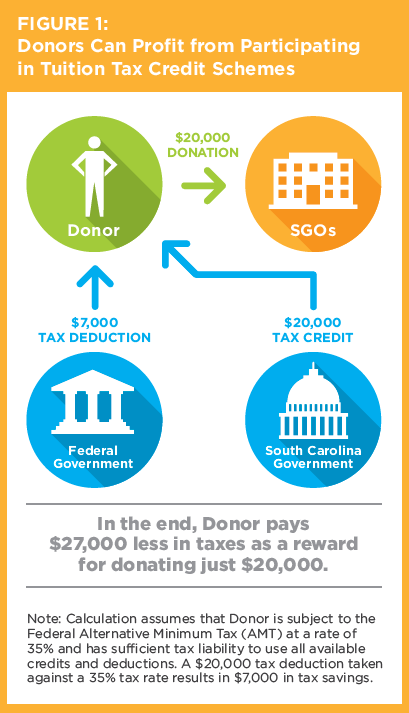
A new report by the Institute on Taxation and Economic Policy (ITEP) and AASA, the School Superintendents Association, details how tax subsidies that funnel money toward private schools are being used as profitable tax shelters by high-income taxpayers. By exploiting interactions between federal and state tax law, high-income taxpayers in nine states are currently able […]
Public Loss Private Gain: How School Voucher Tax Shelters Undermine Public Education
May 17, 2017 • By Carl Davis, Sasha Pudelski
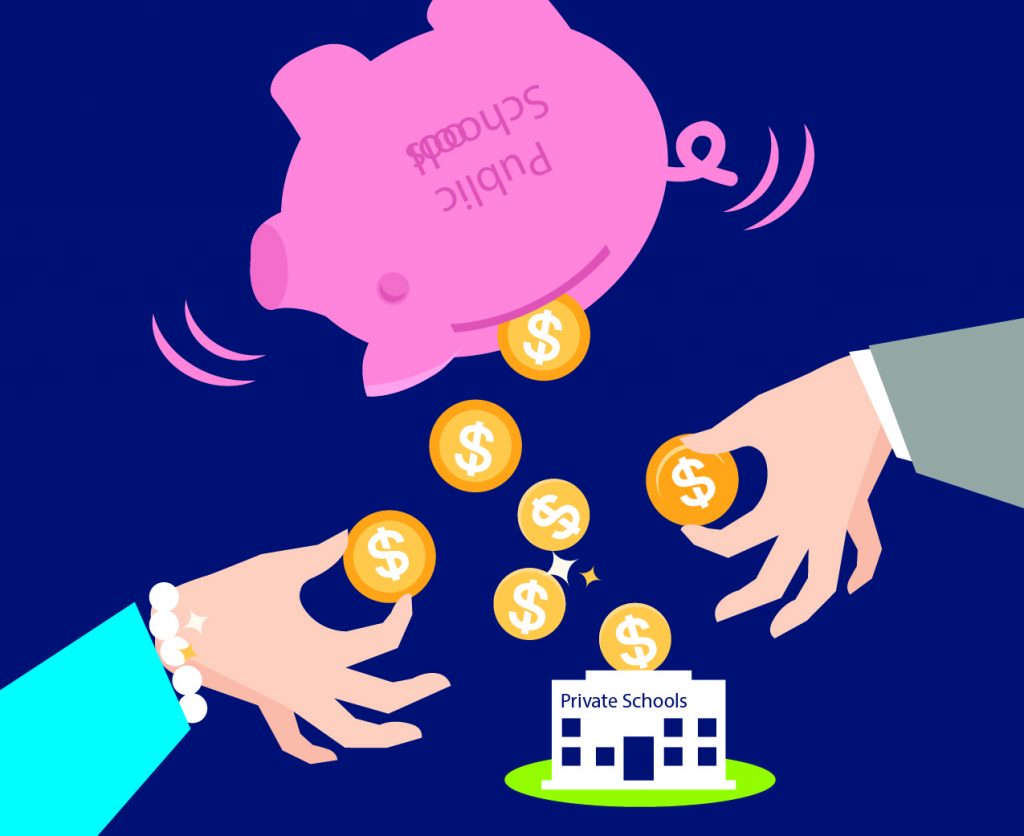
One of the most important functions of government is to maintain a high-quality public education system. In many states, however, this objective is being undermined by tax policies that redirect public dollars for K-12 education toward private schools.
3 Percent and Dropping: State Corporate Tax Avoidance in the Fortune 500, 2008 to 2015
April 27, 2017 • By Aidan Davis, Matthew Gardner, Richard Phillips
The trend is clear: states are experiencing a rapid decline in state corporate income tax revenue. Despite rebounding and even booming bottom lines for many corporations, this downward trend has become increasingly apparent in recent years. Since our last analysis of these data, in 2014, the state effective corporate tax rate paid by profitable Fortune 500 corporations has declined, dropping from 3.1 percent to 2.9 percent of their U.S. profits. A number of factors are driving this decline, including: a race to the bottom by states providing significant “incentives” for specific companies to relocate or stay put; blatant manipulation of…
States are experiencing a rapid decline in state corporate income tax revenue, and the downward trend has become increasingly pronounced in recent years. Despite rebounding bottom lines for many corporations, a new ITEP report, 3 Percent and Dropping: State Corporate Tax Avoidance in the Fortune 500, 2008 to 2015,finds that effective tax rates paid by […]
Dylan Grundman O’Neill
April 21, 2017 • By ITEP Staff

Dylan is the “coach on the floor” of the ITEP state policy team. He provides hands-on analysis and support on tax policy issues to advocates and lawmakers in several states. He also supports and vets the work of ITEP's other state policy analysts as they do the same in their states, and he liaises between the state team and the data and model team to ensure quality and consistency in how ITEP models policies and presents data.
Atlanta Journal Constitution: Is a flat tax right for Georgia?
April 11, 2017
That’s the problem Tharpe has with studies like the Wallethub.com survey. That 50-state look at state taxes found Georgia has a tax burden of 8.2 percent of individual personal income. The Washington, DC,-based financial services website ranked Georgia slightly better than Arizona and just behind Washington state. When I tweeted out those findings, Tharpe was quick to […]
What to Watch in the States: State Earned Income Tax Credits (EITC) on the Move
March 24, 2017 • By Misha Hill
While every state’s tax system is regressive, meaning lower income people pay a higher tax rate than the rich, some states aim to improve tax fairness through a state Earned Income Tax Credit (EITC). Federal lawmakers established the in 1975 to bolster the earnings of low-wage workers, especially workers with children and offset some of […]
Arizona Daily Sun: Trump corporate tax cut must be paired with reforms
March 22, 2017
A new study by the Institute on Taxation and Economic Policy, based on the regulatory filings of 258 U.S. Fortune 500 companies, illustrates how the 35 percent tax rate is nominal, not an actual onerous burden, in many industries. The actual rate paid by the companies was 21.2 percent. One-hundred of the firms had at […]
State tax debates have been very active this week. Efforts to eliminate the income tax continue in West Virginia. Policymakers in many states are responding to revenue shortfalls in very different ways: some in Iowa, Mississippi, and Nebraska seek to dig the hole even deeper with tax cuts, while the Missouri House’s response has been […]
A growing number of Americans are getting rides or booking short-term accommodations through online platforms such as Uber and Airbnb. This is nothing new in concept; brokers have operated for hundreds of years as go-betweens for producers and consumers. The ease with which this can be done through the Internet, however, has led to millions of people using these services, and to some of the nation's fastest-growing, high-profile businesses. The rise of this on-demand sector, sometimes referred to as the "gig economy" or, by its promoters, the "sharing economy," has raised a host of questions. For state and local governments,…
American Prospect: How States Turn K-12 Scholarships Into Money-Laundering Schemes
March 3, 2017
This article was originally published in The American Prospect. By Carl Davis Politicians have long had a knack for framing policy proposals, however controversial, in terms that make them more palatable to voters. This is why unpopular tax cuts for the wealthy are often sold as plans to “invest” in America or to stimulate “growth.” […]
What to Watch in the States: Modernizing Sales Taxes for a 21st Century Economy
February 15, 2017 • By Misha Hill
This is the fourth installment of our six-part series on 2017 state tax trends. The introduction to this series is available here. State lawmakers often find themselves looking for ways to raise revenue to fund vital public services, fill budget gaps, or pay for the elimination or weakening of progressive taxes. Lately, that search has […]
This is the second installment of our six part series on 2017 state tax trends. The introduction to this series is available here. State tax policy can be a divisive issue, but no area has generated more agreement among lawmakers across the country than the need to raise new revenues to fund infrastructure improvements. The […]
What to Watch in the States: Further Attempts to Weaken or Eliminate Progressive Taxes
February 2, 2017 • By Aidan Davis
This is the third installment of our six-part series on 2017 state tax trends. The introduction to this series is available here. As we described last week, many states are gearing up for challenging budget debates this year. But the need to address revenue shortfalls has not stopped lawmakers in many states from pursuing harmful […]
This week’s Rundown brings news of tax cuts passed in Arkansas and advanced in Idaho, proposals to exempt feminine hygiene products from sales taxes in Nevada and Michigan, revenue shortfalls forcing tough choices in Louisiana and Maine, and more governors’ state of the state addresses and budget proposals setting the stage for yet more tax […]
Below is a list of notable resources for information on state taxes and revenues: Alabama Alabama Department of Revenue Alabama Department of Finance – Executive Budget Office Alabama Department of Revenue – Tax Incentives for Industry Alabama Legislative Fiscal Office Alaska Alaska Department of Revenue – Tax Division Alaska Office of Management & Budget Alaska […]
Since the 2007-2009 economic crisis, rising income inequality and the role our public policies play in aiding or easing this trend have been an ongoing part of the public discourse. In spite of what we know about the growing gap between the rich and the rest of us, federal and state policymakers continue to sell […]
Fairness Matters: A Chart Book on Who Pays State and Local Taxes
January 26, 2017 • By Carl Davis, Meg Wiehe
When states shy away from personal income taxes in favor of higher sales and excise taxes, high-income taxpayers benefit at the expense of low- and moderate-income families who often face above-average tax rates to pick up the slack. This chart book demonstrates this basic reality by examining the distribution of taxes in states that have pursued these types of policies. Given the detrimental impact that regressive tax policies have on economic opportunity, income inequality, revenue adequacy, and long-run revenue sustainability, tax reform proponents should look to the least regressive, rather than most regressive, states in crafting their proposals.
The Arizona Center for Economic Progress: Questions and Answers About Arizona’s State Budget and Taxes 2017
January 24, 2017
State budgets and taxes are the foundation for achieving our common priorities that will lead to more quality jobs, a strong economy, and thriving communities. This publication provides information and analysis to help policymakers, community leaders, and community-based organizations make good decisions about Arizona’s state budget and taxes to reach those goals. These questions and […]
State Rundown 1/18: Revenue Woes Piling Up Faster Than Solutions
January 18, 2017 • By ITEP Staff
This week we continue to track revenue shortfalls, governors’ budget proposals, and other tax news around the country, finding most proposals to be focused on slashing taxes and reducing public investments despite public opinion and economic research showing the benefits of well-funded state services and progressive tax policies. — Meg Wiehe, ITEP State Policy Director, […]
State Rundown 1/11: State Legislative Sessions Kick Off Amid Uncertainty
January 11, 2017 • By ITEP Staff
This week brings still more states looking for solutions to revenue shortfalls, multiple governors’ State of The State addresses, important reading on counter-transparency and local-preemption efforts, and more. — Meg Wiehe, ITEP State Policy Director, @megwiehe A Nebraska legislator this week diagnosed the state’s $900 million revenue shortfall in plain terms, describing it as “self-inflicted […]
The Arizona Center for Economic Progress: Arizona’s State Budget and Taxes: What Every Arizonan Needs to Know About Growing Our Economy
January 10, 2017
When all types of state and local taxes are combined—income, sales and property—families with incomes in the bottom fifth pay nearly three times what families in the top 1 percent do—$12.50 for every $100 of income compared to $4.58 for the highest income families and $8.20 for middle income families. Sales taxes make up the […]
This report explains the workings, and problems, with state-level tax subsidies for private K-12 education. It also discusses how the Internal Revenue Service (IRS) has exacerbated some of these problems by allowing taxpayers to claim federal charitable deductions even on private school contributions that were not truly charitable in nature. Finally, an appendix to this report provides additional detail on the specific K-12 private school tax subsidies made available by each state.
