
2,364 posts
Complex: Nike Hasn’t Paid Any Federal Income Tax for the Last Three Years
April 2, 2021
Nike has made $4.1 billion in profits over the last three years but didn’t pay a dime in federal income tax for its earnings, according to new reports by the New York Times. The publication’s latest findings revealed that the sportswear giant was among the companies that were able to evade federal income tax payments […]
Quartz: Nike And FedEx Haven’t Paid Federal Income Tax in Three Years
April 2, 2021
Despite raking in billions in earnings, Nike, FedEx, and two dozen other public companies have paid no federal corporate income tax in the US since 2018, according to a study by the Institute on Taxation and Economic Policy, a Washington-based research organization. The behavior continues what ITEP describes as a decades-long trend of companies finding […]
Forbes: More Than 50 Major U.S. Corporations—Including Nike And FedEx—Paid No Federal Taxes Last Year
April 2, 2021
Benefitting from Trump-era tax cuts and capitalizing on loopholes in the tax code, at least 55 prominent U.S. companies paid $0 in federal corporate income taxes in 2020 on billions of dollars in profits, according to a report published Friday by the Institute on Taxation and Economic Policy. Read more
Business Insider: Nike, FedEx, and 24 Other Companies with $77 Billion of Combined Income Have Avoided Paying Taxes for Years, a New Report Found
April 2, 2021
55 of America’s biggest companies paid $0 in federal taxes last year, a new study from the Institute on Taxation and Economic Policy (ITEP) found. The 55 publicly traded companies would have paid an estimated $12 billion in federal taxes if not for corporate tax breaks in 2020, including $8.5 billion in tax avoidance and […]
The Hill: 55 Major Companies Paid Zero Federal Income Tax in 2020: Watchdog
April 2, 2021
At least 55 major profitable companies didn’t pay any federal corporate income taxes last year, according a report by the left-leaning Institute on Taxation and Economic Policy (ITEP). The group faulted the GOP tax cuts passed in 2017 as well as tax breaks enacted in the first major coronavirus relief bill passed early last year […]
Associated Press: Even with Pretax Profits, Many Big Companies Pay Zero US Tax
April 2, 2021
Just as President Joe Biden is pushing to raise taxes on companies to help pay for his infrastructure plan, a report from a Washington policy group is highlighting how many firms pay zero despite making big pretax profits. More than 50 of the largest U.S. companies paid nothing in federal income taxes last year, with […]
Fast Company: Report: 55 of America’s Biggest Companies Paid Zero Taxes during the Pandemic
April 2, 2021
The stock market boomed last year, despite a pandemic that put 45 million people out of work. But dozens of the biggest, most profitable corporations in the United States still paid $0 in federal taxes, according to a new report. The nonpartisan Institute on Taxation and Economic Policy found that 55 of the largest firms […]
New York Times: No Federal Taxes for Dozens of Big, Profitable Companies
April 2, 2021
Just as the Biden administration is pushing to raise taxes on corporations, a new study finds that at least 55 of America’s largest paid no taxes last year on billions of dollars in profits. The sweeping tax bill passed in 2017 by a Republican Congress and signed into law by President Donald J. Trump reduced […]

55 Corporations Paid $0 in Federal Taxes on 2020 Profits
• By Matthew Gardner, Steve Wamhoff
At least 55 of the largest corporations in America paid no federal corporate income taxes in their most recent fiscal year despite enjoying substantial pretax profits in the United States. This continues a decades-long trend of corporate tax avoidance by the biggest U.S. corporations, and it appears to be the product of long-standing tax breaks preserved or expanded by the 2017 tax law as well as the CARES Act tax breaks enacted in the spring…
Corporate Tax Reform in the Wake of the Pandemic
• By Amy Hanauer
Read as PDF Note: This report is adapted from written testimony submitted by Amy Hanauer before testifying in person to the Senate Budget Committee on March 25, 2021. In 2020, the pandemic killed hundreds of thousands of Americans and unemployment soared to levels not seen since the Bureau of Labor Statistics started collecting data in […]
Biden’s Corporate Tax Revolution
• By Steve Wamhoff
The corporate tax plan put forth on Wednesday by President Joe Biden to offset the cost of his infrastructure priorities would be the most significant corporate tax reform in a generation if enacted.
West Virginia Center on Budget and Policy: Senate Income Tax Cut Plan is More of the Same: Tax Cuts for the Wealthy, Tax Increases and Budget Cuts for Everyone Else
• By ITEP Staff
This week, the Senate Finance Committee took up HB 3300, the House’s income tax cut plan, and made significant changes before quickly passing it out of committee. Unlike the House plan, which phased out the income tax over time with no revenue offsets, the Senate’s plan is more similar to the governor’s proposal, making a […]
A New Look at Taxes and Race at the State and Local Levels
• By Carl Davis, ITEP Staff, Meg Wiehe
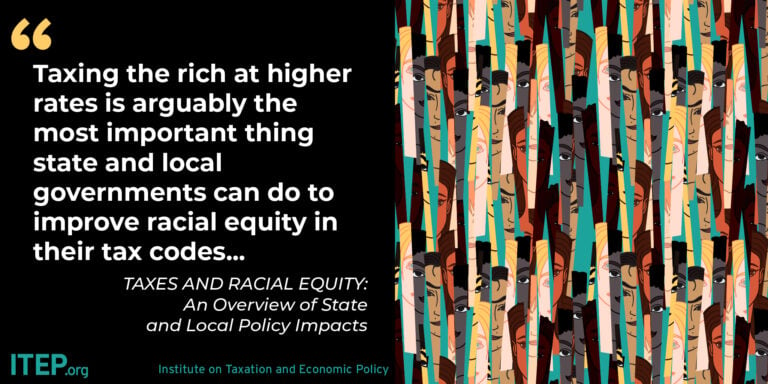
A new ITEP report reveals how different taxes have very different impacts on racial equity and unveils data for two states showcasing the consequences of their contrasting tax policy choices. In short, we find that income taxes can help narrow the racial income and wealth divides while sales taxes generally make those divides worse.
Taxes and Racial Equity: An Overview of State and Local Policy Impacts
• By ITEP Staff
Historic and current injustices, both in public policy and in broader society, have resulted in vast disparities in income and wealth across race and ethnicity. Employment discrimination has denied good job opportunities to people of color. An uneven system of public education funding advantages wealthier white people and produces unequal educational outcomes. Racist policies such as redlining and discrimination in lending practices have denied countless Black families the opportunity to become homeowners or business owners,…
New Research: Tax Policy Choices Can Narrow or Worsen the Racial Income Gap
• By ITEP Staff
Media contact A new report released today by the Institute on Taxation and Economic Policy spotlights a stark challenge confronting state and local lawmakers. Tax policy has the potential to narrow the racial income and wealth gaps, but an overreliance on inequitable revenue sources in some states indefensibly makes those gaps worse. The research builds […]

California Budget & Policy Center: American Rescue Plan Provides Assistance to Millions of Californians
• By ITEP Staff
This latest round of federal fiscal relief will help reduce hardship as a result of the pandemic, particularly for Californians with low incomes and people of color, and begins to set the stage for a more equitable economic recovery. This report outlines key provisions of the plan and what it means for Californians. Read more
WTTW: Proposals Could Expand Eligibility for Earned Income Tax Credit
March 29, 2021
“[Illinois] just piggybacks off of that by saying if you got the federal credit you get 18% of that for state purposes,” said Lisa Christensen Gee, the director of special initiatives at the Institute of Taxation and Economic Policy. The credit offsets state income tax liability, and if an individual has more credit than the […]
Here Are Some Truths About Corporate Tax Avoidance
• By Amy Hanauer
We all need the things that the public sector provides. When corporate taxes go unpaid, the American people have less for the things that would help our communities. That means less repair of our failing infrastructure, less investment in greening our economy, less funding to help young people attend college.
Testimony to Senate Budget Committee on Ending a Rigged Tax Code: The Need To Make the Wealthiest People and Largest Corporations Pay their Fair Share of Taxes
• By Amy Hanauer
Following is testimony of ITEP Executive Director Amy Hanauer before the Senate Budget Committee to consider “Ending a Rigged Tax Code: The Need To Make the Wealthiest People and Largest Corporations Pay their Fair Share of Taxes” “Chairman Sanders and Ranking Member Graham, thank you for the opportunity to speak to this committee. My name […]
Indy Week: Anti-Poverty Advocates Rejoice Over New Child Tax Credit
March 24, 2021
It’s hard to overstate the significance of the expanded tax credit for low-income families. Information released by the Institute on Taxation and Economic Policy found that more than 2.6 million children in North Carolina stand to benefit from the credit, and the Center on Budget and Policy has calculated that the legislation will move 137,000 […]
Connecticut Post: State Rep. Sean Scanlon (opinion): State child tax credit would ease burden on families
March 24, 2021
The good news for families is that President Biden’s recently passed stimulus bill features a provision long championed by my Congresswoman Rosa DeLauro that not only makes the tax credit fully refundable but also expands the credit from $2,000 to $3,000 for children 6 to 17 and to $3,600 per child under the age of […]
CBS News: Zoom’s pandemic profits exceeded $670 million. Its federal tax payment? Zilch
March 24, 2021
“We are only taxing about half of all corporate profits,” observed Matt Gardner, a senior fellow at the Institute on Taxation and Economic Policy, which put out a report on Monday highlighting Zoom’s likely $0 federal tax bill for 2020. … “There is nothing exceptional or illegal in what Zoom is doing here,” said Gardner, […]
The Street: New York Inches Closer to Legalizing Recreational Cannabis
March 24, 2021
Last November, voters in New Jersey and Arizona voted to legalize marijuana. And in December, New Jersey placed a social equity excise tax on cannabis sales in order to address the disparate effect of anti-marijuana laws on communities of color. About one in three Americans live in a state with legal sales of recreational cannabis, […]
Arkansas Times: Can’t Forget the Millionaires: Income Tax Cut on Agenda Today
March 23, 2021
Arkansas Advocates for Children and Families has run the numbers by the Institute on Taxation and Economic Policy. It says 72 percent of the tax cut will go to people making more than $192,000 a year. The tax cut would take effect in 2022. When fully implemented, it would cut revenue by $27.4 million a […]
Salon: Zoom Increased Profit by 4,000% during the Pandemic — but the Company Paid $0 in Federal Income Tax
March 23, 2021
The U.S.-based online video chat platform Zoom has seen its profits skyrocket by 4000% during the Covid-19 pandemic thanks to the growing reliance on remote work and schooling, but an analysis by the Institute on Taxation and Economic Policy finds that the company didn’t pay a dime in federal corporate income taxes on its 2020 […]

Institute on Taxation
and Economic Policy
ITEP is a non-profit, non-partisan tax policy organization. We conduct rigorous analyses of tax and economic proposals and provide data-driven recommendations to shape equitable and sustainable tax systems.
Subscribe to ITEP Emails
Tax research and policy news in your inbox.
Promote Fair Tax Policy
Your gift to ITEP promotes tax justice. With your help, we do research that supports taxing millionaires and billionaires, taxing big corporations and raising revenue for the things our people, our communities and our planet need.
Together, we can create a country with more economic justice, more racial justice, more climate justice… and more tax justice.