
2,364 posts

CARES Act Helps Create $4.6 Billion Tax Cut for Health Care Companies Paying Opioid Settlements
• By Matthew Gardner
Talk about a one-two punch. A new report from the Washington Post reveals that the U.S. public is set to pay for the opioid crisis again. Already, communities across the country have paid a heavy price via the devastating public health toll. Now, it appears taxpayers will be on the hook for billions in corporate tax breaks as four pharmaceutical companies exploit a loophole in the Trump-GOP tax law and a CARES Act tax provision…

It’s Been 10,000 Days Since the Federal Government Raised the Gas Tax
• By Carl Davis
10,000 days. More than 27 years. By next Tuesday that’s how long it will have been since the federal government last raised the gas tax. Over that time, vehicle fuel efficiency has improved by 25 percent and construction costs have grown 185 percent. And yet the federal gas tax has remained frozen at 18.3 cents per gallon, with its purchasing power shrinking by the day. The federal government has never gone this long without updating…

Testimony to Washington State Legislature House Finance Committee on HB 1496
• By Dylan Grundman O'Neill
Read as PDF Following is testimony of ITEP Senior State Tax Policy Analyst Dylan Grundman O’Neill submitted to Washington State Legislature House Finance Committee in support of HB 1496. “Hello and thank you for this opportunity to testify. My name is Dylan Grundman O’Neill, and I’m a Senior State Tax Policy Analyst with the Institute […]
Policy Matters Ohio: Ohio’s Tax Structure and Racial Disparities
• By ITEP Staff
Our success as a state and a nation depends on whether all people, regardless of race, have the opportunity to thrive. From the beginning, American policies and practices oppressed, exploited and excluded Black, brown and Indigenous people, who still face obstacles to good jobs, housing, educational opportunities and health care. As a result, wealth held […]
CNET: New Child Tax Credit Could Give Your Family A Bonus Check Every Month For A Year. What To Know
February 10, 2021
For the bottom 20% of families in terms of income, the proposed expansion of the CTC would increase income by an average of 9.7% — even higher if you only consider tax filers with children, according to the Institute on Taxation and Economic Policy. The proposal would also lift 4.1 million children above the poverty line, […]
Fatherly: This Chart Reveals How Much Money Families Will Get From Stimulus Package
February 10, 2021
It’s a genuine anomaly in American welfare policy, and a true sign that American politics is changing. But exactly how much money folks at different income levels can expect to receive is a complicated question, and it’s one that has been answered. Luckily, the Institute on Taxation and Economic Policy has a staff of people […]
Washington Post: The Pandemic Hit Undocumented Restaurant Workers Hard. These Bartenders Swooped in to Feed Them.
February 10, 2021
Of the 11 million undocumented immigrants in the country, many are cumulatively paying billions of dollars each year to state and local taxes, according to the nonpartisan Institute on Taxation and Economic Policy. Some file taxes under an individual taxpayer identification number in hopes that one day it will help their case in gaining legal status. […]
Forbes: Democrats’ Stimulus Priorities Would Boost Income By 33% For Poorest Americans
February 10, 2021
Amid fierce debate among liberal economists over the size of the next federal stimulus bill, a new analysis from the left-leaning Institute on Taxation and Economic Policy found that three of Democrats’ anti-poverty initiatives in the draft legislation—another round of direct payments and major expansions of the child tax credit and the earned income tax […]
AccountingToday: Immigration Reform Taxes Could Help States with Post-COVID Recovery
February 10, 2021
The Institute on Taxation and Economic Policy, a nonprofit, nonpartisan think tank, proposed that states and localities can significantly increase revenue collection by legalizing undocumented immigrants. According to an ITEP report, undocumented immigrants collectively pay an estimated $11.64 billion in taxes a year. The state of California, home to more than 3 million undocumented immigrants, collects […]
Business Insider: The Poorest Americans Can Expect to See a 33% Income Boost with Stimulus Checks and Tax Credit Expansions, New Report Finds
February 10, 2021
The poorest 20% of Americans can expect to see a nearly 33% boost to their incomes with key Democratic stimulus provisions of $1,400 stimulus checks, and the expansion of child tax credits and the Earned Income Tax Credit. In a report released on Tuesday by the Institute on Taxation and Economic Policy — a nonpartisan […]
Law360: NY Gov.’s Pot Tax Proposal Unique, Tax Group Says
February 9, 2021
A potency-based cannabis tax proposal by New York’s governor would bring in more sustainable revenue to the state if passed, Institute on Taxation and Economic Policy said on Tuesday. Read more
Details of House Democrats’ Cash Payments and Tax Credit Expansions
• By Steve Wamhoff
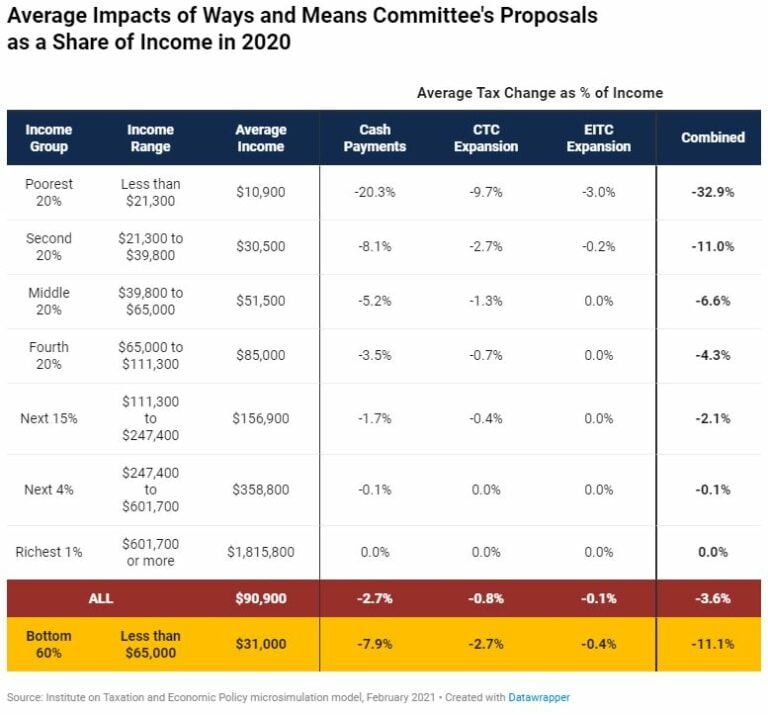
The House Ways and Means Committee published its proposal for the cash payments, tax provisions and other changes that would make up part of the $1.9 trillion COVID relief legislation that President Joe Biden called for a few weeks ago.
YahooFinance: Democrats Propose Leaving Out High Earners from Stimulus Checks and Trimming Jobless Benefits
February 9, 2021
Under Biden’s initial ‘American Rescue’ proposal, high-income households making $247,400 to $601,700 would get an average payment of $930 compared with a $280 payment for the same group under the House Democrats’ new plan, according to an analysis by the Institute on Taxation and Economic Policy. Read more
Forbes: Biden Says He Supports $75,000-A-Year Threshold For Full $1,400 Stimulus Checks
February 9, 2021
An analysis from the left-leaning Institute on Taxation and Economic Policy found that proposals in the Democratic bill would boost income for the poorest Americans by around 33%. Read more
Washington Post: Here’s the New Democratic Plan for $1,400 Stimulus Payments
February 9, 2021
The best argument in favor of the checks is that they have kept many Americans out of poverty during the crisis. An analysis by the left-leaning Institute on Taxation and Economic Policy found that the bottom 20 percent of Americans — those earning less than $21,300 — would see their income rise nearly 30 percent, helping keep […]
Tampa Bay Times: Florida Should Close Tax Loopholes for Corporations | Column
February 9, 2021
Because of its lopsided reliance on sales tax — which forces poorer people to pay a larger share of their income in taxes than richer people — Florida has one of the most unequal tax structures in the country, according to the nonpartisan Institute on Taxation and Economic Policy. The poorest 20 percent of Florida […]
The Fiscal Times: Poorest Americans Would Get Major Income Boost From Covid Relief Bill: Report
February 9, 2021
Three provisions in the legislation released this week by the House Ways and Means Committee would provide a 33% income boost on average for the poorest 20% of Americans, according to an analysis by the left-leaning Institute on Taxation and Economic Policy. Read more

Does New York’s Cannabis Tax Idea Offer a Glimpse of the Future?
• By Carl Davis
Taxing cannabis won’t end New York’s budget difficulties, but a potency tax could bring New York a more sustainable stream of cannabis tax revenue than we see in most states. It could also have significant benefits for cannabis consumers.

Faulty Fact Check on Tax Breaks for the Rich and Corporations
• By Amy Hanauer
When it comes to tax policy, the details are complicated, but the story is often simple. For example, President Trump’s so-called Tax Cuts and Jobs Act (TCJA) disproportionately benefits the rich. This is not controversial. Yet some opinion makers with large megaphones get lost in the details and come to conclusions that only create more confusion.

States Are Finally Going Bold with Progressive Tax Efforts
• By Dylan Grundman O'Neill
Advocates, lawmakers, study commissions, and even governors in some states are proposing bold tax policy reforms that look beyond pandemic-induced budget shortfalls and the “K-shaped recovery” to address underlying inequities and underfunding that gave rise to them. These efforts include proposals to: end or reverse regressive tax policies like the preferential treatment of income derived from wealth over income earned through work; restore or strengthen estate and inheritance taxes to slow the concentration of wealth…

Corporations Avoid Taxes in a Pandemic
• By Amy Hanauer
The public and the Biden administration say corporations should contribute to the public infrastructure that lets them earn so much. We agree. It’s the least we can ask, in a pandemic and at all other times too.
Amazon Has Record-Breaking Profits in 2020, Avoids $2.3 Billion in Federal Income Taxes
• By Matthew Gardner
Amazon’s winning streak in its battle against the U.S. tax system remains intact. This week the retail giant announced record-breaking sales and income for 2020, and an effective federal income tax rate of just 9.4 percent, less than half the statutory corporate tax of 21 percent. If Amazon had paid 21 percent of its profits in federal income tax, that would have come to $4.1 billion. The company’s reported current tax of $1.8 billion was…
Montana Budget & Policy Center: What Proposed Tax Cuts Really Mean for Montanans
• By ITEP Staff
The 2021 Montana Legislature has the opportunity to address longstanding inequities in Montana’s tax code that have made life harder for many families. Previous legislatures have chosen to balance the budget by cutting needed services for our seniors, Montanans with disabilities, and those struggling with mental health instead of finding common-sense solutions to fairly increase […]
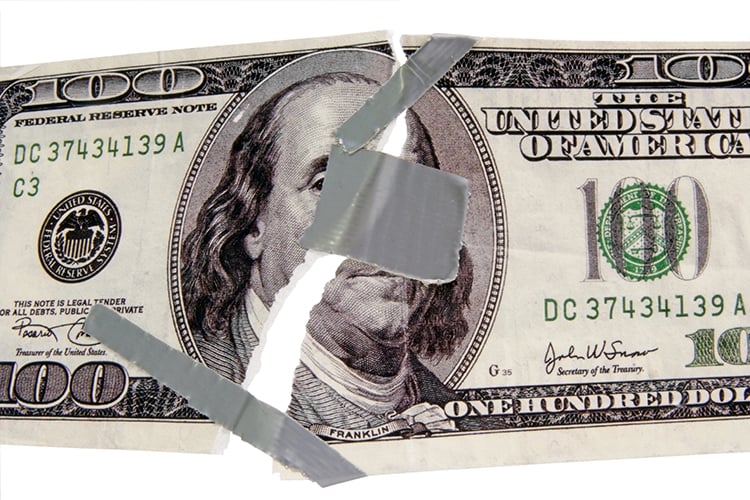
President Biden’s Child Tax Credit Proposal Could Right a Historical Wrong
• By ITEP Staff, Jenice R. Robinson, Meg Wiehe
Many 1990s policies were grounded in harmful, erroneous ideas such as financial struggles are due to personal shortcomings and less government is better. Lawmakers didn’t apply these ideas consistently, however. For example, there was no drive to reduce corporate welfare even as policymakers slashed the safety net and disinvested in lower-income communities. So, it’s not surprising that a bipartisan group of lawmakers concluded during that era that the CTC was an appropriate vehicle to give…

Immediate Action State Lawmakers Can Take to Support Families and Children
• By Aidan Davis
If Congress does act and enact President Biden’s CTC expansion, states could simply couple to that federal change. The changes, while temporary, could become the foundation of a permanent state-level credit over the long-term. But state lawmakers need not wait for legislative action in DC. They can take immediate steps to ensure that their state’s most vulnerable children are positioned to succeed.

Institute on Taxation
and Economic Policy
ITEP is a non-profit, non-partisan tax policy organization. We conduct rigorous analyses of tax and economic proposals and provide data-driven recommendations to shape equitable and sustainable tax systems.
Subscribe to ITEP Emails
Tax research and policy news in your inbox.
Promote Fair Tax Policy
Your gift to ITEP promotes tax justice. With your help, we do research that supports taxing millionaires and billionaires, taxing big corporations and raising revenue for the things our people, our communities and our planet need.
Together, we can create a country with more economic justice, more racial justice, more climate justice… and more tax justice.