
2,364 posts
Business Insider: Zoom Paid $0 in Federal Taxes on $664 Million in Pandemic Profits, Mostly by Paying Executives Stock Options
March 23, 2021
“Companies that compensate their leadership with stock options can write off, for tax purposes, huge expenses that far exceed their actual cost,” Matthew Gardner, a senior fellow at the Institute for Taxation and Economic Policy, wrote in a post breaking down Zoom’s tax strategy. Read more
New York Post: Zoom Paid No Federal Income Tax Last Year amid Pandemic Profit Surge
March 23, 2021
The Silicon Valley firm appears to have achieved that feat largely thanks to its use of stock-based compensation for employees, which helped reduce its worldwide tax bill by more than $302 million for the year ending Jan. 31. Corporations that pay their executives in stock often benefit from a provision in the federal tax code […]
Common Dreams: Zoom Paid $0 in Federal Income Taxes on 4,000% Profit Increase During Pandemic: Report
March 22, 2021
The U.S.-based online video chat platform Zoom has seen its profits skyrocket by 4000% during the Covid-19 pandemic thanks to the growing reliance on remote work and schooling, but an analysis by the Institute on Taxation and Economic Policy finds that the company didn’t pay a dime in federal corporate income taxes on its 2020 […]
The Independent: Zoom Increase Profits by 4000 Per Cent During Pandemic but Paid No Income Tax, Report Says
March 21, 2021
Zoom Video Communications reported that it made a $660m (£476m) pre-tax profit in 2020, up from $16m (£11.5m) in 2019, according to the non-profit Institute on Taxation and Economic Policy. Zoom’s video conferencing platform was widely used by remote workers and school children across the US due to Covid social distancing and quarantine measures. “The […]
Chicago Sun-Times: A New Push to Expand the State’s Earned Income Credit Could Include Immigrants
March 21, 2021
Economic Security for Illinois, working with the Institute in Taxation and Economic Policy, estimates that as many as 500,000 households would benefit from the expansion, including 110,000 immigrant households. Read more

Zoom Pays $0 in Federal Income Taxes on Pandemic Profits
• By Matthew Gardner
Zoom Video Communications, the company providing a platform used by remote workers and school children across the country during the pandemic, saw its profits increase by more than 4,000 percent last year but paid no federal corporate income tax on those profits.
The Hill: A Straightforward Way to Pay for Biden’s Recovery Plan (Opinion)
March 18, 2021
Now that President Biden and Congress have enacted a $1.9 trillion COVID-19 relief measure, the president will soon provide details for the second item on his agenda, a major recovery plan. The package could include some of the tax increases on which he campaigned to pay for new spending.
Idaho Center for Fiscal Policy: Analysis and Considerations Related to House Bill 332
• By ITEP Staff
The Idaho Legislature is considering a proposal that would cut income and corporate tax rates and provide a one-time tax rebate. Under the proposal, the tax benefits from this proposed legislation are heavily lopsided. Taking all provisions into account, households with very modest earnings would receive a $78 average tax cut, and the top 1 […]
Marijuana Moment: Cannabis Banking Bill Comes Back to Congress
March 18, 2021
An Institute on Taxation and Economic Policy analysis concluded that “cannabis taxes are a small part of state and local budgets, clocking in at less than 2 percent of tax revenue in the states with legal adult-use sales” but are also “one of states’ fastest-growing revenue sources.” Read more
The Hill: Ohio AG Sues Biden Administration Over Pandemic Bill
March 17, 2021
Carl Davis, the research director for the left-leaning Institute on Taxation and Economic Policy, said that the rhetoric from the conservative attorneys general has been overblown. “There’s a lot of potential very positive uses for this money that states and localities could find in this moment,” Davis told The Hill. “It’s not intended to be […]
Newsweek: This Last-Minute Provision Blocks GOP Govs from Using Stimulus Money to Subsidize Tax Cuts
March 17, 2021
“Basically any tax cut done at the state level has doubled in cost,” said Carl Davis, research director at the Institute on Taxation and Economic Policy. For example, if a state enacts a $50 million tax cut, it will lose $50 million in the revenue it won’t collect and another $50 million in federal aid. […]
CNN: Historic Benefits in Stimulus Bill May Answer a Big Question for Democrats
March 16, 2021
In figures provided exclusively to CNN, the Institute on Taxation and Economic Policy, which generally advocates for a more progressive tax code, similarly calculated that households headed by Whites will make up 67% of those receiving the bill’s direct cash payments, 64% of those benefiting from its expanded child tax credit and 62% benefiting from […]
One Voice Mississippi: Bill Analysis: House Bill 1439: Tax Proposal Moves State Away from a Better, More Equitable Mississippi
• By ITEP Staff
Mississippi’s House of Representatives recently passed House Bill 1439 (“the Mississippi Tax Freedom Act of 2021”). The House passed the 300-page bill less than 24 hours after they introduced it with little debate and no fiscal note. The plan revives the recurring attempts of some lawmakers to cut state income taxes, but does much more. […]
Law360: 3 Questions State Tax Pros Have About The Pandemic Relief Law
March 16, 2021
Policymakers and state tax specialists noticed almost immediately that if states want to take full advantage of the $350 billion cash infusion the ARPA gives state and local governments, it appears they are going to have to give up some autonomy. While those who spoke to Law360 said only explicit guidance from the U.S. Treasury, […]
GeekWire: Capital Gains Tax in Washington State: Is it about Fairness and Funding, or Will it Drive Away Startups?
March 16, 2021
Dylan Grundman O’Neill, a senior state tax policy analyst with the Institute on Taxation and Economic Policy, said that research shows that in Washington, more so than in any other state, “the higher your income, the lower your tax rate.” “The top 1% pay an effective rate of only about 3%,” O’Neill said. “While middle-income […]
Fortune: Biden Plots Tax Hikes on Corporations and High-earners to Fund Ambitious Infrastructure Plan
March 16, 2021
Should the President get the rest of the Democratic caucus on board with his vision of a massive infrastructure bill funded by higher taxes on corporations and wealthy individuals, Biden could have yet another legislative victory on his hands—one even bigger and more significant than his coronavirus stimulus bill, with further-reaching economic consequences that could […]
Business Insider: H&R Block Customers Will Get 3rd Stimulus Check, No Delay
March 16, 2021
H&R Block also gives taxpayers the option to receive their refund on a debit card called the Emerald Card. Anyone who qualifies for the third stimulus check and had their most recent refund sent to an Emerald Card will get their money deposited directly onto the card. The nonpartisan Institute on Taxation and Economic Policy estimated […]
Yahoo News: ‘Helping the Country Prosper’: Undocumented Immigrants Pay Billions in US Taxes Each Year — and Have Been for Decades
March 16, 2021
A report from the office shows that 50% to 75% of undocumented immigrants pay billions in taxes each year — and have been since the Internal Revenue Service created a program 25 years ago allowing people without a Social Security number to file taxes. When it comes to state and local taxes, undocumented immigrants pay […]
The Columbus Dispatch: Undocumented Immigrants Pay Billions in Taxes Each Year — and Have Been for 25 Years
March 15, 2021
When it comes to state and local taxes, undocumented immigrants pay more than $11 billion a year, according to a 2017 report from the Institute on Taxation and Economic Policy, a nonpartisan nonprofit based in Washington, D.C. In Ohio, they paid $83.2 million in state and local taxes in 2017, according to the institute. Read more
Bloomberg: Biden’s Rescue Hasn’t Stopped States’ Tax-the-Rich Rally Call
March 15, 2021
“No amount of federal aid can change the fact that nearly all state tax codes worsen the economic and racial inequalities that this pandemic has laid bare,” said Dylan Grundman O’Neill, senior state policy analyst at the left-leaning Institute on Taxation and Economic Policy. Read more
CNBC: Expecting a $1,400 Stimulus Check by Mail? Here’s What to Watch for
March 15, 2021
Instead, the checks will be signed by a career official at the Bureau of Fiscal Service, which is working with the IRS to deliver the money. This has been the precedent prior to the previous presidential administration, according to a Treasury official. “It’s really unusual to have an individual president’s name on a check,” said […]

Trickle-Down Myths Swamp Tax Policy Debates in Mississippi and West Virginia
• By Aidan Davis
Recent proposals in both Mississippi and West Virginia seek to pare back, and ultimately eliminate, each state’s income tax while shifting the responsibility of funding services even more onto low- and middle-income taxpayers through increased consumption taxes. The states are moving forward with this tax experiment even though a similar experiment notoriously and immediately sent Kansas into a financial tailspin.
MinnPost: Is Minnesota’s Tax System Unfair?
March 15, 2021
The Institute on Taxation and Economic Policy’s regular assessment of state taxes concludes that just five states and the District of Columbia have positive scores on progressivity: California, Delaware, New Jersey, Vermont and Minnesota. The progressive systems rely less on consumption taxes and more on income taxes, with rates that increase with wealth. They also […]
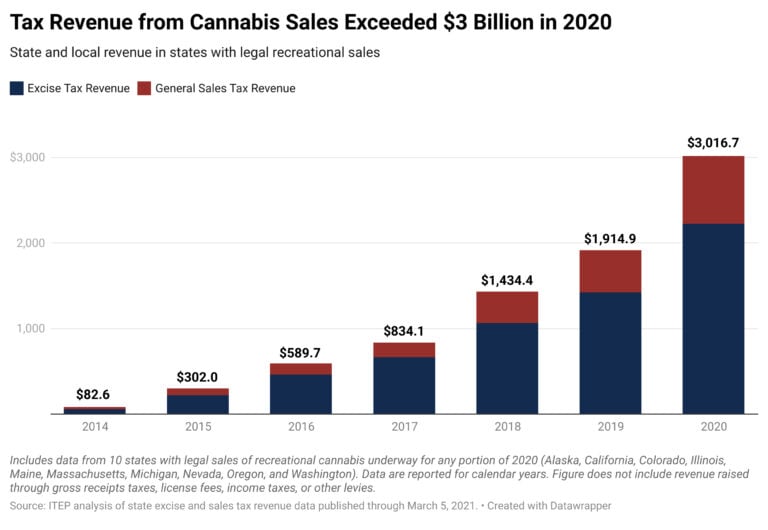
State and Local Cannabis Tax Revenue Jumps 58%, Surpassing $3 Billion in 2020
• By Carl Davis
Cannabis taxes are a small part of state and local budgets, clocking in at less than 2 percent of tax revenue in the states with legal adult-use sales. But they’re also one of states’ fastest-growing revenue sources. Powered by an expanding legal market and a pandemic-driven boost in cannabis use, excise and sales taxes on […]
Washington Post: Joe Biden’s COVID-19 Relief Bill Is an Extraordinary Achievement (Opinion)
March 14, 2021
The American Rescue Plan assumes that almost everyone can use a helping hand. According to the Institute on Taxation and Economic Policy, roughly 85 percent of adults and children will receive a stimulus payment — meaning, as Biden said in his Thursday night speech, that “a typical family of four earning about $110,000 will get […]

Institute on Taxation
and Economic Policy
ITEP is a non-profit, non-partisan tax policy organization. We conduct rigorous analyses of tax and economic proposals and provide data-driven recommendations to shape equitable and sustainable tax systems.
Subscribe to ITEP Emails
Tax research and policy news in your inbox.
Promote Fair Tax Policy
Your gift to ITEP promotes tax justice. With your help, we do research that supports taxing millionaires and billionaires, taxing big corporations and raising revenue for the things our people, our communities and our planet need.
Together, we can create a country with more economic justice, more racial justice, more climate justice… and more tax justice.