
2,364 posts
Independent Record: GOP Lawmaker Doubles Tax Cut Rate in Montana Senate Bill
March 12, 2021
Under the un-amended bill, a person earning from $40,000-$63,000 would see a reduction of about $14, according to an analysis of the proposal by the Institute on Taxation and Economic Policy. The House Taxation Committee delayed action on another bill that also aims to lower the state’s top income tax rate after hitting snags in […]
Fortune: The COVID Relief Bill Doesn’t Raise Taxes on Gig Workers
March 12, 2021
The new tax revenue is money that should’ve been collected all along, but many workers didn’t have the documentation that serves as a reminder and guide to reporting the incomes they make on these platforms. “You are paying what you owe,” said Steve Wamhoff, director of federal tax policy at think tank the Institute on […]
CNBC: New $1,400 Stimulus Checks Are on the Way. Here’s Who Qualifies for the Money
March 12, 2021
“If you got a full payment last time, you will get the full payment this time,” provided your income has not substantially changed, said Steve Wamhoff, director of federal tax policy at the Institute on Taxation and Economic Policy. The $1,400 checks will generally be based on either 2020 or 2019 tax returns, depending on […]
Associated Press: COVID Relief Bill Could Permanently Alter Social Safety Net
March 12, 2021
“The question will be, do they want child poverty to go back up again" by letting that credit expire, said Steve Wamhoff, director of federal tax policy for the liberal Institute on Taxation and Economic Policy.
Forbes: The Historic Child Tax Credit Expansion Could Provide Monthly Payments To Millions Of Households. Here’s How it Would Work
March 11, 2021
The amount of the credit is being increased, but that’s not the whole story. For the first time in history, families will qualify to receive the child tax credit as a monthly stipend. These monthly payments will provide up to $300 per child starting this July through the end of the year (the remaining credit […]
Epoch Times: Biden Administration Eyes Raising Corporate Tax Rate to Pay for Stimulus
March 11, 2021
The tax cuts of 2017, which was signed into law by President Donald Trump, reduced the corporate income tax rate to 21 percent from 35 percent beginning in 2018. It also reduced the tax rates for pass-through businesses and individuals. Progressives criticized the cuts, calling it a giveaway to the rich and corporations. The Institute […]
The Balance: $1.9 Trillion Rescue Bill Hinged On Just 9 Votes
March 11, 2021
The relief package will send stimulus checks of up to $1,400 per taxpayer and $1,400 per dependent, benefiting an estimated 280 million adults and children, according to estimates from the Institute on Taxation and Economic Policy, a nonpartisan nonprofit. Together with the ramped-up rollout of COVID-19 vaccines, the relief package is set to provide the […]
Jacobin: The New COVID-19 Relief Bill Is Good, But Not Good Enough
March 11, 2021
As a spending bill, the ARP’s impact cannot be overstated. It is the mirror opposite of the Trump tax cuts, targeting most of its benefits to the bottom end of the income ladder, rather than the top. It will send stimulus checks up to $1,400 to an estimated 280 million Americans, continue additional $300 weekly […]
The Center Square: Biden Signs $1.9 Trillion Stimulus Bill into Law
March 11, 2021
The $1,400 stimulus checks included in the legislation are expected to reach an estimated 85% of Americans and cost $410 billion, according to the Institute on Taxation and Economic Policy. Read more

Rep. Doggett and Sen. Whitehouse Introduce Bill to Crack Down on Offshore Corporate Tax-Dodging
• By Steve Wamhoff
The 2017 tax law simply replaced one set of loophole-ridden rules that favored offshore profits over domestic profits with a new set of loophole-ridden rules doing the same thing. A bill introduced today by Rep. Lloyd Doggett and Sen. Sheldon Whitehouse would finally fix this to follow a simple principle: we should tax the offshore profits and domestic profits of our corporations the same way.
Fort Worth Star-Telegram: Texas Parents Get Big Tax Breaks from COVID Relief Bill
March 11, 2021
Nearly 6.8 million Texans with children could receive monthly checks starting in July, under the new economic relief plan President Joe Biden signed into law Thursday. Nearly one of three adult Texans would qualify for the aid, which would help 7.8 million Texas children, according to an analysis from the Institute on Taxation and Economic […]
Bloomberg: Millions of Americans Miss Out on Stimulus ‘Survival’ Checks
March 11, 2021
The think tank Institute on Taxation and Economic Policy estimates that 280 million people would receive a full or partial payment under the new criteria, compared with 288 million who received all or some of the second $600 direct payment approved in December. Steve Wamhoff, the institute’s director of federal tax policy, said that the […]
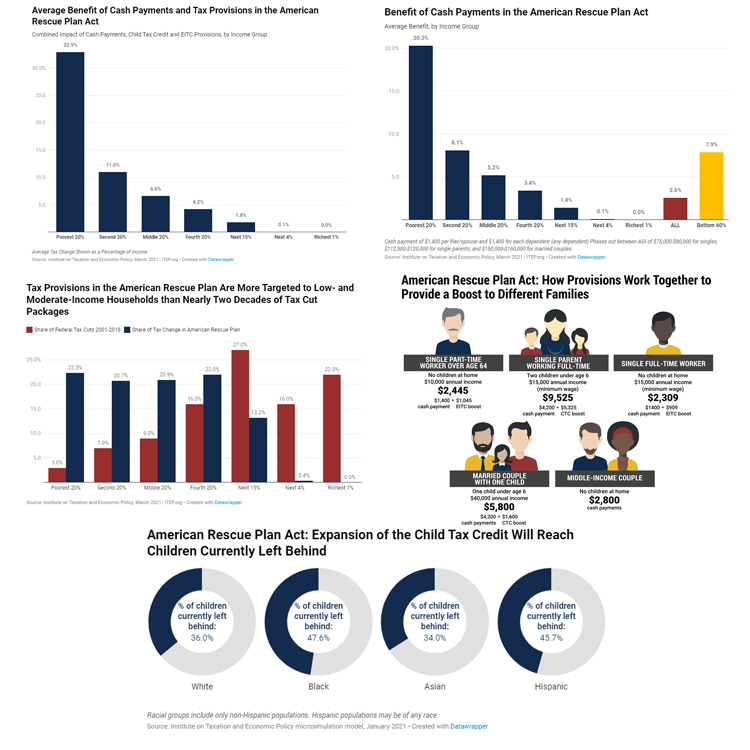
Targeted Relief and the American Rescue Plan in Five Charts
• By Stephanie Clegg
The American Rescue Plan Act is unique in that it employs the tax code to deliver relief to those struggling most. These five charts provide a glimpse of how the plan helps families across the income spectrum and also targets economic relief to low- and moderate-income families in the form of cash payments and expansions to the Child Tax Credit and Earned Income Tax Credit.
Reuters: Analysis: Despite Republican Opposition, Red States Fare Well in Biden’s COVID-19 Bill
March 10, 2021
The Biden bill also expands tax breaks for children and low-income workers to encompass poor households that did not qualify before. Experts say the expanded child tax credit alone could cut child poverty nearly in half. “That’s a big deal,” said Steve Wamhoff of the left-leaning Institute on Taxation and Economic Policy, which analyzed the […]
Washington Post: Yes, the Covid Rescue Bill Is a ‘Liberal Wish List.’ What’s Wrong With That? (Opinion)
March 10, 2021
Indeed, the design of the bill is such that the benefits are spread among poor and middle-class people, while giving little or nothing directly to the wealthy (though the rich will certainly benefit from a quicker recovery). As an analysis from the Institute on Taxation and Economic Policy demonstrates, the direct benefits “are spread evenly […]
Kiplinger: Congress Passes Bill with More “Targeted” Stimulus Payments
March 10, 2021
However, the stimulus check plan in the original version of the bill is different than what’s found in the final bill. While in the Senate, a more aggressive stimulus check “phase-out” (i.e., reduction) rate was added. The new rate made the stimulus check provisions more “targeted” to people who need assistance the most. As a […]
Los Angeles Times: House Sends $1.9-trillion COVID-19 Economic Relief Bill to Biden’s Desk
March 10, 2021
The checks are phased out quickly compared to the previous checks Congress approved last year. Individuals with annual incomes of $80,000 or more, joint filers with annual incomes of $160,000 or more and heads of households earning $120,000 or more would not receive anything. The Institute on Taxation and Economic Policy, a progressive research group, estimates […]

American Rescue Plan Uses Government Muscle to Tackle Big Economic Problems
• By Amy Hanauer
Media contact Following is a statement by Amy Hanauer, executive director of The Institute on Taxation and Economic Policy, regarding the American Rescue Plan, which has cleared both houses of Congress and President Biden is expected to sign. “The American Rescue Plan is a monumental first step toward President Joe Biden’s pledge to build back […]
BuzzFeed: Congress Just Passed Another Round Of COVID Checks And Unemployment Aid
March 10, 2021
The Institute on Taxation and Economic Policy found that 83 million children live in households that will benefit [from the Child Tax Credit expansion]. Currently, the families with the lowest incomes are excluded from receiving this support due to a lack of taxable income. The COVID bill rewrites that language so that families with the […]
Philadelphia Inquirer: The New Coronavirus Relief Bill Promises Big Financial Help for Parents in the Philly Region
March 10, 2021
Combining the relief checks and tax credits, people in the bottom 60% of earners, those making less than $65,000, would see an 11% jump in income, according to the liberal Institute on Taxation and Economic Policy. Those with families would see the largest benefits. Read more
Forbes: Here’s Everything You Need To Know About The New Expanded Child Tax Credit
March 10, 2021
83 million. That’s how many children live in households that will benefit from the expanded credit, according to the Institute on Taxation and Economic Policy. The expansion would send about $116 billion to families with children in 2021, the ITEP estimates. Read more
CNBC: Stimulus Checks and Expanded Tax Credits
March 10, 2021
Between stimulus checks and expanded tax credits in the latest Covid-relief package, most U.S. households are poised to get some extra cash. The amount? An average of $3,450 for the bottom 60% of earners ($65,000 or less), according to research from the Institute on Taxation and Economic Policy. The number reflects direct stimulus payments and […]
San Francisco Chronicle: California Schools, Governments and Residents to Get Billions in COVID Stimulus
March 9, 2021
The bill includes another round of direct stimulus payments to Americans. The nonpartisan Institute on Taxation and Economic Policy estimates that 22 million adults and 9 million children in California will benefit from the $1,400 checks. The bill also expands the child tax credit from $2,000 per year to $3,000 for children over the age […]
Mississippi Today: Study: House Tax Proposal Increases Burden on Poor Mississippians
March 9, 2021
The bottom 60% of Mississippi’s income earners would be paying more taxes under legislation that has passed the House while the top 40% would be paying less, according to an analysis conducted by a Washington, D.C.-based policy think tank. A person in the top 1% with average income of $924,000 would pay $28,610 less in […]
CNET: Child Tax Credit 2021 Approval Could Bring More Money Than Stimulus Checks. What to Know
March 9, 2021
For the bottom 20% of families in terms of income, the proposed expansion of the CTC would increase income by an average of 9.7% — even higher if you consider only tax filers with children, according to the Institute on Taxation and Economic Policy. The proposal would also lift 4.1 million children above the poverty line, […]

Institute on Taxation
and Economic Policy
ITEP is a non-profit, non-partisan tax policy organization. We conduct rigorous analyses of tax and economic proposals and provide data-driven recommendations to shape equitable and sustainable tax systems.
Subscribe to ITEP Emails
Tax research and policy news in your inbox.
Promote Fair Tax Policy
Your gift to ITEP promotes tax justice. With your help, we do research that supports taxing millionaires and billionaires, taxing big corporations and raising revenue for the things our people, our communities and our planet need.
Together, we can create a country with more economic justice, more racial justice, more climate justice… and more tax justice.