
2,364 posts
Washington State Budget & Policy Center: Why Now Is the Time to Pass a Tax on Extraordinary Profits
• By ITEP Staff
Members of the Washington State Senate have an historic opportunity to create a more just state tax code while bolstering and sustaining our state’s fiscal and economic recovery long after federal recovery funds fade away. Senate Bill 5096 would create a new 7% excise tax on extraordinary profits from the sale of financial assets (capital […]
Fiscal Times: Biden’s Stimulus: What You Need to Know Now
March 8, 2021
What you need to know about the $1,400 “stimulus checks”: Individuals earning less than $75,000 and couple making less than $150,000 are eligible for the full $1,400 relief payments, plus an additional $1,400 per dependent. The payments phase out completely for individuals who earn more than $80,000 a year and married couples earning more than […]
Estimates of Cash Payment and Tax Credit Provisions in American Rescue Plan
• By Steve Wamhoff
Update: On March 10, the House passed the Senate version of the COVID relief bill, called the American Rescue Plan Act, and sent it to President Biden for his signature. This means that the Senate version of the bill described herein is the final legislation enacted into law.
West Virginia Center on Budget & Policy: Governor Justice’s Tax Plan Favors the Wealthy, While Creating Large Holes in the Budget
• By ITEP Staff
Governor Justice has finally unveiled his proposal to make sweeping changes to the state’s tax system, including a substantial cut to the state’s personal income tax, while raising a variety of sales and other taxes. The changes would be a dramatic shift in who pays state taxes in West Virginia, shifting the responsibility onto working […]
DC Fiscal Policy Institute: Tax Injustice: DC’s Richest Residents Pay Lower Taxes than Everyone Else
• By ITEP Staff
A tax system that adequately advances racial and economic justice must be progressive, requiring the richest people to pay a much higher share of their income in taxes than lower-income families who have little or no wiggle room in their family budget. Yet new findings from the Institute on Taxation and Economic Policy (ITEP), a […]
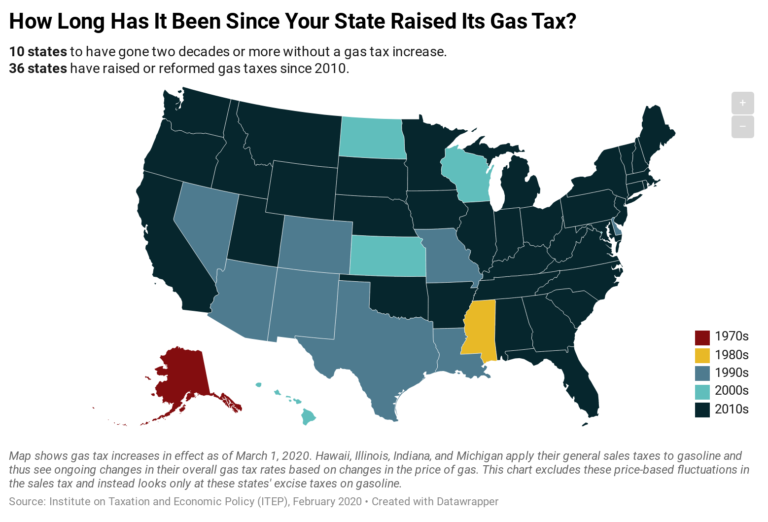
How Long Has It Been Since Your State Raised Its Gas Tax?
• By ITEP Staff
10 states to have gone two decades or more without a gas tax increase.
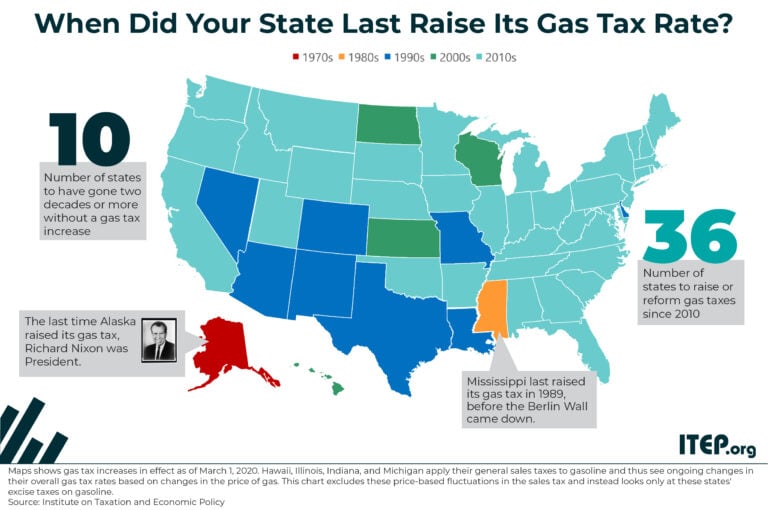
How Long Has It Been Since Your State Raised Its Gas Tax?
• By Carl Davis
Many state governments are struggling to repair and expand their transportation infrastructure because they are attempting to cover the rising cost of asphalt, machinery, and other construction materials with fixed-rate gasoline taxes that are rarely increased.
Bloomberg Tax: Mega-Rich and Plans to Tax Them Abound in Washington State
March 4, 2021
According to a Dec. 31 report from the bipartisan Tax Structure Work Group, the state’s system creates average tax burdens at 8.2% of total income for households with income between $17,000 and $30,000 a year, but the burden drops as incomes rise and is only 1.8% for households making more than $208,000. The Institute for […]
Florida Policy Institute: Florida Policymakers Need to Reassess How the Minimum Wage is Enforced
• By ITEP Staff
Finally, the state budget could take a hit if wage theft persists. Sales tax revenue as an effect of higher minimum wages is particularly relevant to highlight in Florida. The state lacks a personal income tax and over 75 percent of its general revenue fund is comprised of sales tax revenue. General revenue supports critical […]
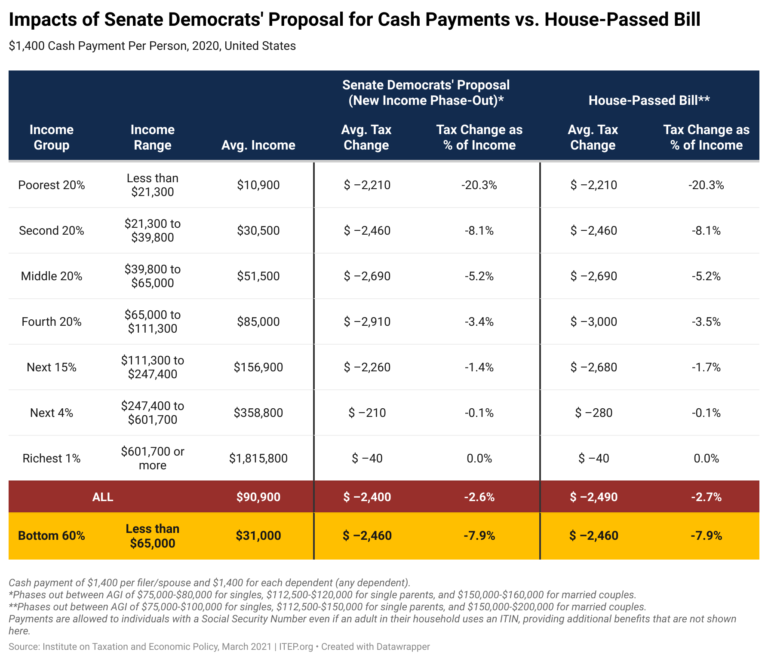
New Estimates on Senate’s Slightly Revised Cash Payment
• By Steve Wamhoff
As the Senate takes up the COVID relief bill passed by the House last week, Senate Democrats have proposed to lower the income level at which the $1,400 cash payments would be phased out. New estimates from ITEP demonstrate that, for most people, the change would make no difference.
Florida Policy Institute: State Resolution Could Result in $1.47 Billion in Lost Wages for Young Workers and Foregone Sales Tax Revenue for Florida
• By ITEP Staff
Florida, lacking a personal income tax, relies on sales tax revenue to support critical areas like education and health and human services. More than 75 percent of Florida’s General Revenue Fund, which finances most of these vital services, is comprised of sales tax revenue. Furthermore, Florida households are the highest contributors to sales tax collections, […]
Montana Budget & Policy Center: Policy Basics: Who Pays Taxes in Montana
• By ITEP Staff
Our tax dollars serve as shared investments in the programs and services that make our state a great place to live, work, and play. Tax dollars enable Montanans to work together for things we cannot achieve alone like a quality education for our children, the development and maintenance of infrastructure, public safety through police and […]

ITEP: Senate Should Pass Rescue Plan without Delay
• By Amy Hanauer
Senators and representatives can look to recent history—the 2007-2009 recession—for lessons on how to best address the current economic crisis. If we do too little, the economy will stay weak much longer, hurting all of us.

Senator Warren Introduces Federal Wealth Tax Legislation
• By Steve Wamhoff
With the onslaught of news about billionaire wealth soaring while low- and moderate-income families have trouble making ends meet, a federal wealth tax makes good economic and fiscal sense—and the public supports it. One poll found that 64 percent of respondents favor the idea, including a majority of Republicans.

How the Minimum Wage Is Becoming a Tax Issue for Congress
• By Steve Wamhoff
The federal minimum wage is almost comically low. At $7.25 an hour, it is 29 percent below its inflation-adjusted peak in the 1960s. Raising the minimum wage to $15 an hour would lift 900,000 Americans out of poverty. A solid 61 percent of voters support the idea. A majority of lawmakers in both the House and Senate support at least some version of a minimum wage hike. The popular $1.9 trillion American Rescue Plan includes…
Kansas Action for Children: Working Kansas Families Bear Brunt of Skewed Policies
• By ITEP Staff
In the midst of a global pandemic and recession, the Kansas Legislature shockingly continues to consider bills that will further lower the already low tax responsibilities of corporations and high-income Kansans. Lawmakers should reject legislation like Senate Bill 22 and instead work to enhance economic and racial equity through Kansas’s tax code. Our state’s leaders […]
Georgia Budget & Policy Institute: Georgia Tax Breaks Don’t Deliver
• By ITEP Staff
In addition to eroding the corporate income tax base and harming the state budget, in many cases, the state’s tax credit programs represent the transfer of Georgia taxpayer dollars to large out-of-state corporations and top income earners. Granting funds to corporations in this manner leaves less funding for schools, job training and health care programs […]

An Unequal Recession Will Breed Unequal Recovery Without Bold Investments
• By Stephanie Clegg
Without bold investments now, experts predict a longer, more unequal recovery. President Biden's American Rescue Plan, the framework for legislation expected to pass this week in the House, would boost economic well-being for those whose livelihoods were most affected by the pandemic-induced economic crisis.

Income Tax Discussion Continues in Alaska
• By Carl Davis
Alaska is notoriously reliant on tax and royalty revenue from oil to fund vital public services and institutions, but declining oil prices and production levels have rendered those revenues inadequate to meet the state’s needs. ITEP analysis of potential state income tax options in Alaska shows the potential to raise between $526 million and $696 million per year yet are quite modest compared to personal income tax structures in other states. When measured relative to…
Comparing Flat-Rate Income Tax Options for Alaska
• By Carl Davis
Alaska lawmakers are facing an unprecedented fiscal crisis. The state is more dependent than any other on oil tax and royalty revenues but declines in oil prices and production levels have sapped much of the vitality of these revenue sources. One way of diversifying the state’s revenue stream and narrowing the yawning gap between state revenues and expenses would be to reinstitute a statewide personal income tax. Alaska previously levied such a tax until 1980.…

Enacting a Federal Wealth Tax Is Playing the Long Game
• By Steve Wamhoff
Should lawmakers enact laws that they believe are sensible and constitutional, or should they shape their legislative agenda around what they believe ideological Supreme Court justices will allow? This is a dilemma facing Americans who support a federal wealth tax.

EITC Enhancements for States to Consider in 2021
• By Aidan Davis
While the federal EITC provides a great deal of support for families with children, its impact is limited for those without children or who are not raising children in their homes. Childless workers under 25 and over 64 have for far too long received no benefit from the federal credit. And workers aged 25 to 64 have received very little value from the existing credit (the maximum credit is much smaller and the income limits…
Kentucky Center for Economic Policy: 10 Ways the Kentucky General Assembly Can Advance Race Equity and Shared Prosperity
• By ITEP Staff
HB 356, sponsored by Rep. Lisa Willner, would go a significant way toward cleaning up Kentucky’s tax code of the many tax breaks that benefit wealthy, predominately white Kentuckians — and would raise over $1 billion in needed revenue annually to invest in equitable and prosperous Kentucky communities. Currently, the state’s tax system plays an […]
Washington State Budget & Policy Center: Washington State’s Upside-down Tax Code is Even More Racist than You Think
• By ITEP Staff
Lawmakers in Olympia are finally listening to communities and rightly focusing on addressing racial disparities that have permeated our state economy and institutions for far too long. They must act immediately to reform many areas of public policy – from policing to housing, health care to employment – that serve to oppress Black, Indigenous, and […]
Washington Post: Drug Companies Seek Billion-dollar Tax Deductions from Opioid Settlement
February 12, 2021
“A settlement has not been reached, and, therefore, we applied significant judgment in estimating the ultimate amount of the opioid litigation settlement that would be deductible,” the company said. Matthew Gardner, a senior fellow at the nonprofit Institute on Taxation and Economic Policy, said these disclaimers suggest the companies are making conservative estimates. “That’s one […]

Institute on Taxation
and Economic Policy
ITEP is a non-profit, non-partisan tax policy organization. We conduct rigorous analyses of tax and economic proposals and provide data-driven recommendations to shape equitable and sustainable tax systems.
Subscribe to ITEP Emails
Tax research and policy news in your inbox.
Promote Fair Tax Policy
Your gift to ITEP promotes tax justice. With your help, we do research that supports taxing millionaires and billionaires, taxing big corporations and raising revenue for the things our people, our communities and our planet need.
Together, we can create a country with more economic justice, more racial justice, more climate justice… and more tax justice.