
Iowa
Public Loss Private Gain: How School Voucher Tax Shelters Undermine Public Education
May 17, 2017 • By Carl Davis, Sasha Pudelski

One of the most important functions of government is to maintain a high-quality public education system. In many states, however, this objective is being undermined by tax policies that redirect public dollars for K-12 education toward private schools.
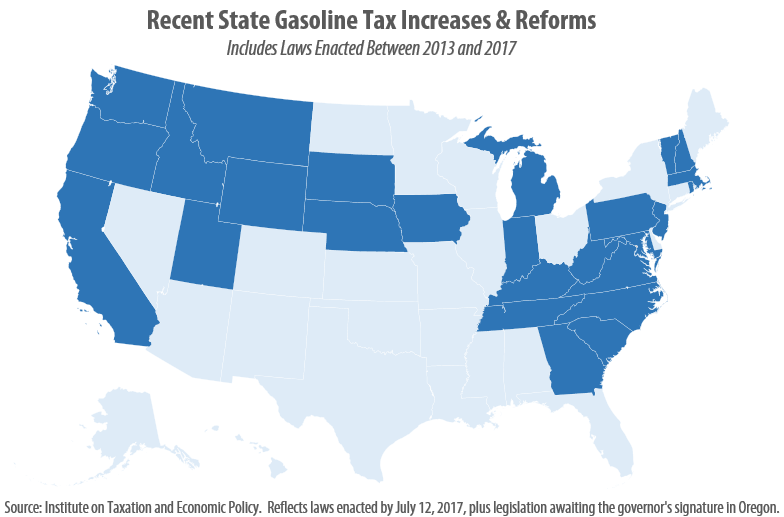
This post was updated July 12, 2017 to reflect recent gas tax increases in Oregon and West Virginia. As expected, 2017 has brought a flurry of action relating to state gasoline taxes. As of this writing, eight states (California, Indiana, Montana, Oregon, South Carolina, Tennessee, Utah, and West Virginia) have enacted gas tax increases this year, bringing the total number of states that have raised or reformed their gas taxes to 26 since 2013.
Time to Repeal State Deductions for Federal Income Taxes
May 1, 2017 • By Dylan Grundman O'Neill
Three of the biggest needs facing state policymakers right now are new revenues to fund their priorities in the face of budget shortfalls and federal funding cuts, ways to insulate those revenue streams from unpredictable tax changes at the federal level, and approaches to meet these needs without leaning even more heavily on low- and […]
Why States That Offer the Deduction for Federal Income Taxes Paid Get It Wrong
May 1, 2017 • By Dylan Grundman O'Neill
With many states currently facing budget shortfalls—whether due to weak economic recovery after the Great Recession, struggling commodity prices, or self-inflicted tax cuts—and all states bracing for possible federal budget cuts in areas from education to health care to infrastructure, states are unlikely to be able to continue providing high-quality services to their residents without raising new revenue. In this context, states must find ways to generate additional revenue without increasing taxes on individuals and families who are already struggling to make ends meet and may bear the biggest brunt of federal funding cuts.
3 Percent and Dropping: State Corporate Tax Avoidance in the Fortune 500, 2008 to 2015
April 27, 2017 • By Aidan Davis, Matthew Gardner, Richard Phillips
The trend is clear: states are experiencing a rapid decline in state corporate income tax revenue. Despite rebounding and even booming bottom lines for many corporations, this downward trend has become increasingly apparent in recent years. Since our last analysis of these data, in 2014, the state effective corporate tax rate paid by profitable Fortune 500 corporations has declined, dropping from 3.1 percent to 2.9 percent of their U.S. profits. A number of factors are driving this decline, including: a race to the bottom by states providing significant “incentives” for specific companies to relocate or stay put; blatant manipulation of…
State Rundown 4/12: Season in Transition as Some States Close, Others Open Tax Debates
April 12, 2017 • By ITEP Staff
This week in state tax news we see Louisiana‘s session getting started, budgets passed in New York and West Virginia, Kansas lawmakers taking a rest after defeating a harmful flat tax proposal, and Nebraska legislators preparing for full debate on major tax cuts. Nevada lawmakers may make tax decisions related to tampons, diapers, marijuana, and […]
State Rundown 3/29: More States Looking to Raise or Protect Revenues Amid Fiscal and Federal Uncertainty
March 29, 2017 • By ITEP Staff
This week we see West Virginia, Georgia, Minnesota, and Nebraska continue to deliberate regressive tax cut proposals, as the District of Columbia considers cancelling tax cut triggers it put in place in prior years, and lawmakers in Hawaii, Washington, Kansas, and Delaware ponder raising revenues to shore up their budgets. Meanwhile, gas tax debates continue […]
State tax debates have been very active this week. Efforts to eliminate the income tax continue in West Virginia. Policymakers in many states are responding to revenue shortfalls in very different ways: some in Iowa, Mississippi, and Nebraska seek to dig the hole even deeper with tax cuts, while the Missouri House’s response has been […]
This week brings more news of states considering reforms to their consumption taxes, on everything from gasoline in South Carolina and Tennessee, to marijuana in Pennsylvania, to groceries in Idaho and Utah, and to practically everything in West Virginia. Meanwhile, the fiscal fallout of Kansas’s failed ‘tax experiment’ has new consequences as the state’s Supreme […]
Undocumented Immigrants’ State & Local Tax Contributions
March 1, 2017 • By Lisa Christensen Gee, Meg Wiehe, Misha Hill
Public debates over federal immigration reform, specifically around undocumented immigrants, often suffer from insufficient and inaccurate information about the tax contributions of undocumented immigrants, particularly at the state level. The truth is that undocumented immigrants living in the United States paybillions of dollars each year in state and local taxes. Further, these tax contributions would increase significantly if all undocumented immigrants currently living in the United States were granted a pathway to citizenship as part of comprehensive immigration reform. Or put in the reverse, if undocumented immigrants are deported in high numbers, state and local revenues could take a substantial…
This week we are following a number of significant proposals being debated or introduced including reinstating the income tax in Alaska and eliminating the tax in West Virginia, establishing a regressive tax-cut trigger in Nebraska, restructuring the Illinois sales tax, moving New Mexico to a flat income tax and broader gross receipts tax, and updating […]
What to Watch in the States: Further Attempts to Weaken or Eliminate Progressive Taxes
February 2, 2017 • By Aidan Davis
This is the third installment of our six-part series on 2017 state tax trends. The introduction to this series is available here. As we described last week, many states are gearing up for challenging budget debates this year. But the need to address revenue shortfalls has not stopped lawmakers in many states from pursuing harmful […]
Below is a list of notable resources for information on state taxes and revenues: Alabama Alabama Department of Revenue Alabama Department of Finance – Executive Budget Office Alabama Department of Revenue – Tax Incentives for Industry Alabama Legislative Fiscal Office Alaska Alaska Department of Revenue – Tax Division Alaska Office of Management & Budget Alaska […]
And Then There Were Six: Amazon Expands Its Sales Tax Collection
January 30, 2017 • By Carl Davis
UPDATE: After this post was published, Amazon announced that it will begin collecting sales tax in Oklahoma on March 1. This post has been updated to reflect this development. The nation’s largest Internet retailer has made an about-face on its sales tax policy, making consumers’ ability to evade sales tax on online purchases a little […]
Since the 2007-2009 economic crisis, rising income inequality and the role our public policies play in aiding or easing this trend have been an ongoing part of the public discourse. In spite of what we know about the growing gap between the rich and the rest of us, federal and state policymakers continue to sell […]
This week brings more news of states facing budget crunches, a new state looking to eliminate income taxes, and plans to raise gas taxes to fund transportation projects. Be sure to check out the What We’re Reading section for a look at how repealing federal health reform could add to those crunches and a review […]
State Rundown 1/11: State Legislative Sessions Kick Off Amid Uncertainty
January 11, 2017 • By ITEP Staff
This week brings still more states looking for solutions to revenue shortfalls, multiple governors’ State of The State addresses, important reading on counter-transparency and local-preemption efforts, and more. — Meg Wiehe, ITEP State Policy Director, @megwiehe A Nebraska legislator this week diagnosed the state’s $900 million revenue shortfall in plain terms, describing it as “self-inflicted […]
Iowa Fiscal Partnership: Understanding Iowa Taxes
January 10, 2017
The Iowa Fiscal Partnership is pleased to distribute a new report by the Institute on Taxation and Economic Policy: The ITEP Guide to Fair State and Local Taxes. We hope you will find this useful in understanding and evaluating state and local tax policy. Many of the general tax principles and issues presented in the […]
State Rundown 1/4: Revenue Shortfalls, Gas Tax Changes Dominate Early Debates
January 4, 2017 • By ITEP Staff
This week we bring you updates on major revenue shortfalls looming in Nebraska, Oklahoma, and Pennsylvania, as well as gas tax changes taking effect in some states and being debated in others. — Meg Wiehe, ITEP State Policy Director, @megwiehe Oklahoma lawmakers are weighing options to close the state’s $870 million shortfall. Up for discussion are […]
For much of the last century, estate and inheritance taxes have played an important role in fostering strong communities by promoting equality of opportunity and helping states adequately fund public services. While many of the taxes levied by state and local governments fall most heavily on low-income families, only the very wealthy pay estate and inheritance taxes. Changes in the federal estate tax in recent years, however, caused states to reevaluate the structure of their estate and inheritance taxes. Unfortunately, the trend of late among states has tended toward weakening or completely eliminating them. But this need not be so;…
Yahoo! Finance: New Jersey just hiked its gas tax by 159%. Is your state next?
November 7, 2016
“Of course, New Jersey isn’t the only state that has or is toying with raising gasoline taxes. Georgia, Idaho, Iowa, Kentucky, Michigan, Nebraska, North Carolina, South Dakota, Utah, and Washington upped their gas taxes in 2015, notes the Institute on Taxation and Economic Policy. Louisiana, Tennessee, Alaska, Alabama and Minnesota are contemplating increases in 2017.” […]
This report explains the workings, and problems, with state-level tax subsidies for private K-12 education. It also discusses how the Internal Revenue Service (IRS) has exacerbated some of these problems by allowing taxpayers to claim federal charitable deductions even on private school contributions that were not truly charitable in nature. Finally, an appendix to this report provides additional detail on the specific K-12 private school tax subsidies made available by each state.
Iowa Policy Project: $8.9 million revenue boost with immigration reform
April 6, 2016
“A new report projects a 24 percent increase in state and local tax revenues from undocumented immigrants in Iowa if they were granted permanent legal residence.” Read full report
Undocumented Immigrants’ State & Local Tax Contributions (2016)
February 24, 2016 • By Lisa Christensen Gee, Meg Wiehe
This report was updated in March 2017 Read as a PDF. (Includes Full Appendix of State-by-State Data) Report Landing Page Public debates over federal immigration reform often suffer from insufficient and inaccurate information about the tax contributions of undocumented immigrants particularly at the state level. The truth is that undocumented immigrants living in the United […]
American Press: Lawmakers examine income tax
February 22, 2016
“Three identical measures would allow voters to decide whether they want to eliminate the federal income tax deduction that is allowed on state income tax forms. The deduction is in the constitution. The change would raise $748 million annually, and the vote to decide the issue would take place Nov. 8. Only three states — […]
