
2,364 posts

ICYMI: A Brief Summary of Our March Blogs and Reports
• By ITEP Staff
This month in tax policy news: Corporate profits soar while corporate tax collections plummet. Also inside: A look at regressive state tax policies and progressive remedies and the continued unpackaging of the Tax Cuts and Jobs Act. It's ITEP's March 2019 Monthly Digest.

The Trump Tax Law Further Tilted an Already Uneven Playing Field
• By Jessica Schieder
Proponents sold the Tax Cuts and Jobs Act (TCJA) as a way to spur new investment, increase workers’ paychecks, and reverse the off-shoring of jobs. Testimony presented during a House Ways and Means hearing held today reflected on how—more than a year after the law’s passage—each of those pitches ring hollow.
Policy Matters Ohio: Senate Transportation Budget Zeroes Out Public Transit, Slightly Improves EITC
• By ITEP Staff
Last week, the Ohio Senate took a leap backwards by removing $100 million for public transit from the Transportation Budget allocated by the Ohio House of Representatives. They also took small steps to otherwise improve equity by expanding Ohio’s Earned Income Tax Credit. Read more
Corporate Profits ?, Corporate Federal Tax Collections ?
• By Matthew Gardner
Data released Friday by the U.S. Treasury Department should give great pause to all who care about the federal government’s ability to raise revenue in a fair, sustainable way. In the wake of the 2017 corporate tax overhaul, corporate tax collections have fallen at a rate never seen during a period of economic growth.
Unfair State Tax Codes Also Exacerbate Racial Inequity
• By Misha Hill
A 2019 ITEP analysis found that Black and Latinx households are overrepresented in the lowest-income quintiles; while they represent about 22 percent of overall tax returns, they account for 30 percent of the poorest quintile of taxpayers.
North Carolina Justice Center: Higher Rates on Higher Income: Why a Graduated Income Tax is Good Policy for North Carolina
• By ITEP Staff
At the same time, a graduated rate structure — in contrast with the state’s current flat tax rate on income — can make more revenue available for key public investments, generating broad-based benefits to many people and communities. It is also better able to keep up with the needs of a growing state. That is […]

Rep. Doggett and Sen. Whitehouse Reintroduce Bill to End Offshore Tax Avoidance
• By Lorena Roque
On Thursday, Representative Lloyd Doggett and Senator Sheldon Whitehouse announced that they are reintroducing the “No Tax Breaks for Outsourcing Act.” Our international corporate tax rules have been a mess for a long time, and Tax Cuts and Jobs Act (TCJA) failed to resolve the problems. The old rules and the new rules under TCJA both tax offshore corporate profits more lightly than domestic corporate profits, but in different ways. The No Tax Breaks for…

State Millionaires’ Taxes Can Advance Racial Justice
• By ITEP Staff
Millionaires’ taxes can help address this problem. They can raise substantial revenue for public services by asking more of those at the top, a group that’s disproportionately white. White families are three times likelier than Black and Latinx families to be in the top 1 percent, according to a report by Prosperity Now and the Institute on Taxation and Economic Policy.
Policy Matters Ohio: Loopholes Upon Loopholes
• By ITEP Staff
As noted, of the three deductions, by far the most taxpayers took advantage of the deduction for self-employment taxes. The Institute on Taxation and Economic Policy, which has a model of the federal and Ohio tax systems, roughly estimates that 330,000 of the Ohio taxpayers who had business income and took the self-employment tax deduction […]
Gov. Pritzker’s Tax Proposal Is a Huge Step Toward Fairer Taxes
• By Lisa Christensen Gee
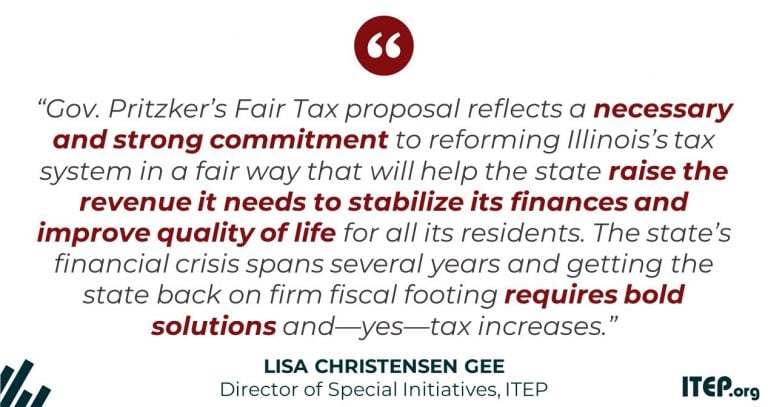
Gov. Pritzker’s Fair Tax proposal reflects a necessary and strong commitment to reforming Illinois’s tax system in a fair way that will help the state raise the revenue it needs to stabilize its finances and improve quality of life for all its residents. The state’s financial crisis spans several years and getting the state back on firm fiscal footing requires bold solutions and—yes—tax increases.
How State Tax Systems Worsen the Economic Divide – in Charts
• By Carl Davis
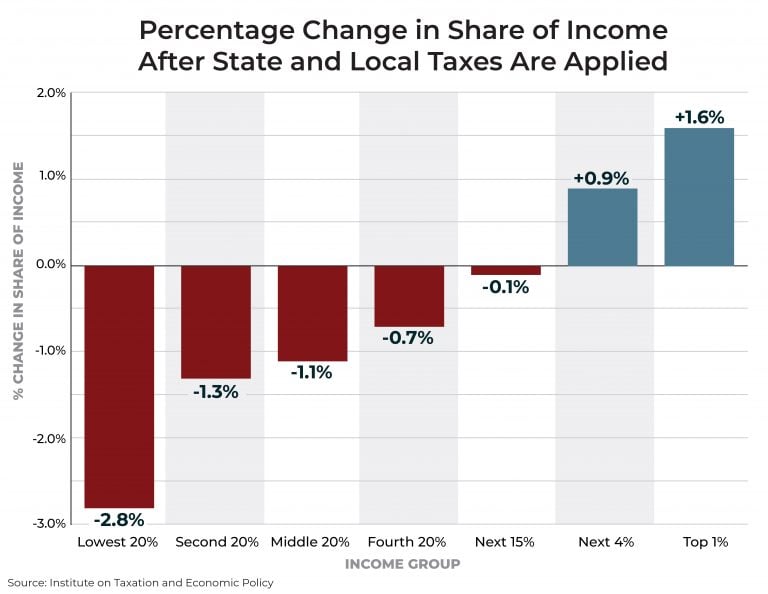
The nation is currently engaging in serious discourse about how to expand economic opportunity and remedy income inequality via the federal tax code. State tax systems are also important and have a dismal effect on the growing economic divide. In a new report, Fairness Matters: A Chart Book on Who Pays State and Local Taxes, we further parse our Who Pays? data.
Fairness Matters: A Chart Book on Who Pays State and Local Taxes
• By ITEP Staff
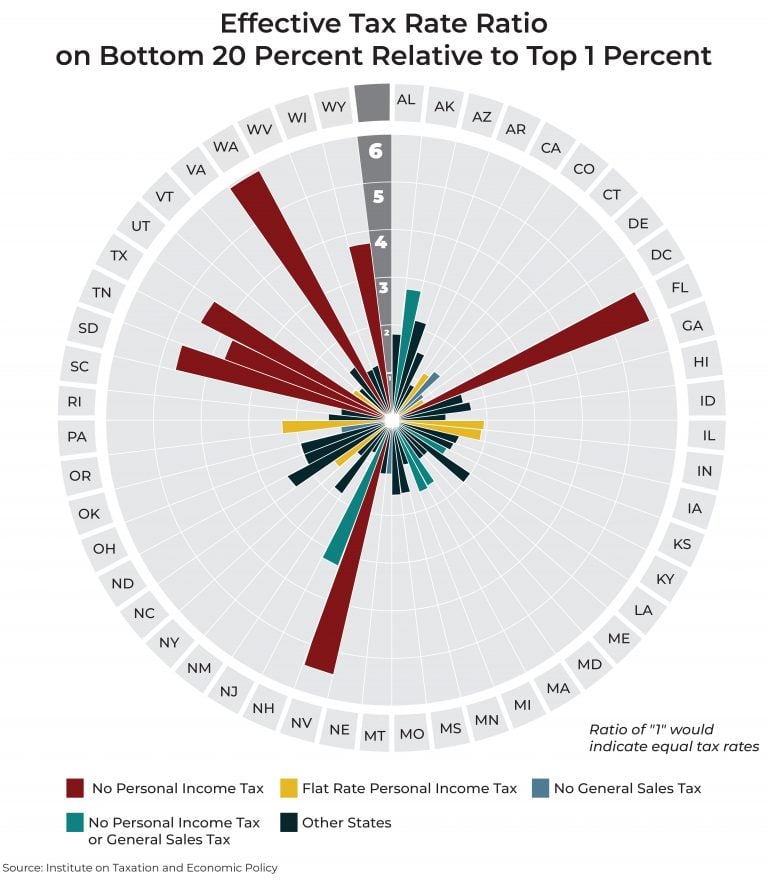
There is significant room for improvement in state and local tax codes. State tax codes are filled with top-heavy exemptions and deductions and often fail to tax higher incomes at higher rates. States and localities have come to rely too heavily on regressive sales taxes that fail to reflect the modern economy. And overall tax collections are often inadequate in the short-run and unsustainable in the long-run. These types of shortcomings provide compelling reason to…
Georgia Budget and Policy Institute: Georgia Work Credit Grows the Middle Class
• By ITEP Staff
A non-refundable Georgia Work Credit would cut state taxes for more than 700,000 lower and middle-income households by up to $475. The Institute on Taxation and Economic Policy estimates that adopting this policy would be equivalent to investing $130 million annually in Georgia families. Read more here
Education Department Tax Credit Proposal Would Undermine Public Schools
• By Carl Davis
The Education Department today announced a proposed new federal tax credit for so-called school choice. The $5 billion proposal would give those who donate to private school voucher programs a tax credit. Following is a statement by Carl Davis, research director at the Institute on Taxation and Economic Policy.


Public News Service: Could Fast-Moving Tax-Cut Proposal Blow WV Budget?
• By ITEP Staff
House Bill 3137 would create a fund where new money, including out-of-state online sales taxes, would go. Then, each time that fund reached a certain level, it would trigger compounding cuts in state income taxes. Ted Boettner, executive director of the West Virginia Center on Budget and Policy, said some lawmakers may not realize they […]

Overdue Gas Tax Hikes are Back on the Agenda in Statehouses
• By Carl Davis
State tax policy can be a contentious topic, but one issue on which lawmakers largely agree is that higher gas tax rates are necessary to keep our nation’s infrastructure operating safely and efficiently. Lawmakers in 27 states have approved gas tax increases since 2013.

Chicago Resilient Families Task Force: Big Shoulders, Bold Solutions: Economic Security for Chicagoans
• By ITEP Staff
People with low and middle-incomes are financially savvy in ways that are often underestimated, but despite this are on thin ice financially. Despite doing all the right things, they are caught in a trap that is very hard to escape. Wages are falling behind and jobs are increasingly structured in ways that foster precariousness instead […]
West Virginia Center on Budget & Policy: House Income Tax Cut Plan Mostly Benefits Wealthy and Puts Large Holes in the State Budget (HB 3137)
• By ITEP Staff
According to the Institute on Taxation and Economic Policy, a one-percentage reduction in each personal income tax rate would give a West Virginian with an income between $36,000 and $56,000 an average tax cut of $231 compared to $6,044 for someone in the top 1 percent with an income of above $451,000. This means someone […]
Bloomberg: Amazon Doesn’t Plan to Pay the IRS Anything This Tax Season
February 22, 2019
The fact that Amazon can legally reduce its tax bill to nothing calls into question the effectiveness of the code, said Matthew Gardner, a senior fellow at the Institute of Taxation and Economic Policy. While those breaks have the backing of Congress and were implemented for some social or economic policy goal, they might be […]
InsideSources: Amazon Paid Zero Corporate Taxes Last Year. Why Aren’t 2020 Democrats Talking About It?
February 22, 2019
“I blame Congress,” says Matt Gardner, a senior fellow at the Institute on Taxation and Economic Policy which first released the news of Amazon’s zero corporate tax bill. “Unless we see the actual tax returns, nobody can say exactly how Amazon avoided paying any corporate income taxes, but the available information makes it clear that […]
Financial Post: Lawrence Solomon: Amazon Is Fleecing Taxpayers. Strangely, Socialists Are the Ones Saving Us
February 22, 2019
According to the non-partisan Institute on Taxation and Economic Policy, while profitable major corporations have paid an average of over 21 per cent in federal taxes, over the last 10 years Amazon’s use of tax loopholes has lowered its average to just three per cent. In the last two years, during which it earned US$16.8 billion in profits, it paid no federal income tax at all, thanks to its use of unspecified tax credits and…
The Guardian: Why Didn’t Amazon Pay Federal Taxes for the Second Consecutive Year?
February 22, 2019
Amazon is already getting plenty of benefits from the federal government. The company nearly doubled its profits to $11.2bn in 2018 from $5.6bn the year before and, for the second year running didn’t pay a single cent of federal income tax. In fact, Amazon reported a federal income tax rebate for the past two years totalling almost $270m according to the Institute on Taxation and Economic Policy analysis of Securities and Exchange Commission filings. Netflix…
Irish Examiner: New EU Competition Commissioner Must Take on US Tech Giants, Says ISME
February 21, 2019
“The Institute on Taxation and Economic Policy report in Washington DC has noted that Amazon enjoyed a negative tax rate in the US in 2018. That is not a misprint. “On $10.8bn of US profits in 2018, Amazon got a tax rebate of $130m, equivalent to an effective tax rate of -1.2%.” Mr McDonnell concluded: […]
Think Progress: U.S. Banks Raked in Record Profits Thanks to GOP Tax Bill
February 21, 2019
Because of the corporate tax cut, massive corporations like Amazon, which is valued at nearly $800 billion, will pay $0 in federal taxes this year. In fact, the company is expecting a federal refund of nearly $129 billion. This essentially puts Amazon at a federal income tax rate of -1 percent this year, after paying a federal rate of more than 11 percent from 2011 to 2016. This is the second year in a row…

Institute on Taxation
and Economic Policy
ITEP is a non-profit, non-partisan tax policy organization. We conduct rigorous analyses of tax and economic proposals and provide data-driven recommendations to shape equitable and sustainable tax systems.
Subscribe to ITEP Emails
Tax research and policy news in your inbox.
Promote Fair Tax Policy
Your gift to ITEP promotes tax justice. With your help, we do research that supports taxing millionaires and billionaires, taxing big corporations and raising revenue for the things our people, our communities and our planet need.
Together, we can create a country with more economic justice, more racial justice, more climate justice… and more tax justice.