
Blog
569 posts
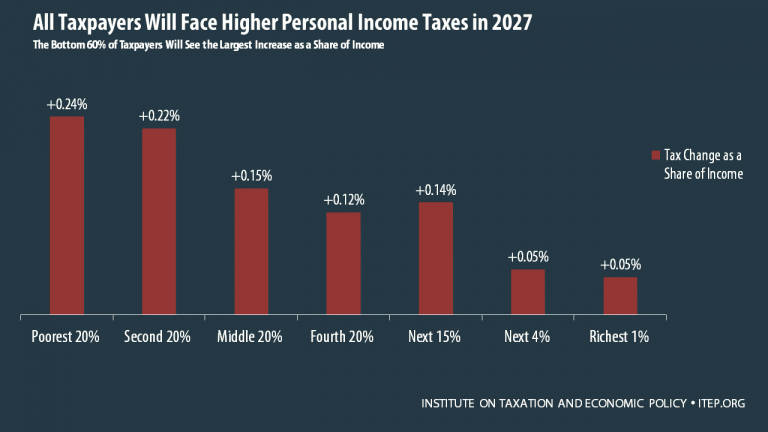
Chained CPI Would Raise Everyone’s Personal Income Taxes in the Future, Would Hurt the Poor Right Away
• By Steve Wamhoff
One of the findings is that every income group would face higher personal income taxes in years after 2025 (including 2027). Chained CPI would gradually push taxpayers into higher income tax brackets and make the standard deduction, the Earned Income Tax Credit, and several other breaks less generous over time. The switch to chained CPI would cause some low-income people to face a tax hike starting in 2019, the second year the plan would be…
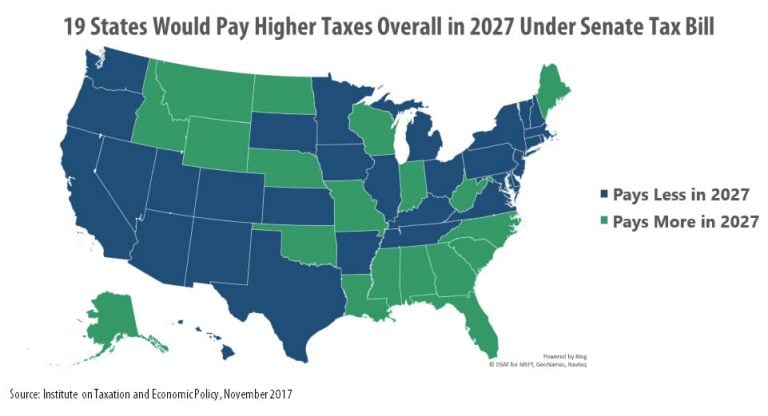
Mick Mulvaney and the 19 States Paying Higher Taxes Under the Senate Tax Bill
• By Steve Wamhoff
One of the more surprising findings of ITEP’s recent estimates on the Senate tax bill is that 19 states would pay more overall in federal taxes if the bill becomes law. This is not just an increase in the personal income taxes paid (which would happen in some states under the House bill). This is an increase in their net federal taxes overall, even including the assumed benefits of corporate tax cuts and estate tax…

The Senate Tax Plan’s Big Giveaway to Multinational Corporations
• By Richard Phillips
Instead of addressing the hundreds of billions in lost federal tax revenue due to offshore tax avoidance schemes, the Senate tax bill would forgive most of the taxes owed on these profits and open the floodgates to even more offshore profit-shifting in the future.

The Bottom 40 Percent Has Grown Poorer, So Why Are Tax Cut Plans Focused on the Rich and Corporations?
• By Jenice R. Robinson
The bottom line is that the rich and corporations are doing fine. We don’t need legislative solutions that fix non-existent problems. Only in a world of alternative facts does the top 0.2 percent of estates need to be exempt from the estate tax, for example.

Shopping for a Tax Haven: How Nike and Apple Accelerated Their Tax Avoidance Strategies, according to the Paradise Papers
• By Steve Diese
A year and a half after the release of the Panama Papers, a new set of data leaks, the Paradise Papersreleased by the International Consortium of Investigative Journalists (ICIJ) provides important new information on the tax dodging of wealthy individuals as well as multinational corporations.
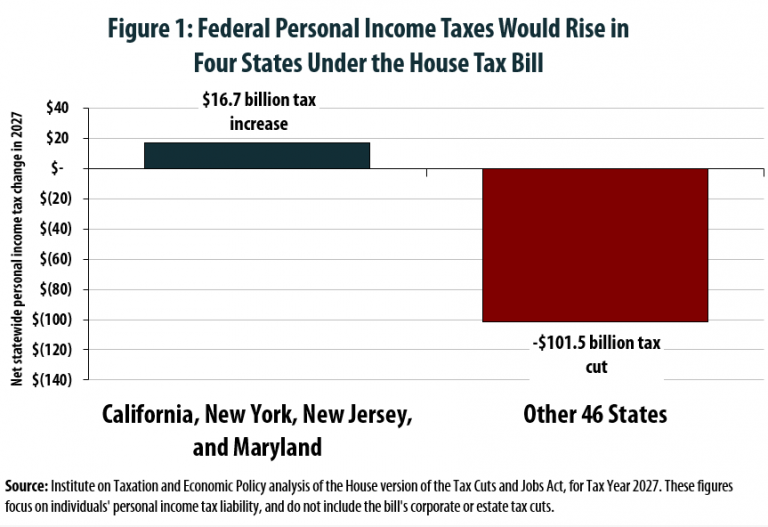
House Tax Plan Offers an Exceptionally Bad Deal for California, New York, New Jersey, and Maryland
• By Carl Davis
An ITEP analysis reveals that four states would see their residents pay more in aggregate federal personal income taxes under the House’s Tax Cuts and Jobs Act. While some individual taxpayers in every state would face a tax increase, only California, New York, Maryland, and New Jersey would see such large increases that their residents’ overall personal income tax payments rise when compared to current law.

House Tax Bill Would Put Property Tax Deduction Out of Reach for Most Households
• By ITEP Staff
The House of Representatives is expected to vote this week on a bill that would reduce federal revenues by roughly $1.5 trillion over the next decade. Despite the bill’s high price tag, many households would pay more in federal tax if the bill is enacted, in large part because it slashes the deduction for state […]

Flawed Data from House Leadership Attempts to Hide Tax Hikes Under Proposal
• By Carl Davis
In a story published yesterday evening, Politico reported that House leaders have been “working to create customized data models” to show lawmakers that their constituents will not face a tax increase under the tax bill being debated in the House. On this point, House leaders have taken on an impossible task.

House Tax Plan Would Make Offshore Tax Avoidance Substantially Worse
• By Richard Phillips
The Sunday release of the Paradise Papers has once again brought the issue of offshore tax avoidance to the forefront of public discussion. The papers expose the complex structures that companies such as Apple and Nike have pursued in recent years to pay little to nothing in taxes on their offshore earnings. Yet even as these revelations make headlines, House Republicans are moving forward with major tax legislation, the Tax Cuts and Jobs Act, that…
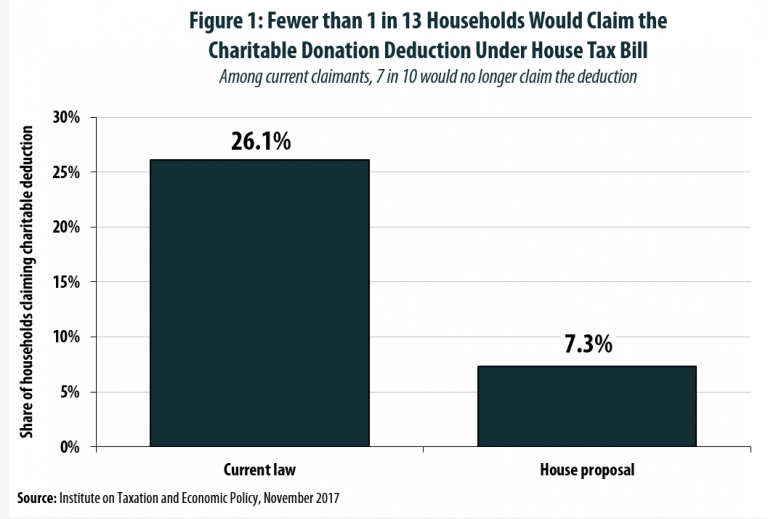
House Tax Bill Would Reserve Charitable Giving Subsidies for a Small Subset of Wealthier Households
• By Carl Davis, Steve Wamhoff
In the tax policy framework released in September, President Trump and Congressional leadership insisted that their proposal would retain the tax incentive for donating to charity because doing so helps “accomplish important goals that strengthen civil society, as opposed to dependence on government.” Now that the House has released a more detailed proposal, it is finally possible to evaluate exactly how their plans would impact the incentive to donate to charity.
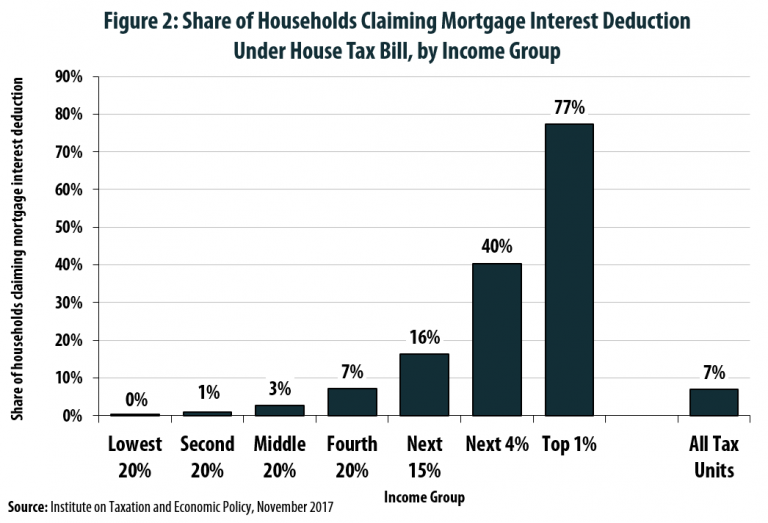
Mortgage Interest Deduction Wiped Out for 7 in 10 Current Claimants Under House Tax Plan
• By Carl Davis, Steve Wamhoff
Throughout the ongoing federal tax debate, President Trump and Congressional leadership have insisted that while many tax deductions and credits would be wiped out, the mortgage interest deduction would be spared from the chopping block. But while the proposal recently unveiled by House leaders retains the mortgage interest deduction on paper, the actual substance of this policy would be nearly unrecognizable to today’s homeowners.
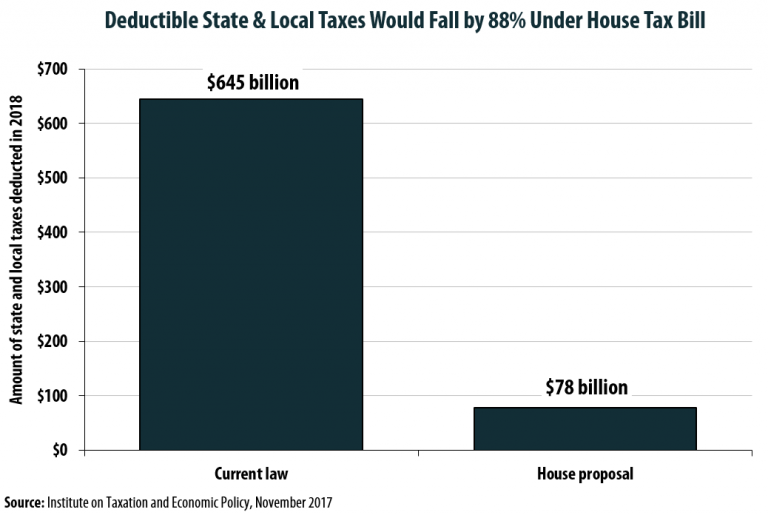
House Plan Slashes SALT Deductions by 88%, Even with $10,000 Property Tax Deduction
• By Carl Davis, Steve Wamhoff
One of the most contentious issues in the current federal tax debate is over what to do with the deduction for state and local taxes paid (the SALT deduction). Since the deduction’s benefits vary by state, the House proposal to drastically scale it back has led to an outcry among lawmakers from states such as New York, New Jersey, and California whose constituents would be impacted most dramatically by the change. In an attempt to…
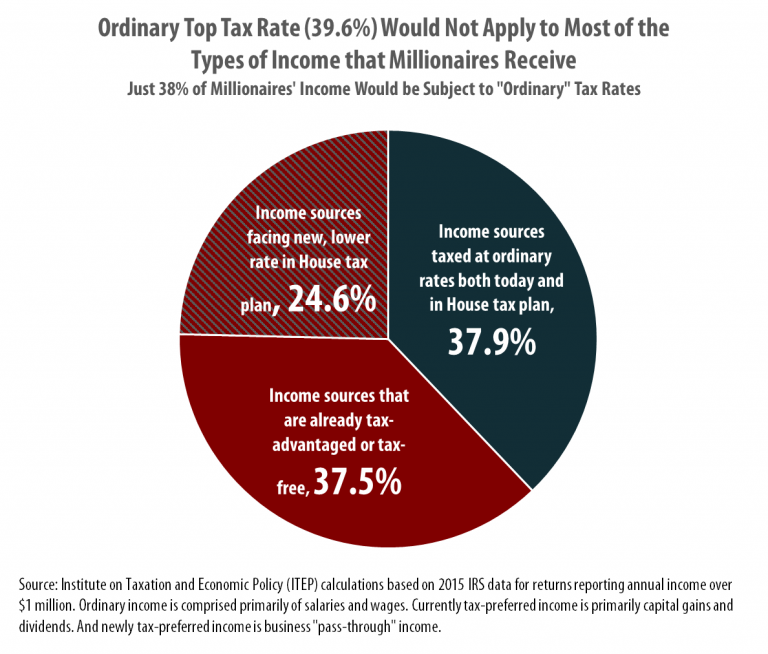
House Tax Plan Will Keep 39.6% Top Rate, But That Won’t Matter for Most Types of Income Going to the Rich
• By Carl Davis
In recent days, news that House tax writers will not seek to cut the top personal income tax rate below 39.6 percent on taxable income above $1 million has led some to question whether the newest iteration of the Trump-GOP tax plan will provide a major windfall to the wealthy—a fact that has so far been widely understood. Unfortunately, this second-guessing is unnecessary.

The Manufacturing Deduction Is a Case Study in Tax Policy Gone Wrong
• By Richard Phillips
When you think of manufacturing, what comes to mind? According to the U.S. Congress, manufacturing may include things like the production of wrestling-rated films, assembling bouquets of flowers and even slicing cheesecake. These unusual definitions of manufacturing come from the domestic production activities deduction (better known as the manufacturing deduction), a tax break Congress created to encourage manufacturing in the United States.

The Framework’s Tax Increases and Tax Cuts by State
• By Steve Wamhoff
As our report on the Trump-GOP tax framework explained, in nine states plus the District of Columbia, more than a fifth of households would pay higher taxes under the framework.

GOP Tax Plan Will Mainly Benefit Millionaires Even If Top Rate Remains 39.6 Percent
• By Steve Wamhoff
The Trump-GOP taxframework would reduce the top personal income tax rate from 39.6 percent to 35 percent, but now lawmakers are discussing keeping the top personal income tax rate at 39.6 percent for those with taxable income of more than $1 million. This modification would barely change the proposal’s overall impact.

The Jig Is Up: Republican Budget Resolution Finally Admits That Deficit Will Soar Under GOP Tax Plan
• By Alan Essig
For some lawmakers, annual deficits matter a lot—unless the nation is paying for tax cuts for the wealthy via deficit spending. Last night, Republican lawmakers demonstrated that previous grandstanding about the nation’s debt is much ado about nothing. The Senate approved a budget resolution on a party-line vote that would 1. fast-track legislation adding $1.5 trillion to the deficit over 10 years by cutting taxes, and 2. make it easy to enact this measure without…

The Dishonest Pitch for Trump-GOP Tax Cuts
• By Richard Phillips
Real tax reform would mean raising more revenue to make public investments and increasing the progressivity of the tax code. Many conservatives strongly disagree with this and insist that a substantial tax cut for the wealthiest Americans will grow the economy. Rather than engage in this policy debate based on policy ideals and principles, President Trump, other White House officials and GOP leaders have peppered their sales pitch for tax cuts with false claims about…

The Corporate Tax Code is in Dire Shape, But Trump-GOP Plan Would Make It Worse
• By Richard Phillips
Just how bad has the corporate tax code gotten? The newest edition of Offshore Shell Games, a joint report by the Institute on Taxation and Economic Policy (ITEP) and U.S. PIRG, outlines the massive scale of the offshore tax avoidance undertaken by U.S. multinationals. It’s well known that Fortune 500 companies have accumulated a stash of $2.6 trillion in earnings offshore, which has allowed them to avoid an estimated $752 billion in taxes.
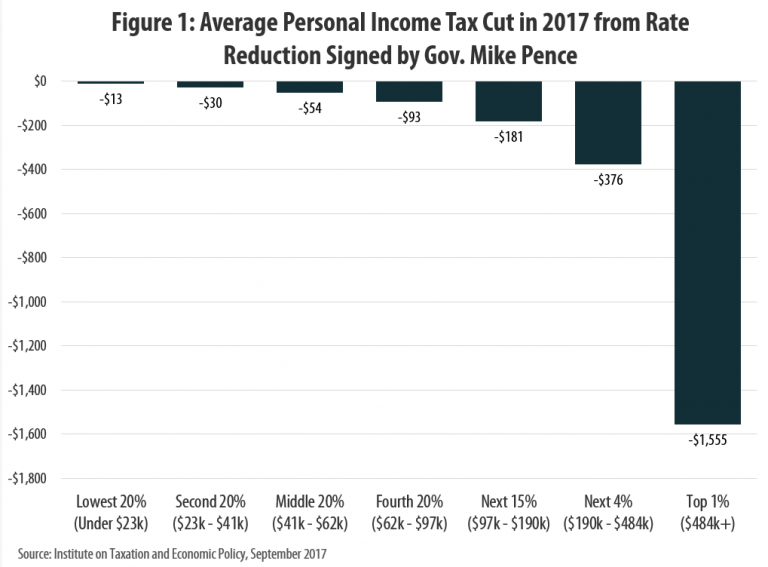
Indiana’s Tax Cuts Under Mike Pence Are Not a Model for the Nation
• By Carl Davis
In announcing a new tax cut framework this week in Indianapolis that was negotiated with House and Senate leaders, President Trump claimed that “Indiana is a tremendous example of the prosperity that is unleashed when we cut taxes and set free the dreams of our citizens …. In Indiana, you have seen firsthand that cutting taxes on businesses makes your state more competitive and leads to more jobs and higher paychecks for your workers.”

Poverty is Down, But State Tax Codes Could Bring It Even Lower
• By Misha Hill
The U.S. Census Bureau released its annual data on income, poverty and health insurance coverage this week. For the second consecutive year, the national poverty rate declined and the well-being of America’s most economically vulnerable has generally improved. In 2016, the year of the latest available data, 40.6 million (or nearly 1 in 8) Americans were living in poverty.

Census Data Reveal Modest Gains for Working People; GOP Tax Overhaul Could Reverse These Gains
• By Jenice R. Robinson
On the surface, census poverty and income data released Tuesday reveal the nation’s economic conditions are improving for working families. The federal poverty rate declined for the second consecutive year and is now on par with the pre-recession rate. For the first time, median household income surpassed the peak it reached in 1999 and is […]

Trump (Sort of) Used Our Data on Corporate Tax Avoidance, But He Missed the Point
• By Matthew Gardner
On Wednesday, reporters waiting to write about President Trump’s much-ballyhooed tax reform speech in Missouri received a fact sheet from the White House informing them that, “Fortune 500 corporations are holding more than $2.6 trillion in profits offshore to avoid $767 billion in Federal taxes, according to the Institute on Taxation and Economic Policy.”

GOP Leaders Tout Corporate Tax Cuts at Boeing and AT&T, Companies that Already Have Single-Digit Tax Rates
• By Matthew Gardner
House Speaker Paul Ryan plans to visit a Boeing factory in Washington State tomorrow to promote the GOP’s ideas for tax reform, which include a deep cut in the corporate tax rate, while House Ways and Means Chairman Kevin Brady is bringing the same message today to employees of AT&T in Dallas. What is unclear is how much lower taxes for these companies can possibly go.

Inaccuracies Pile Up During Speaker Ryan’s Town Hall Meeting
• By Steve Wamhoff
On Monday, House Speaker Paul Ryan participated in a live-broadcast town hall meeting in his district in Wisconsin where he discussed tax reform, among other issues. One could credit Ryan for holding such a meeting, but sadly, anyone wishing to learn about the rationale for Ryan’s ideas on taxes would have been disappointed.
Blog Categories

Institute on Taxation
and Economic Policy
ITEP is a non-profit, non-partisan tax policy organization. We conduct rigorous analyses of tax and economic proposals and provide data-driven recommendations to shape equitable and sustainable tax systems.
Subscribe to ITEP Emails
Tax research and policy news in your inbox.
Promote Fair Tax Policy
Your gift to ITEP promotes tax justice. With your help, we do research that supports taxing millionaires and billionaires, taxing big corporations and raising revenue for the things our people, our communities and our planet need.
Together, we can create a country with more economic justice, more racial justice, more climate justice… and more tax justice.