
Blog
569 posts

Walmart’s Minimum Wage Hike: Did the Tax System Make Them Do It?
• By Matthew Gardner
The Walmart corporation announced this week that it will increase its minimum wage to $11 an hour, in a move that the company attributed to the major corporate tax cut signed into law by President Trump last month. The $300 million the company will spend on the wage boost is just a fraction of the more than $2 billion a year ITEP estimates Walmart could net from the corporate tax rate cuts that took effect…

New Tax Breaks for Craft Beer Are a Drop in the Barrel: 76 percent of Tax Bill’s Beer Tax Cut Goes to a Handful of the Biggest Producers
• By Matthew Gardner
The $1.5 trillion tax cut that took effect on Jan.1 was never really going to be about small businesses, despite President Trump’s transparently false claims to the contrary. However, one economic sector still appears happy, for now, to hoist a mug to Congress’s successful sleight of hand: craft breweries.

Corporate America, You Just Got a $650 Billion Tax Cut! What Are You Going to Do Next?
• By Matthew Gardner
While many Fortune 500 CEO’s likely had to restrain themselves from preemptively shouting “we’re going to Disneyland” in an homage to the Disney Corporation’s trademark ad spot involving the winner of each year’s Super Bowl, it’s pretty understandable that several of them—including known tax avoiders AT&T, Boeing, Comcast and Wells Fargo—would preemptively make grandiose promises that they will reserve part of their tax cuts for the little people who made it all possible.

Final Tax Bill Hits Parents of College Students Harder than Other Taxpayers
• By Steve Wamhoff
While many provisions targeting higher education in previous versions of the tax plan were eventually dropped, little thought has been given to how the bill still raises taxes on parents at the time they are trying to pay for college tuition.

The Trump-GOP’s Big Giveaway to Multinational Corporations
• By Richard Phillips
The tax bill just approved by Congress was a golden opportunity to solve these problems for good—but turned out to be a colossal missed opportunity. Instead of addressing the hundreds of billions in lost federal tax revenue due to offshore tax avoidance schemes, the Trump-GOP tax bill would forgive most of the taxes owed on the profits held offshore right now and open the floodgates to even more offshore profit-shifting in the future.

Corker Claims Provisions Benefiting Him Could Not Have Changed His Vote Because He Never Read the Bill
• By Matthew Gardner
Many Republicans who had previously claimed to be deficit hawks have been cheerfully supportive of major tax-cutting legislation as it has moved forward this fall. But one Republican Senator, Bob Corker of Tennessee, has taken a defiant stance on the issue, insisting that “passing off increased debt to future generations” would be a deal-breaker for him. When the Senate passed its version of the tax plan last week, Corker was the only Republican to vote…
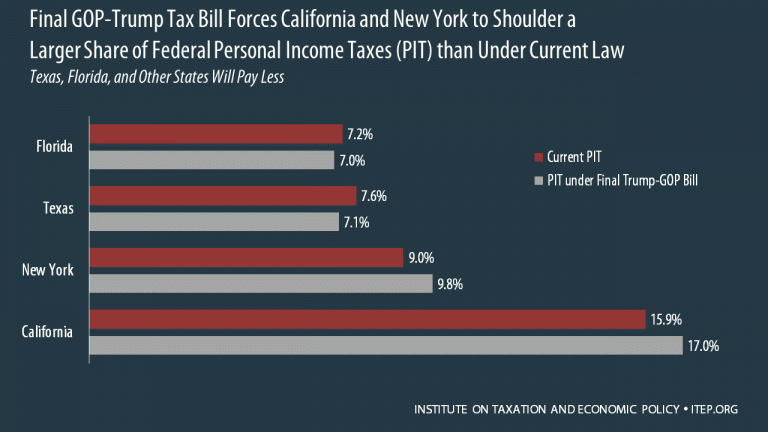
Final GOP-Trump Bill Still Forces California and New York to Shoulder a Larger Share of Federal Taxes Under Final GOP-Trump Tax Bill; Texas, Florida, and Other States Will Pay Less
• By Meg Wiehe
Residents of California and New York pay a large amount of the nation’s federal personal income taxes relative to their share of the population. As illustrated by the table below, the final GOP-Trump tax bill expected to be approved this week would substantially increase the share of total federal personal income taxes (PIT) paid by both states. Connecticut, Maryland, Massachusetts, and New Jersey would also see their share of federal PIT increase.
Final Tax Bill Reported to Provide Senator Rubio With Much Smaller Improvement for Children than He Demanded
• By Steve Wamhoff
The latest news on the GOP tax bill is that, in order to secure the vote of Senator Marco Rubio, Republican leaders have agreed to expand the child tax credit — but only by a fraction of the amount that Rubio initially demanded.
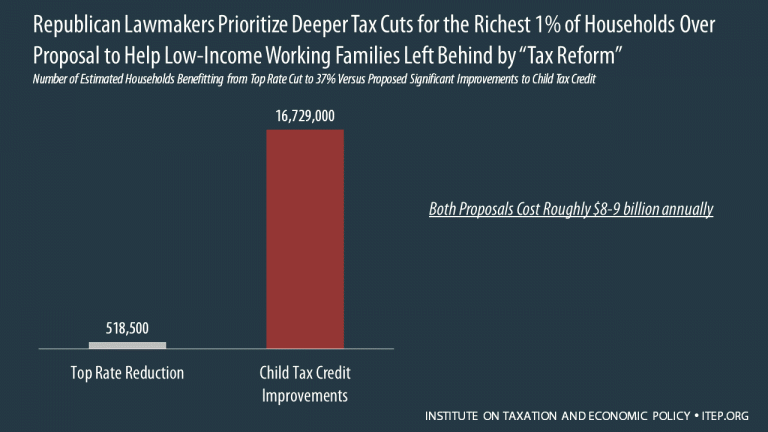
GOP Leaders Scrounge Up Money to Lower Top Tax Rate for the Rich But Not to Help Low-Income Working Families with Children
• By Meg Wiehe
Republican leaders who rejected a proposal to have corporations pay a single percentage point higher tax rate to benefit families with children have tapped the exact same source of savings to provide more breaks for the richest 1 percent of taxpayers. The table below compares the number and share of households nationally and in all 50-states who would benefit from the proposal to reduce taxes for working families with children versus the ”compromise” to cut…
ITEP Resources for the Tax Reform Debate
• By ITEP Staff
ITEP researchers have produced new reports and analyses that look at various pieces of the tax bill, including: the share of tax cuts that will go to foreign investors; how the plans would affect the number of taxpayers that take the mortgage interest deduction or write off charitable contributions, and remaining problems with the bill in spite of proposed compromises on state and local tax deductions.

Private Schools Donors Likely to Win Big from Expanded Loophole in Tax Bill
• By Carl Davis
For years, private schools around the country have been making an unusual pitch to prospective donors: give us your money, and you’ll get so many state and federal tax breaks in return that you may end up turning a profit. Under tax legislation being considered in Congress right now, that pitch is about to become even more persuasive.
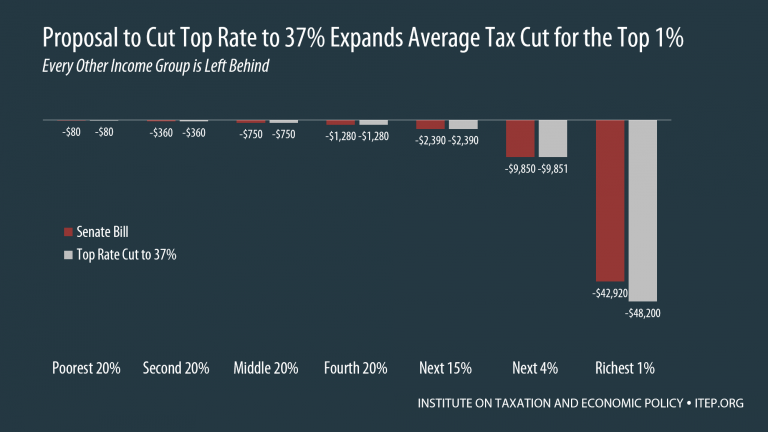
Latest “Compromise” for Tax Plan Is Even Worse than Previous Proposals, Would Reduce the Plans’ “Losers” by Less than 17,000 Taxpayers
• By Meg Wiehe, Steve Wamhoff
Earlier this week, ITEP explained that two possible “compromises” to improve the Senate tax bill would accomplish very little other than make the plan more expensive. Incredibly, Republican leaders are now discussing a third possible “compromise” that is even worse — a further reduction in the top personal income tax rate to 37%. This would […]
Parents of College Students: The Tax Plans’ Losers that No One Is Talking About
• By Steve Wamhoff
Parents of college students or kids in their last years of high school are more likely to face a tax hike than others under the tax legislation moving through Congress. Higher education has entered the tax debate because the House bill (but not the Senate bill) would repeal several provisions that make college and graduate education more accessible. But little thought has been given to how the tax bills would affect the parents of college…

Who Is “America First” Under the Tax Plan? The Rich First, Foreign Investors Second, Then the Rest of Us.
• By Steve Wamhoff
In his inaugural speech, President Trump told the world that Washington would be driven by a principle of “America First.” But the tax plans moving through Congress only put the richest Americans first. Everyone else comes after foreign investors.

Treasury’s 1-Page Memo Reasserts False Claims that Tax Cuts Largely Pay for Themselves — But Only When Accompanied by Spending Cuts
• By Steve Wamhoff
Treasury Secretary Steven Mnuchin claimed for weeks that his department would release a study showing that the $1.5 trillion tax cut moving through Congress would “pay for itself.” On Monday he released a one-page memo that asserts, without evidence, that economic growth resulting from President Trump’s policies would raise enough revenue to more than offset the costs of the tax cuts.
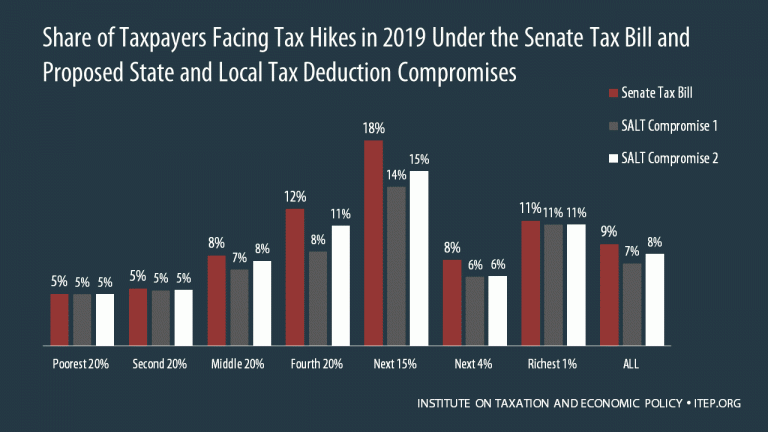
“Compromises” Under Discussion for the State and Local Tax Deduction Do Not Fix Flawed Tax Bills
• By Meg Wiehe, Steve Wamhoff
Republicans in Congress are reported to be considering two versions of a change they claim would “improve” the current bills by making them more generous to residents of higher-taxed states. As illustrated by these estimates, the reality is that these proposals would make little difference on those states and taxpayers hit hardest.
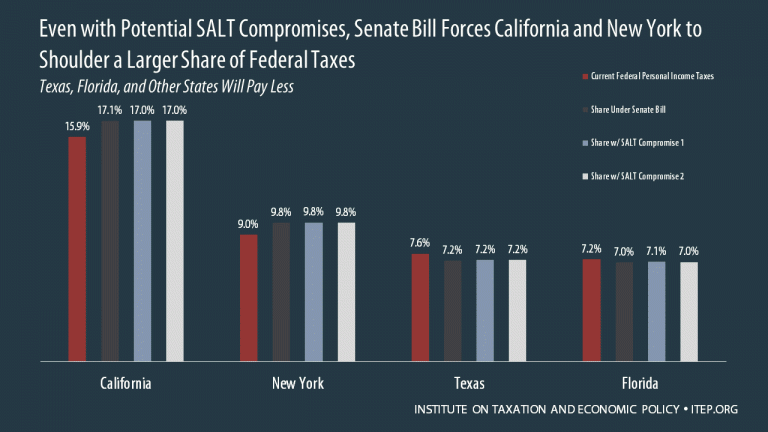
Even with Potential SALT Compromises, Senate Bill Forces California and New York to Shoulder a Larger Share of Federal Taxes While Texas, Florida, and Other States Will Pay Less
• By Meg Wiehe, Steve Wamhoff
The Senate tax bill, with or without either of the compromises that could be added to it, would shift personal income taxes away from Florida and Texas to states like California and New York, which are already paying a high share relative to their populations.

Charitable, Property Tax, and Mortgage Interest Deductions Would Be Wiped Out for Two-Thirds of Current Claimants Under Congressional Tax Plans
• By Carl Davis
In the ongoing debate over major federal tax legislation, there is significant focus on how House and Senate bills would eliminate the deduction for state income tax payments and cap the deduction for property taxes at $10,000 per year. At the same time, tax writers have retained deductions for charitable gifts and mortgage interest with what appear to be comparatively minor changes, at least at first glance.

They Can’t Help Themselves: GOP Leaders Reveal True Intent Behind Tax Overhaul
• By Jenice R. Robinson
The hand-written scrawls in the margins of the hastily written 500-page Senate tax bill had barely dried when lawmakers began to reveal the true motivation behind their rush to fundamentally overhaul the nation’s tax code.

Senate “Pass-Through” Deduction Threatens to Undermine State Tax Systems
• By Carl Davis
The U.S. Senate will soon be voting on a bill that would, among other things, allow so-called “pass-through” businesses to pay significantly lower taxes than their employees...If the Senate “pass-through” deduction is enacted into law, dozens of states will be forced to confront the possibility of reduced revenue collections, more regressive tax codes, and increased tax avoidance.

New ITEP Report Explains How Tax Reform Should Eliminate Breaks for Real Estate Investors Like Trump
• By Steve Wamhoff
A new report from ITEP provides more details on the many breaks and loopholes for wealthy real estate investors like Trump and what a true tax reform would do to close them.
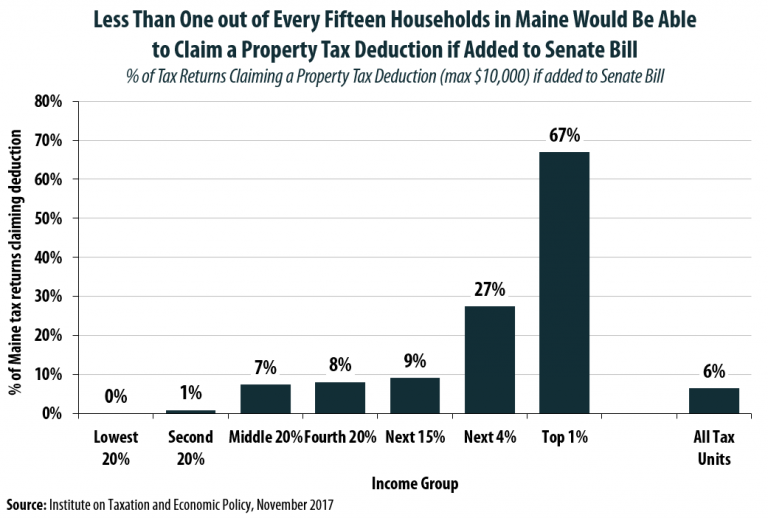
Senator Collins Pushes Hard for a Property Tax Deduction that Very Few of Her Constituents Will Be Able to Claim
• By Carl Davis
Adding a property tax deduction back into the Senate bill may sound like a compromise, but a new analysis performed using the ITEP Microsimulation Tax Model reveals that the amount of state and local taxes deducted by Maine residents would plummet by 90 percent under this change, from $2.58 billion to just $262 million in 2019. In short, this change is much more symbolic than substantive.
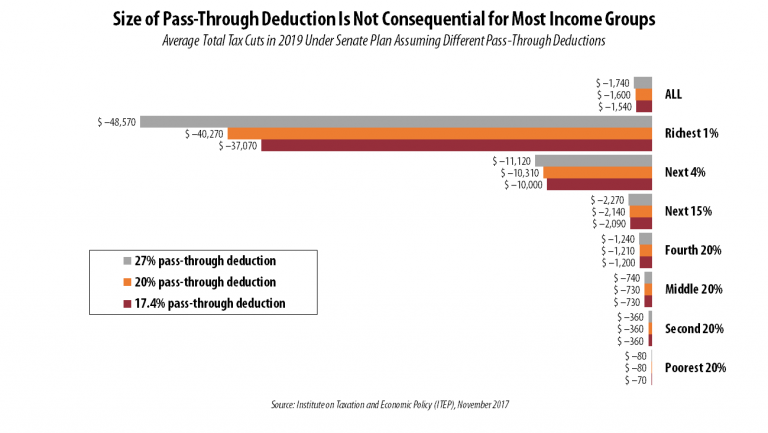
Republican Senators Debate Size of “Pass-Through” Break, But Proposed Compromises Will Make No Difference to Anyone Who Is Not Well-Off
• By Steve Wamhoff
Senators Ron Johnson of Wisconsin and Steve Daines of Montana want the tax bill on the Senate floor to be amended to offer a more generous tax break for “pass-through” businesses. We have estimated how all the provisions in the tax bill would impact each income group under three possible scenarios. The only thing different in each scenario is the size of the deduction for pass-through income: 17.4 percent (the deduction in the bill as…
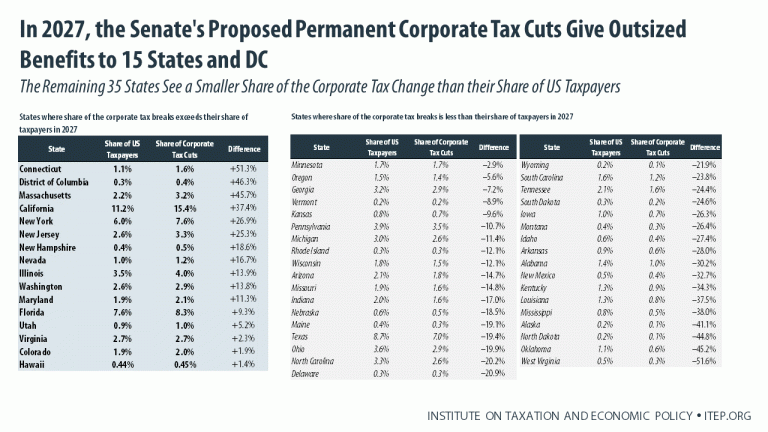
A Corporate Tax Cut Would Benefit Coastal Investors, Not the Heartland
• By Carl Davis
The centerpiece of the House and Senate tax plans is a major tax cut for profitable corporations that the American public does not want, and that will overwhelmingly benefit a small number of wealthy investors living in traditionally “blue” states. New ITEP research shows that poorer states such as West Virginia, Oklahoma, Alabama, and Tennessee would be largely left behind by a corporate tax cut, while the lion’s share of the benefits would remain with…

Lawmakers Are Allowing Monied Interests to Trump the Voices of Their Constituents
• By Alan Essig
George Washington is said to have described the U.S. Senate as the body that cools the passions of an impulsive House of Representatives just as a saucer cools tea. But current Senate leaders appear to think of themselves as more of a Bunsen burner.
Blog Categories

Institute on Taxation
and Economic Policy
ITEP is a non-profit, non-partisan tax policy organization. We conduct rigorous analyses of tax and economic proposals and provide data-driven recommendations to shape equitable and sustainable tax systems.
Subscribe to ITEP Emails
Tax research and policy news in your inbox.
Promote Fair Tax Policy
Your gift to ITEP promotes tax justice. With your help, we do research that supports taxing millionaires and billionaires, taxing big corporations and raising revenue for the things our people, our communities and our planet need.
Together, we can create a country with more economic justice, more racial justice, more climate justice… and more tax justice.