
2,364 posts

Washington State Budget and Policy Center: It’s time to include undocumented immigrants in state response to COVID-19
• By ITEP Staff
In addition to state and local taxes, new estimates show that the labor of undocumented workers in Washington state has resulted in nearly $400 million of contributions to the state and federal unemployment trust fund over the past ten years. Yet these workers are systematically denied protection when they become unemployed. Read more

The HEROES Act Would Correct CARES Act Business Tax Mistakes
• By Steve Wamhoff
The Health Economic Recovery and Omnibus Emergency Solutions (HEROES) Act includes important changes to business tax provisions in the CARES Act, the most recent COVID-19 legislation enacted by Congress and the president. The House-passed plan would undo CARES Act changes that make it easy for businesses to claim losses to reduce or avoid all taxes. […]

A Dimon Memo Will Buy You a Dime’s Worth of Social Change
• By Matthew Gardner
JPMorgan Chase CEO Jamie Dimon, in a May 19 memo to employees, outlines steps the company is taking to help its customers, small businesses and communities stay afloat. The part of the public relations memo that has received the most attention, however, is Dimon’s call for “rebuilding a more inclusive economy.” “It is my fervent […]
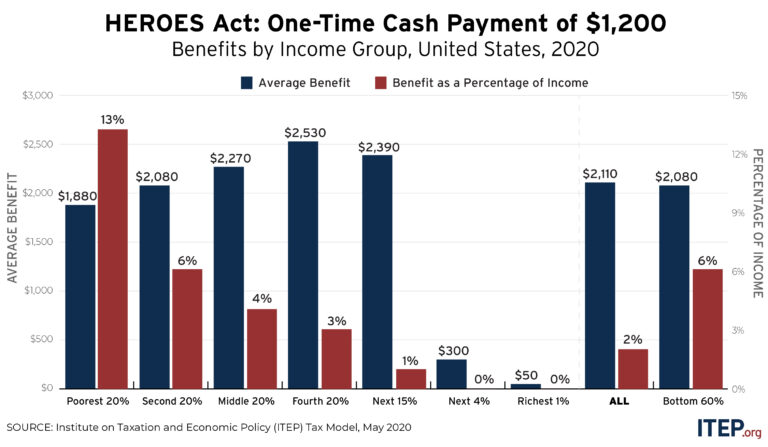
Major Cash Payment and Tax Provisions in the HEROES Act
• By ITEP Staff, Meg Wiehe, Steve Wamhoff
The major provisions for cash payments and tax changes in the House Democrats’ Health and Economic Recovery Omnibus Emergency Solutions (HEROES) Act would provide nearly $600 billion to individuals and households and average benefits of more than $3,000 to families in all but the highest income levels.
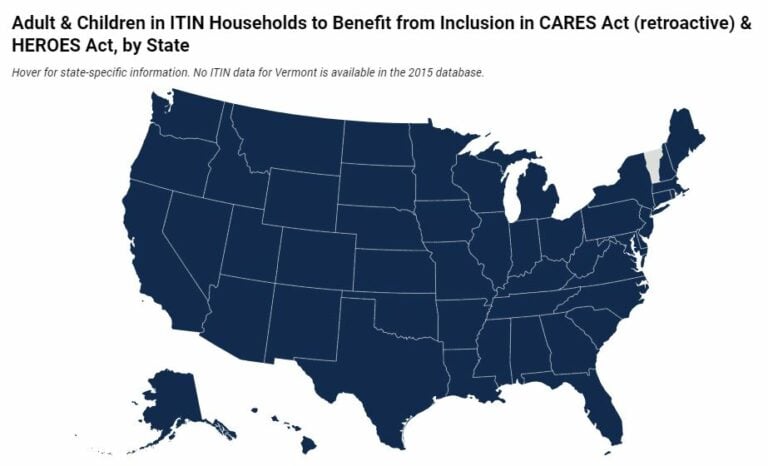
Analysis: How the HEROES Act Would Reach ITIN Filers
• By Meg Wiehe
The HEROES Act, filed by the House Democrats this week, includes a new one-time payment of $1,200 per adult and child and extends the payment to ITIN filers and their families. The bill also includes a retroactive change to the CARES Act ensuring ITIN filers will also receive the initial payment under the CARES Act. ITEP estimates more than 4.3 million adults and 3.5 million children would benefit from this change.
Fiscal Policy Institute: Unemployment Insurance Taxes Paid for Undocumented Workers in NYS
• By ITEP Staff
In the midst of a pandemic, there has been a growing call for undocumented immigrants, who make up five percent of the New York State labor force, to be covered by some form of unemployment insurance. What is often overlooked in discussions of unemployment insurance is the extent to which undocumented immigrants are already part […]

HEROES Act is an Appropriate Recession Response
• By Amy Hanauer
House Democrats today introduced a proposal that responds to our staggering economic crisis with the right policies at the necessary scale. It’s a refreshing change from some of the misdirected ideas that have passed or been floated in these alarming economic times.

Which Workers Wouldn’t Be Helped by a Payroll Tax Cut?
• By Jessica Schieder, Lorena Roque
New data released today estimates 20.5 million jobs were lost in the month of April alone. Workers not currently receiving paychecks would be left out of any benefits provided by a payroll tax cut.

Harris-Sanders-Markey Cash Payment Proposal Would Dwarf Checks Sent Under the CARES Act
• By Steve Wamhoff
Sens. Kamala Harris, Bernie Sanders and Edward Markey released a proposal to provide a monthly payment of $2,000 for each member of a household (including up to three dependents), with benefits phased out at income levels starting at $200,000 for married couples. The proposal is partly a response to concerns that one-time cash payments under the CARES Act, which amount to $1,200 ($2,400 for married couples) and $500 for each child under age 17, are…

ITEP: White House Seeks to Exploit COVID-19 Crisis to Enact Unpopular Tax Cuts
• By Amy Hanauer
Following is a statement by Amy Hanauer, executive director of the Institute on Taxation and Economic Policy, regarding the Trump administration’s musings to respond to the COVID-19 health and economic crisis with tax cuts.

Trump’s Latest Tax Break Proposals Include Everything—Except Helping Regular People
• By Steve Wamhoff
None of the tax proposals considered by the administration would provide help to those who need it or do much, if anything, to boost investment.

Trump’s Payroll Tax Cut Makes Even Less Sense as Job Losses Mount
• By Steve Wamhoff
Last August, long before COVID-19 ravaged the U.S. economy, the Trump Administration began touting a payroll tax cut as a stimulus. Now, with more than 30 million official unemployment claims and projections that the jobless rate could grow to Depression-era levels, the White House is claiming that a payroll tax cut is the best way […]

The Price We Pay for Amazon in Its Prime
• By Matthew Gardner
There is every reason to believe that Amazon will continue its tax-avoidance ways in 2020. The entirely-legal tax avoidance tools the company used to zero out its federal income tax bills over the last three years remain entirely legal today. From accelerated depreciation to the research and development tax credit to the deduction for executive stock options, Amazon’s tax avoidance tools have been blessed by lawmakers, and presidents, of all stripes.

Intended Consequences: Deliberate Disinvestment Caused Florida’s Unemployment Disaster
• By Stephanie Clegg
Florida politicians deliberately rigged the unemployment system after the Great Recession to avoid raising taxes on businesses. Now, in a pandemic, some out-of-work residents are left waiting more than six weeks for unemployment benefits while more than 280,000 others have been inexplicably denied. What’s happening in Florida underscores deeper challenges with systems that should help those in need, but instead are designed to fail them.

Two Pandemics, Separate and Unequal
• By Jenice R. Robinson
COVID-19 has revealed a policy apparatus that reflexively prioritizes those who need it least, a wholly inadequate safety net, an underfunded public health infrastructure, and an inefficient national health stockpile. If the nation stays this course, it will make only cosmetic restorations to a shoddily built house.

New Mexico Voices for Children: Essential But Excluded
• By ITEP Staff
Immigrants pay taxes and are important contributors to New Mexico’s economy. Nationwide, immigrants pay hundreds of billions of dollars in federal, state, and local income and other taxes. New Mexico immigrants – both legal residents and those who are undocumented – contribute more than $996 million in federal, state, and local taxes that help support […]
Community Change: End the Tax Penalty Against Immigrant Workers
• By ITEP Staff
The Earned Income Tax Credit is a powerful path out of poverty in America, but millions of immigrant households are barred from receiving it, even though they would otherwise qualify based on their work and earnings. Allowing all working families who qualify to receive the credits they earn would strengthen all communities and boost the […]

Economic Catastrophe in States Looms as Federal Relief Lags
• By Amy Hanauer
A bipartisan group of governors and senators from Louisiana to Maryland to Ohio have called for at least $500 billion in state and local fiscal relief. They also need specific help with testing, protective equipment, unemployment costs, Medicaid costs, social services, education and infrastructure. States can’t be on their own as they address the double whammy of plunging revenue and skyrocketing needs.

Pandemic Profits: Netflix’s Record Profit Haul, Past Tax Avoidance Raise Questions about Tax Law’s Weaknesses
• By Matthew Gardner
At a time when many companies are facing existential threats due to the COVID-19 pandemic and associated economic shutdown, it is vital to ensure that our corporate tax laws apply fairly to companies that are still turning a profit in these turbulent times.

Sales Tax Policy in a Pandemic: Exemptions for Digital Goods and Services Are More Outdated Than Ever
• By Estefan Hernandez Escoto
Many states are making the decline in sales tax collection worse by failing to apply their sales taxes to digital goods (such as downloads of music, movies, or software) and services (such as digital streaming). A state that taxes movie theater tickets but not digital streaming, for instance, is needlessly hastening the decline of its own sales tax.

The CARES Act Provision for High-Income Business Owners Looks Worse and Worse
• By Steve Wamhoff
A select group of millionaires will receive an average tax break of $1.6 million thanks to a CARES Act provision that is receiving delayed but well-deserved scrutiny. Wealthy business owners are receiving this windfall because the CARES Act provides tax breaks to people with losses from a business they own. This approach may seem sensible because businesses small and large are taking a hit from the economic recession, but on close inspection, these provisions benefit…

Partying Like It’s 2017: How Congress Went Overboard on Helping Businesses with Losses
• By Steve Wamhoff
The Coronavirus Aid, Relief, and Economic Security (CARES) Act provides some needed relief for individuals and families, but two arcane tax provisions related to business losses will further enrich the wealthy and fail to boost our economy more broadly.

ITEP: Making Decisions on Federal Relief Based on Blue v. Red States is Morally Bankrupt
• By Meg Wiehe
Following is a statement by Meg Wiehe, deputy executive director of the Institute on Taxation and Economic Policy, regarding Senate Majority Leader Mitch McConnell’s press release on “blue state bailouts” and suggestion that states facing budgetary shortfalls should seek bankruptcy protection.

To Avoid the CARES Act’s Flaws, Invest in Automatic Relief
• By Jessica Schieder
With adequate automatic stabilizers, the United States might not end up with economic relief bills that have provisions tucked in them mostly helping millionaires, as we learned was the case with a CARES Act provision suspending limits on business losses. And regular people could get help more quickly, blunting the economic downturn.
ITEP: Congress Must Provide More Relief to States
• By Amy Hanauer
Media contact Following is a statement by Amy Hanauer, executive director of the Institute on Taxation and Economic Policy, regarding the Senate bill on small business relief. “State budgets have already taken an enormous hit due to the necessary halting of economic activity to curb the COVID-19 public health crisis. The initial $150 billion in […]

Institute on Taxation
and Economic Policy
ITEP is a non-profit, non-partisan tax policy organization. We conduct rigorous analyses of tax and economic proposals and provide data-driven recommendations to shape equitable and sustainable tax systems.
Subscribe to ITEP Emails
Tax research and policy news in your inbox.
Promote Fair Tax Policy
Your gift to ITEP promotes tax justice. With your help, we do research that supports taxing millionaires and billionaires, taxing big corporations and raising revenue for the things our people, our communities and our planet need.
Together, we can create a country with more economic justice, more racial justice, more climate justice… and more tax justice.