
2,364 posts

It’s Time to Rethink Those Tax Cuts
• By Aidan Davis
The full effect of the coronavirus pandemic on state revenue streams remains largely unknown. One key policy option is to reevaluate recent misguided tax cuts—particularly those that have not yet taken full effect and will add to growing revenue shortfalls in the coming years.

Morally and Economically, Including Undocumented Immigrants Is the Right Thing to Do
• By ITEP Staff
Undocumented immigrants pay taxes and play an integral part in the social and economic welfare of our country, yet Congress left them almost entirely out of the CARES Act package. Fortunately, immigrants, workers and their allies are helping policymakers advance better policy approaches.

State Options to Shore up Revenues and Improve Tax Codes amid Pandemic
• By Dylan Grundman O'Neill, Meg Wiehe
The COVID-19 pandemic is an extraordinarily challenging time, as we see harm and struggle affecting the vast majority of our families, businesses, public services, and economic sectors. No one will be unaffected by the crisis, and everyone has a stake in the recovery and faces tough decisions. In the world of state fiscal policy, where revenue shortfalls are likely to be far bigger than can be filled by the initial $150 billion in federal aid…

GBPI: Implement Immigrant-Inclusive Policies During the COVID-19 Crisis
• By ITEP Staff
Immigrants represent one in 10 Georgians and are critical to Georgia’s economy, with 31 percent of main street businesses owned by foreign-born Georgians and undocumented Georgians contributing $352 million in state and local taxes in 2017. Immigrants are key leaders in our communities and contribute to the state’s cultural and linguistic diversity. During this public […]

ITEP: Tax Cuts for Millionaires in the CARES Act Violate Public Trust
• By Amy Hanauer
“Public trust and the broad agreement that families and communities needed immediate relief from the economic crisis allowed the $2.2 trillion economic relief package to move quickly through Congress. Yet during a crisis in which thousands have lost their lives and millions are losing their jobs, their health care and their retirement security, some of our lawmakers snuck in tax benefits for the nation’s richest families."
Addressing the COVID-19 Economic Crisis: Advice for the Next Round
• By Steve Wamhoff
Americans need many things right now beyond tax cuts or cash payments. But for people whose incomes have declined or evaporated, money is the obvious, immediate need to prevent missed rent or mortgage payments, skipped hospital visits and other cascading catastrophes. So, what should Congress do next to get money to those who need it?

Trump to Restaurant Owners: “Let Them Eat Skyboxes”
• By Matthew Gardner
Last week, President Trump destroyed everyone’s coronavirus press conference bingo card by announcing that a conversation he had with celebrity chef Wolfgang Puck inspired him to propose restoring a corporate tax deduction for business entertainment expenses. Trump’s own signature tax plan repealed this break two years ago.

Federal Relief Bill Doesn’t Go Far Enough: Q&A with Meg Wiehe
• By ITEP Staff, Meg Wiehe, Stephanie Clegg
The final version of the Coronavirus Aid, Relief and Economic Security (CARES) Act enacted last week included rebate provisions that will reach most low-, moderate- and middle-income adults and children, but not everyone. Meg Wiehe sits down for a Q&A to discuss who benefits from the rebate provision, who is excluded and how states can respond to support communities.
NC Policy Watch: Those Federal COVID-19 Checks: What They Mean and Who Might Get Left Out
• By ITEP Staff
In a replay of how aid checks were dispensed during the Great Recession, the CARES Act reveals giant holes in how we get cash to people in desperate need. Without federal, state, and local policy action, many of the North Carolinians who need aid most urgently will be the last to get it or won’t […]

Colorado Fiscal Institute: Protection From a Pandemic: The Federal Response to COVID-19 in Colorado
• By ITEP Staff
The federal response contains important provisions designed to help individuals and families, businesses, and state and local governments respond to this unprecedented event. This report aims to provide a summary of these provisions and how they will affect Colorado specifically. Read more

Sales Taxes and Social Distancing: State and Local Governments May Face Their Steepest Sales Tax Decline Ever
• By Carl Davis, ITEP Staff, Meg Wiehe
One pressing question is what will an economic downturn in which consumers are anxious, facing job loss, or simply spending their time sheltering in place and not spending money in typical ways, mean for states’ ability to raise revenue?

Boeing “CARES” A Lot About its Shareholders—But What about the Rest of Us?
• By Matthew Gardner
The gigantic Coronavirus-related tax and spending bill enacted last week, the so-called “CARES Act,” sets aside $17 billion in loans for “businesses critical to maintaining national security.” It’s generally understood that the bill’s authors want much, if not all, of this $17 billion to go to a single company: Boeing. So it behooves us to ask whether Boeing benefits America and its economy in ways that merit this largesse.

Adding Flexibility to Make the EITC Work During the Pandemic
• By Aidan Davis
Temporarily modifying the structure of the EITC to reflect the realities of our current economy could provide a vital lifeline to low-income workers who have seen their incomes disappear during this crisis. What follows are a few such ideas which could be implemented at either the federal or state levels, or both.

House Democrats’ Suggestion of Retroactively Repealing SALT Cap is a Poor Emergency Relief Measure
• By Steve Wamhoff
The House Democrats have plenty of ideas to help workers and families and boost the economy, but Speaker Nancy Pelosi’s recent idea to repeal the cap on deductions for state and local taxes (SALT) is not one of them. The 2017 Trump-GOP tax law includes many provisions that should be repealed. Unfortunately, Congressional Democrats have long made it clear that they want to start by repealing the $10,000 cap on SALT deductions, which is one…

Congress “CARES” for Wealthy with COVID-19 Tax Policy Provisions
• By Matthew Gardner
At a time when record numbers of Americans are facing unemployment, state and local governments are facing a perfect storm of growing public investment needs and vanishing tax revenues, and small business owners are struggling to avoid even more layoffs, lavishing tax breaks on the top 1 percent in this way shouldn’t be in anyone’s top 20 list of needed tax changes.
Tax Rebates in the Federal CARES Act
• By ITEP Staff
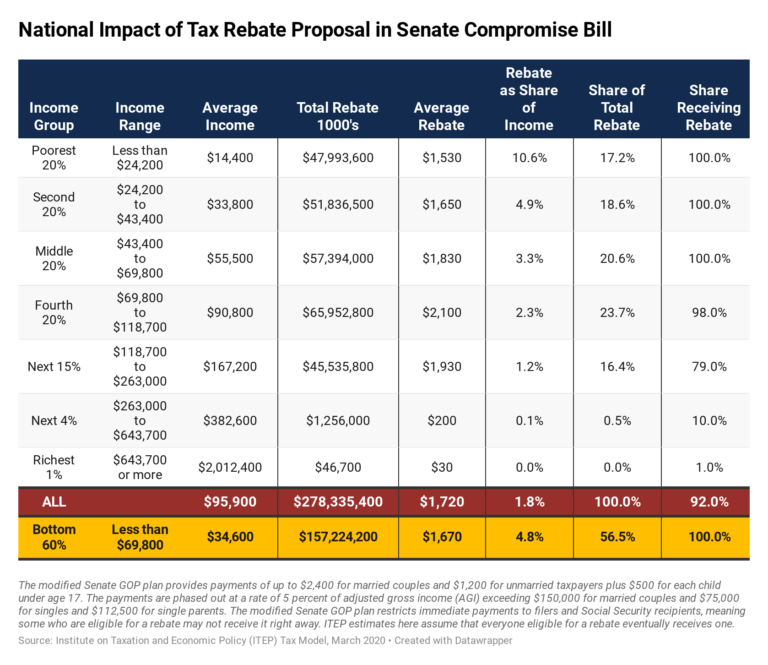
Data available for download Congress passed and the president signed a $2 trillion plan that includes $150 billion in fiscal aid to states, $150 billion in health care spending, large expansions of unemployment compensation and more. These measures are clearly needed as the economy teeters on the brink. Though the bill improves on flaws in […]
How the Tax Rebate in the Senate’s Bill Compares to Other Proposals
• By Steve Wamhoff
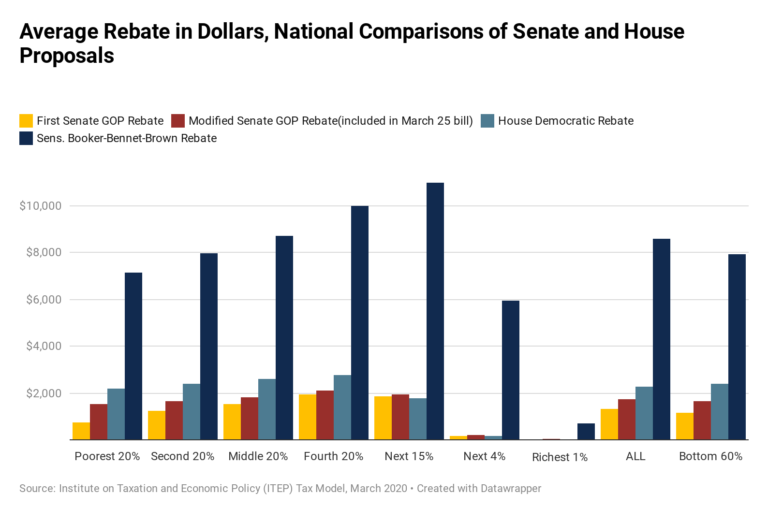
Congress is poised to pass a $2 trillion plan that includes $150 billion in fiscal aid to states, $150 billion in health care spending, large expansions of unemployment compensation and more. These measures are clearly needed as the economy teeters on the brink. As the Senate votes on its stimulus/COVID19 bill, one provision ITEP has deeper insights on is the payments to households in the form of tax rebates. ITEP has provided several analyses over…
New Analysis Shows Average Rebate for Families in the Stimulus Bill
• By ITEP Staff
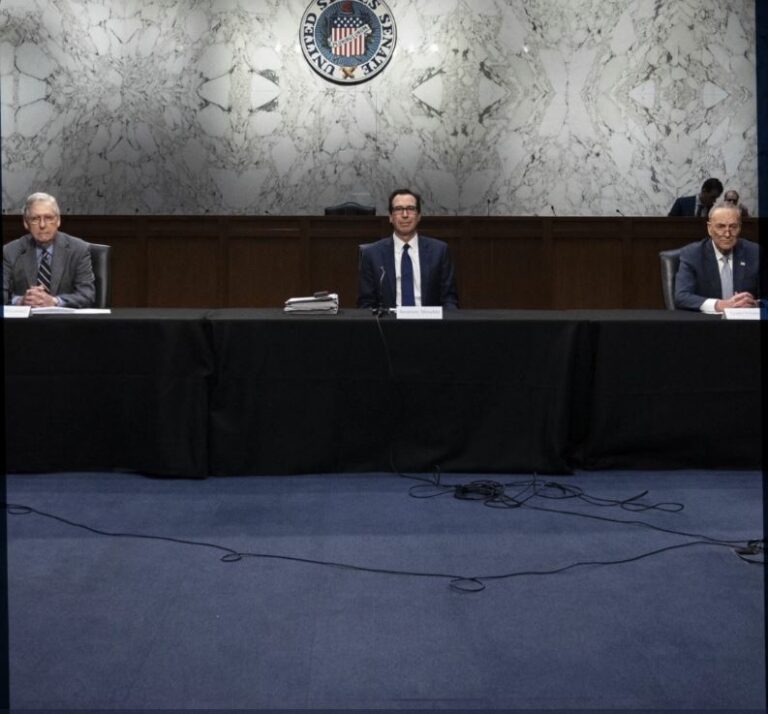
The Senate agreed to a compromise stimulus bill last night that improves on flaws in its initial bill but still fails to go as far as other proposals and leaves out immigrants who file taxes via Individual Taxpayer Identification Numbers (ITIN), the Institute on Taxation and Economic Policy said today.

COVID-19 and the Case for Race-Forward Economic Policy Prescriptions
• By Jenice R. Robinson
Unconscious bias runs deep. Legislative proposals to assuage the exploding economic crisis are advancing and changing quickly, but initial GOP proposals are consistent with the nation’s long history of ostensibly race-neutral policies that are discriminatory in their outcomes.

NEW ANALYSIS: House Democratic Stimulus Bill Explained
• By ITEP Staff, Meg Wiehe, Steve Wamhoff
Breaking ITEP analysis explains how a newly-introduced House Democrats' proposal—far more comprehensive and better targeted than the recently failed GOP Senate bill—combines overdue expansion of the Earned Income Tax Credit and Child Tax Credit with direct rebates to reach workers and families across all income groups.
New Analysis: Revised GOP Stimulus Proposals Still Fails to Meet Critical Needs
• By ITEP Staff
Media Contact The revised GOP stimulus proposal still fails to do enough for struggling families while providing a no-strings-attached bailout to corporations, the Institute on Taxation and Economic Policy said today. ITEP today released an analysis of the revised plan. Among its key findings: The revised proposal could leave 7.5 million households without access to […]

New State-by-State Estimates: Modified Senate GOP Stimulus Bill Still Falls Short
• By ITEP Staff, Meg Wiehe, Steve Wamhoff
The GOP Senate stimulus bill voted down yesterday is a slight improvement over the first GOP proposal released Thursday, but it still fails to prioritize workers and families or provide fast relief to those who need it most.

Why the GOP Senate Bill Fails to Address the Crisis, and Why a Democratic Bill Looks More Promising
• By ITEP Staff, Meg Wiehe, Steve Wamhoff
National and state-by-state data available for download By Steve Wamhoff and Meg Wiehe On Thursday night, Senate Majority Leader Mitch McConnell released a bill that reportedly cost more than $1 trillion, most of which would go toward breaks for corporations and other businesses. A provision in the bill to provide payments to families would cost […]
New Analysis Compares Republican- and Democratic-Sponsored Proposals to Help Families and Individuals
• By ITEP Staff
Media Contact The economic stimulus bill released by Senate Majority Leader Mitch McConnell Thursday night would leave behind millions of adults and children and do little to help struggling families weather this current public health and economic crisis, the Institute on Taxation and Economic Policy (ITEP) said today. ITEP has released a new analysis that […]

It’s Time for Some State Fiscal Policy Triage
• By Carl Davis, Dylan Grundman O'Neill, ITEP Staff
The COVID-19 novel coronavirus’s effects on public health and economies at all scales are creating a daunting situation for state budgets as well. Lawmakers can choose and prioritize their responses through a straightforward approach similar to that taken by health professionals: marshal and reinforce available resources, triage response options to prioritize the most vital services and most vulnerable people, and enact or strengthen the policies that will help address longer-term issues as well as immediate…

Institute on Taxation
and Economic Policy
ITEP is a non-profit, non-partisan tax policy organization. We conduct rigorous analyses of tax and economic proposals and provide data-driven recommendations to shape equitable and sustainable tax systems.
Subscribe to ITEP Emails
Tax research and policy news in your inbox.
Promote Fair Tax Policy
Your gift to ITEP promotes tax justice. With your help, we do research that supports taxing millionaires and billionaires, taxing big corporations and raising revenue for the things our people, our communities and our planet need.
Together, we can create a country with more economic justice, more racial justice, more climate justice… and more tax justice.