
2,364 posts
Governor Newsom Launches New State Investment and Philanthropic Collaboration To Continue Supporting Families Under Federal Assault
• By ITEP Staff
Undocumented immigrants contributed $8.5 billion in state and local taxes in 2022 — a number that would rise to $10.3 billion if these taxpayers could apply to work lawfully. People are afraid to leave their homes, children are left without their parents, and families unable to afford groceries. Families are even foregoing critical medical care. […]

Video: ITEP’s Brakeyshia Samms Talks About Race and the Tax Code on Colorado Fiscal Institute Podcast
• By Brakeyshia Samms
Senior Analyst at ITEP, Brakeyshia Samms, joins the “Exploring How Race, Money, and Power Collide in the Tax System” episode of Colorado Fiscal Institute’s podcast.
Policy Matters Ohio: The Great Ohio Tax Shift, 2026
• By ITEP Staff
ITEP’s analysis examines two categories of changes to the Ohio tax code: changes made to personal income taxes and changes made to other types of taxes. Read more.
Audio: ITEP’s Kamolika Das on the Need for States to Raise Revenue in the Wake of 2025 Trump Tax Law
February 19, 2026
Kamolika Das talks about a current nationwide effort to raise revenue in states to replace billions of dollars in vital local and state funding for social safety net programs that were lost in last year’s Trump-GOP budget mega-bill that dramatically cut social programs while giving away huge tax cuts for profitable corporations and the rich. […]
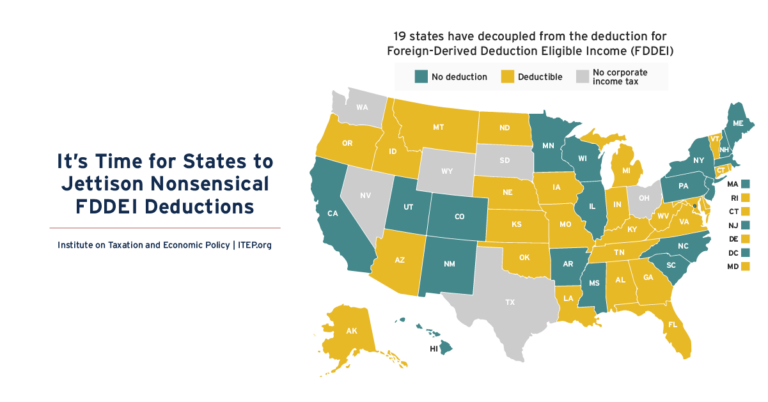
It’s Time for States to Jettison Nonsensical FDDEI Deductions
• By Carl Davis
FDDEI deductions should be repealed for policy reasons alone as they do not serve a legitimate purpose at the state level.
Massachusetts Budget & Policy Center: Testimony Regarding an Act To Manage Federal Tax Changes in Massachusetts
• By ITEP Staff
The Massachusetts Budget and Policy Center (MassBudget) proposes that the state opts out the five most costly federal corporate tax cuts made in the One Big Beautiful Bill Act. Read more.
Economic Policy Institute: Everything You Need To Know About “No Tax on Overtime”
• By ITEP Staff
The Trump administration has trumpeted this policy as a substantial victory for workers—in reality, it is not. Most workers will not benefit from this policy whatsoever. Read more.
The Cascadia Advocate: Five More Claims Against the Million-Dollar Earners’ Tax That Don’t Check Out: Debunking Republicans’ Opposition to SB 6346
• By ITEP Staff
Republican legislators yesterday leveled a barrage of familiar arguments against the Senate Democratic majority’s proposal to create a million-dollar earners’ tax. While these charges have been made before, repetition does not make an argument true. Read more.
Business Insider: Mamdani Says if the State Won’t Tax the Wealthiest New Yorkers, He’d Have To Tax the Middle Class as a ‘Last Resort’
February 19, 2026
Without Albany’s willingness to hike income or corporate taxes, Mamdani is signaling he will need to turn to other measures to fund his budget. He’s floating increasing property taxes for the city’s residents. Read more.
KCUR: Eliminating Missouri’s Income Tax Could Actually Cost You More — Unless You’re Rich
February 19, 2026
If the state’s income tax is eliminated, experts anticipate that Missouri’s already regressive tax system would become more so. Households with a yearly income of $65,000 would see a $500 tax increase each year, while households in the top 1% would see an average tax cut of nearly $40,000. Read more.
Mackinac Center: Lawmakers Should Reject Sales Tax Holidays
• By ITEP Staff
The Institute on Taxation and Economic Policy argues that tax holidays may slightly reduce the regressive nature of sales taxes but produce minimal overall benefit. Read more.
Thomson Reuters: OBBB Put Pressure on States to Raise Revenues, Analysts Say
February 19, 2026
Policy experts warned that the One Big Beautiful Bill (OBBB) is creating a fiscal crisis for states, forcing them to choose between cutting essential services or raising their own taxes. Aidan Davis, state policy director at the Institute on Taxation and Economic Policy, said lawmakers have an opportunity to reverse course and align public policy […]
The Hill: Want ‘Affordability?’ Start by Retooling Your State’s Regressive Tax System.
February 19, 2026
The White House plan “would represent the single largest legislated transfer of wealth from the working class to the rich in the nation’s history,” according to the Institute on Taxation and Economic Policy. “Working-class families would face dramatic tax increases while the nation’s wealthiest families would see their state tax bills plummet.” Read more.
Education Week: How Do Schools Solve a Problem Like Property Taxes?
February 19, 2026
As tax season dawns, backlash to a nationwide surge in property-tax bills is spurring states to double down on proposals to diminish one of the main revenue sources for school districts. At least 10 states are pitching the end of one of schools’ chief revenue sources. Read more.
Quartz: Big Tech’s Big Trump Tax Win
February 19, 2026
Republicans in Congress delivered on one important item on corporate America’s wishlist that allowed companies to pay lower taxes to Uncle Sam: their ability to immediately deduct new domestic research and development spending from their tax bills instead of spreading them out over years. Read more.

Palantir Pays Zero Federal Income Tax Despite Explosive Growth, Largely Due to Trump Tax Law
• By Matthew Gardner
Palantir reported $1.5 billion of U.S. income but paid exactly zero federal income tax in 2025. Despite explosive growth, tax breaks from the Trump tax law helped Palantir avoid paying even a dime of federal income tax on its earnings.
Economic Policy Institute: Everything You Need To Know About “No Tax on Tips”
• By ITEP Staff
The 2025 Trump tax bill that created the tipped income deduction simultaneously enacted massive cuts to health care, energy, and food assistance programs that will cause tremendous harm for millions of low-income households, including some with tipped workers—all to finance tax cuts for the ultrawealthy. Read more.
Center for American Progress: Overturning D.C.’s Tax Law Would Infringe on Common State Tax Practices and Threaten the District’s Budget and Fiscal Autonomy
• By ITEP Staff
Overruling the jurisdiction’s control of its own state tax code would deprive Washington, D.C., of $658 million in revenue, raise child poverty, and throw the tax-filing system into disarray. Read more.
New York Times: States Say No Thanks to Trump Tax Cuts, Drawing Republican Fire
February 12, 2026
“This is a traditional, core area of state authority,” said Carl Davis. “There are zero states that fully adopt the federal tax rules in their own codes. When state lawmakers are doing their job well, they sit down and give each item careful consideration about whether it makes sense in their own code or not.” […]
The American Prospect: Tesla’s Wile E. Coyote Moment Is Here
February 2, 2026
According to a report from the Institute on Taxation and Economic Policy, the company has paid precisely zero federal taxes on its earnings in both 2025 and 2024, so the company is certainly being helped along by federal forbearance. But things are getting dire. Read more.

Hawai’i Appleseed Center for Law and Economic Justice: A Fairer Tax Code for a Thriving Hawaiʻi
• By ITEP Staff
Hawaiʻi stands at a crossroads. The path we choose now will define our islands for generations. We can either accept a future of diminishing public goods and deepening inequality, or we can choose to build one of shared prosperity and collective resilience. Read more.
ITEP Statement: President Trump Sues the American People for $10 Billion
• By ITEP Staff
The following is a statement by Amy Hanauer, executive director at the Institute on Taxation and Economic Policy, in response to yesterday’s announcement that President Trump and his family are suing the IRS over the leak of his tax returns by an IRS contractor: “Several years ago, an IRS contractor leaked confidential tax return data […]

An Anti-Affordability Agenda: Trump’s Advisors Call on States to Raise Taxes on the Working Class and Drastically Cut Taxes for the Rich
• By Carl Davis
The Trump administration’s Council of Economic Advisors suggests that states consider drastically raising sales taxes and using those new revenues to pay for repealing taxes on corporate and personal income. Working-class families would face dramatic tax increases while the nation’s wealthiest families would see their state tax bills plummet.

Tesla Reported Zero Federal Income Tax on $5.7 Billion of U.S. Income in 2025
• By Matthew Gardner
Tesla enjoyed almost $5.7 billion of U.S. income in 2025 but paid $0 in federal income tax. Over the past three years, the Elon Musk-led company reported $12.5 billion of U.S. income on which its current federal tax was just $48 million.

An Analysis of a Potential Reduction in Massachusetts’ Long-Term Capital Gains Tax Rate
• By Eli Byerly-Duke, Matthew Gardner
A ballot initiative in Massachusetts has proposed cutting the base rate for nearly all income sources from 5 to 4 percent. In 2026, this would cost the state about $5 billion per year of which $347 million would come from the reduced rate on long-term capital gains.

Institute on Taxation
and Economic Policy
ITEP is a non-profit, non-partisan tax policy organization. We conduct rigorous analyses of tax and economic proposals and provide data-driven recommendations to shape equitable and sustainable tax systems.
Subscribe to ITEP Emails
Tax research and policy news in your inbox.
Promote Fair Tax Policy
Your gift to ITEP promotes tax justice. With your help, we do research that supports taxing millionaires and billionaires, taxing big corporations and raising revenue for the things our people, our communities and our planet need.
Together, we can create a country with more economic justice, more racial justice, more climate justice… and more tax justice.