
2,364 posts

Flying Under the Tax Radar: How Profitable Airlines Avoided Federal Income Taxes in 2025
• By Sarah Buttikofer, Spandan Marasini
Corporate tax disclosures reveal that five profitable airlines paid almost nothing in federal income tax last year. In 2025, the effective federal income tax rates of these airlines ranged from 1.07 percent to below zero.
Business Insider: States want to tax the rich less. They’re taxing your purchases more.
July 27, 2026
As many voters clamor for higher taxes on the ultrawealthy and corporations, many states have moved in the opposite direction: lowering taxes on high earners and raising them on everyday goods.
Barron’s: Back to School Spending Expected to Set Records as Shoppers Hunt for Bargains
July 27, 2026
Shoppers are especially focused on value and spacing out purchases as they shop for back to school this summer, but overall spending is still expected to reach record levels.

The Campaign by Former Democratic Officials to Stop Taxes on the Wealthy Is Back
• By Steve Wamhoff
A former Democratic senator from Nebraska has joined Saving America’s Family Enterprises and taken up its cause of opposing wealth taxes.
Congressional Republicans Say D.C. Shouldn’t Be Allowed to Run Its Own Tax System
• By Matthew Gardner
This week a U.S. House of Representatives committee approved a bill that would effectively take away Washington, D.C.’s fiscal autonomy, requiring Congressional approval of any new D.C. laws that increase taxes or fees.

Localities Try Vacant Land Taxes, Mansion Taxes and Second Home Taxes
• By Rita Jefferson
In 2026, cities, counties, and school districts must manage tax cuts coming from federal and state governments, the end of federal pandemic aid, rising costs, and a stagnant economy. This challenging environment is forcing municipalities of all types to ask how they can best fund core priorities and invest in communities in the long term.
The Changing Landscape of State Tax Rates
• By Sarah Austin
Many states have repeatedly cut top personal and corporate income tax rates in recent years, sometimes while approving increased sales tax rates to push tax systems in a more regressive direction. Other states, however, have charted a very different course and have moved to increase taxes on higher income households to fund public services.
State Tax Expenditures Deserve a Closer Look
• By Brooklyn Ramirez
As many states enter a new fiscal year this month, it’s an ideal time to take a closer look at a major but often overlooked category of government spending: tax expenditures. To make these programs easier to explore and compare, ITEP has updated its state-by-state tax expenditure reports resource.
Senator Chris Van Hollen: Van Hollen, Pettersen Lead Lawmakers in Introducing Legislation to Bring Transparency to Corporate Abuse of Tax Havens, Job Offshoring
• By Matthew Gardner
U.S. Senator Chris Van Hollen and U.S. Representative Brittany Pettersen led their colleagues in reintroducing the Disclosure of Tax Havens and Offshoring Act, legislation to provide transparency around corporations’ use of tax havens and incentives to offshore jobs.

New Legislation Would Require Big Multinationals to Tell Shareholders Where They’re Hiding Offshore Profits
• By Matthew Gardner
Sen. Chris Van Hollen introduced legislation requiring big multinational corporations to tell shareholders and the public what they’re already telling tax authorities behind closed doors: how much income they’re booking in specific offshore tax havens and how little tax they’re paying to these jurisdictions.
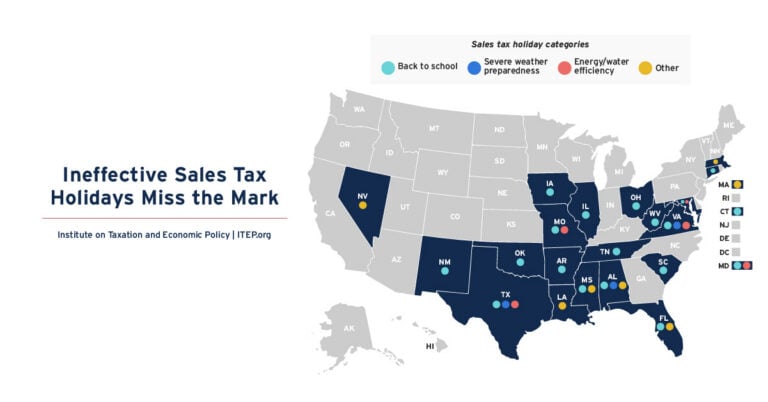
Ineffective Sales Tax Holidays Miss the Mark
• By Miles Trinidad
Twenty states have sales tax holidays in 2026. These sales tax holidays will cost states and localities nearly $600 million in lost revenue this year, and they're poorly targeted and too temporary to meaningfully change the regressive nature of a state’s tax system.
Center on Budget and Policy Priorities: Missouri Tax Amendment Likely to Seriously Harm Services, Shift Taxes Onto Working Families
• By ITEP Staff
In early August, Missouri voters will decide one of the most consequential state tax policy questions in recent memory: whether to eliminate their state’s personal income tax.
California Budget & Policy Center: Should Voters Approve Prop. 3? How Top Tax Rates Have Helped Californians
• By ITEP Staff
Proposition 3 will appear on the November 2026 statewide ballot, asking California voters whether to make permanent the higher-income tax rates on the state’s highest earners.

Missouri’s Amendment 5 Would Cut Taxes for the Rich and Raise Taxes on Seniors and the Middle Class
• By Eli Byerly-Duke
On August 4, Missouri voters will vote on whether to increase taxes on the middle class and seniors to fund tax cuts for the richest households in the state.
Migration Policy Institute: Rooted in the Valley: Immigrants in Napa County’s Communities and Economy
• By ITEP Staff
Immigrants made up 29 percent of Napa County’s workforce as of 2019–23, with those working in the wine and hospitality industry generating an estimated $1.5 billion in county GDP.

Trump Administration Says Shining Light on Corporate Tax Avoidance is ‘Very Dangerous’
• By Matthew Gardner
Administration officials appear far more concerned about the public knowing too much about how U.S. corporations shift their income into offshore tax havens.

The Bell Policy Center: Colorado Ballot Guide 2026
• By ITEP Staff
According to the Institute on Taxation and Economic Policy, immigrants without documentation contributed $436.5 million in state and local taxes in Colorado in 2022.
CSG Midwest: Conform or decouple? Changes in federal tax policy stir debates in state legislatures
• By ITEP Staff
“Congress often tinkers with the tax code from one year to the next, so state conformity debates happen all the time, says Carl Davis, research director at the Institute on Taxation and Economic Policy. “But they’re usually much more minor considerations.”
Michigan Democratic Party: Michigan Democrats Slam GOP Billionaire Bailout Budget On One-Year Anniversary of OBBBA’s Passage
• By ITEP Staff
The Institute on Taxation and Economic Policy found the OBBBA “will increase taxes for most Americans, significantly expand income inequality, and add trillions to the national debt, while delivering substantial tax cuts to high-income households, corporations, and foreign investors.”
CBS News: The One Big Beautiful Bill Act is 1 year old. Here are the winners and losers.
July 13, 2026
"The top 1%, in fact, are in line to get $1 trillion in tax cuts from the law over a decade," Jon Whiten, deputy director of the nonpartisan Institute on Taxation and Economic Policy, or ITEP, told CBS News.
Yahoo News: Hawaii’s new ‘millionaire tax’ rivals top tax rate among other states
July 13, 2026
Nick Johnson, senior fellow at the Institute on Taxation and Economic Policy, another Washington, D.C.-based nonprofit and nonpartisan tax policy organization, told the Hawaii Tax Review Commission during a June 16 meeting that the state's personal income tax is "quite progressive" given its graduated rate structure and low-income tax credits.
Lexington Herald-Leader: How are gas prices set in KY? From oil to the pump, here’s what to know
July 9, 2026
In the South, rising costs averaged to about an additional $39.42 in monthly expenses on gas, according to data from the Institute on Taxation and Economic Policy.
Stop Greed, Build Green | Climate and Community Institute: AI First: How the Federal Government is Prioritizing AI Over People and Planet
• By ITEP Staff
The recent explosion of artificial intelligence (AI) and the construction of data centers threatens to swallow the US economy and transform society.

2026 Sessions in Review: States Fund Tax Credits by Preserving, Raising Revenue
• By Aidan Davis
In a year of cautious uncertainty around current and ongoing revenues, many state lawmakers strengthened their tax credits for families and children.

America at 250: It’s Time for a Tax Code That Lives Up to Our Ideals
• By Brakeyshia Samms
After 250 years, our leaders must show a commitment to completing the unfinished work of American democracy.

Institute on Taxation
and Economic Policy
ITEP is a non-profit, non-partisan tax policy organization. We conduct rigorous analyses of tax and economic proposals and provide data-driven recommendations to shape equitable and sustainable tax systems.
Subscribe to ITEP Emails
Tax research and policy news in your inbox.
Promote Fair Tax Policy
Your gift to ITEP promotes tax justice. With your help, we do research that supports taxing millionaires and billionaires, taxing big corporations and raising revenue for the things our people, our communities and our planet need.
Together, we can create a country with more economic justice, more racial justice, more climate justice… and more tax justice.