
2,364 posts
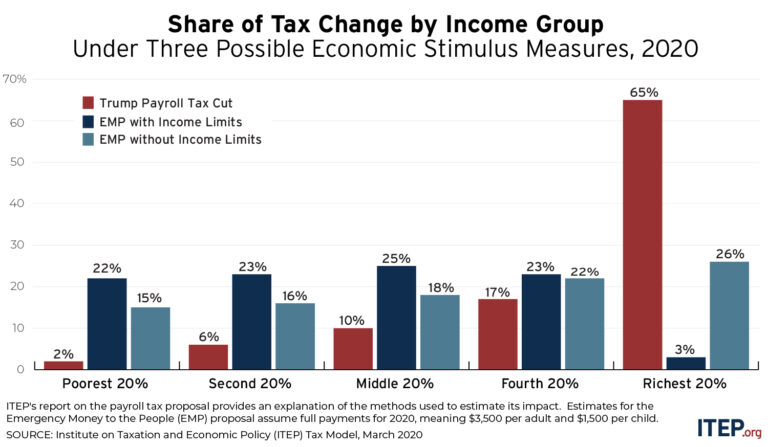
Checks to All vs. Trump’s Payroll Tax Cut
• By Steve Wamhoff
A payroll tax cut would help those lucky enough to keep their job and would provide a bigger break to those with more earnings. Sending checks to every household would be a far more effective economic stimulus because it would immediately put money in the hands of everyone who would likely spend it right away, pumping it back into the economy.

New ITEP Report on President’s Misguided Payroll Tax Proposal
• By Steve Wamhoff
Earlier this week, ITEP analyzed what would happen if Congress and the President repeated the 2 percentage-point cut in the Social Security payroll tax that was enacted for two years during the last recession. Little did we know that President Trump was about to propose something far more radical: eliminating all Social Security and Medicare […]
Trump’s Proposed Payroll Tax Elimination
• By Steve Wamhoff
President Trump has proposed to eliminate payroll taxes that fund Social Security and Medicare through the end of the year. ITEP estimates that this would cost $843 billion and 65 percent of the benefits would go to the richest 20 percent of taxpayers, as illustrated in the table below.

An Overload of Pie Graphs and Metaphors for Pi Day
• By ITEP Staff, Jenice R. Robinson, Stephanie Clegg
For Pi Day, we’re doubling down on the pie metaphor to reiterate the compelling case for progressive tax policies to ensure more of us have an opportunity to share a slice of this nation’s economic pie.

ITEP Testimony on the Illinois Earned Income Credit
• By Lisa Christensen Gee
Read as PDF Testimony of Lisa Christensen Gee, Director of Special Initiatives, Institute on Taxation and Economic Policy Submitted to: Illinois House Revenue Committee Chairman Zalewski, committee members—thank you for holding this subject matter hearing this morning on the Earned Income Credit (EIC) and its importance for hard working Illinoisans and their families. My name […]
Trump’s Proposed Payroll Tax Cut Is Not the Right Answer
• By Steve Wamhoff
The Trump administration is floating a cut in the Social Security payroll tax as a measure to counteract a potential economic downturn related to the COVID-19 virus. It should go without saying that a public health crisis requires government interventions that have nothing to do with taxes. But even if policymakers want to find ways to stimulate the economy beyond solving the health crisis, the payroll tax cut is not likely to be very effective.

Illinois ITIN Impact
• By ITEP Staff
Impact of Including Illinois ITIN Filers in State & Federal EITCs Based on IRS 2015 ITIN Filer Counts and Current EITC Policy Notes: ITIN filer counts represent estimate of EITC eligible ITIN filers in tax year 2015. All $s expressed in 2020. STATE EITC 2015 Assuming Full Participation EITC eligible ITIN Filers: 156,330 State EITC […]

COVID-19 Is No Excuse for Airline Industry or Any Other Corporate Tax Cut
• By Matthew Gardner
Trump administration officials have reportedly floated the idea of including tax breaks for the airline industry in its package of COVID-19-related stimulus proposals, which would allow airline companies to defer income taxes into the future. This is an odd policy choice since most of the biggest airlines are already using deferral to zero out most or all of their federal income taxes on billions of dollars in profits.

Taxes in a Time of Coronavirus
• By Amy Hanauer
Some problems can only be solved when public officials have the resources to act. Today’s public health crisis is that kind of problem. Unfortunately, the Trump administration’s deep tax cuts leave our health infrastructure knee-capped, just when we need it most.

State and Local Cannabis Tax Revenue Jumps 33%, Surpassing $1.9 Billion in 2019
• By Carl Davis
Excise and sales taxes on cannabis raised more than $1.9 billion in 2019. This represents a jump of nearly half a billion dollars, or 33 percent, compared to a year earlier. These are the findings of an ITEP analysis of newly released tax revenue data from the eight states where legal sales of adult-use cannabis took place last year.

Talking Taxes in Alaska
• By Carl Davis
Alaska’s tax system underwent major changes in the 1970s when oil was found at Prudhoe Bay. Lawmakers repealed the state’s personal income tax (making Alaska the only state ever to do so) and began balancing the state’s budget primarily with oil tax and royalty revenue instead. But as oil prices and production levels have declined, a yawning gap has opened between state revenues and the cost of providing vital public services.
ITEP Testimony Regarding Connecticut Senate Bill 16, An Act Concerning the Adult Use of Cannabis
• By Carl Davis
This testimony explains the advantages of the cannabis tax structure proposed in Connecticut’s Senate Bill 16 and offers additional background information as well as ideas for potential changes to the bill.
The Latest Wildly Misleading Argument Against Taxing the Rich
• By Steve Wamhoff
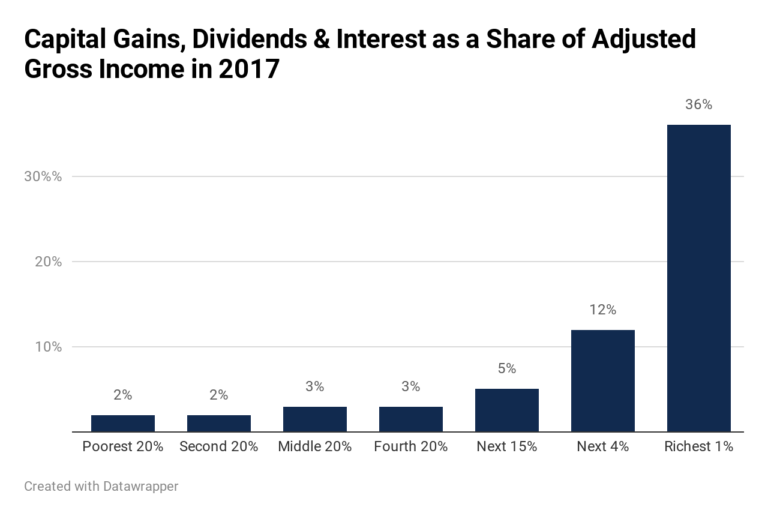
Anti-tax activists’ convoluted claims that the rich pay too much in taxes broke new ground with an op-ed published last week in the Wall Street Journal. Penned by former Texas Sen. Phil Gramm and John Early, a former official of the Bureau of Labor Statistics, the piece is particularly misleading. The so-called evidence in support of their argument against raising taxes on the rich fails to correctly calculate effective tax rates.
West Virginia Center on Budget and Policy: House Income Tax Plan Benefits Wealthy and Could Punch Large Holes in State Budget
• By ITEP Staff
Once the fund reaches “an amount equal to or exceeding 2.5 times the total net reduction in personal income tax revenue collections that would have been received in that fiscal year if the income tax rates for that fiscal year had been reduced by 0.25 percent” it triggers a reduction in the state’s personal income […]
Chicago Resilient Families Task Force: EITC Expansion and Modernization
• By ITEP Staff
Expanding and modernizing the Earned Income Tax Credit will put more money back in the pockets of the people who need it most. Recent polling suggests such policies would be popular, with 70% of respondents supporting a modernized EITC statewide and 80% supporting such an effort in Chicago. Read more

Federal Inaction on the Gas Tax is Costing Us Dearly
• By Carl Davis
Lawmakers should keep in mind that transportation funding woes can be traced to the federal government’s extremely outdated gas tax rate, which has not been raised in more than 26 years—not even to keep up with inflation.

Tax Cuts Floated by White House Advisors Are an Attempt to Deflect from TCJA’s Failings
• By ITEP Staff, Jenice R. Robinson, Steve Wamhoff
Now that multiple data points reveal the current administration, which promised to look out for the common man, is, in fact, presiding over an upward redistribution of wealth, the public is being treated to pasta policymaking in which advisors are conducting informal public opinion polling by throwing tax-cut ideas against the wall to see if any stick. But the intent behind these ideas is as transparent as a glass noodle.
Commonwealth Institute: State Funding Proposals Include Regressive Tax Increases – Many without Offsets
• By ITEP Staff
Although many significant state (Virginia) tax policy bills filed for this year did not move beyond the committee level, several proposals remain under consideration. A large transportation funding package (HB 1414 and SB 890) and several standalone regional transportation funding bills have advanced from their respective chambers in the Virginia General Assembly. In addition, proposed […]

Hawai’i Budget and Policy Center: Hawai’i’s Earned Income Tax Credit: Next Steps
• By ITEP Staff
In 2017, Hawaiʻi passed legislation to create a state EITC.11 The new law allowed qualified taxpayers to claim a state tax credit beginning in 2018. The state tax credit amounts to 20 percent of the federal EITC but, unlike its federal counterpart, Hawaiʻi’s tax credit is not refundable. That is, if the filer owes less […]

How Democratic Presidential Candidates Would Raise Revenue
• By Steve Wamhoff
One of the biggest problems with the U.S. tax code in terms of fairness is that investment income, which mostly flows to the rich, is taxed less than the earned income that makes up all or almost all of the income that working people live on.

West Virginia Center on Budget & Policy: Senate Tax Plan a Bad Deal for West Virginia
• By ITEP Staff
Senate Republicans unveiled their latest proposal to eliminate the business personal property tax this week, passing the proposal out of the Senate Finance Committee. The plan, which builds upon an earlier proposal to eliminate the property tax on manufacturing equipment, machinery, and inventory, would blow a nearly $100 million hole in the state budget, introduce inconsistency in […]

States Can Lead on Making the EITC Benefit More Young and Older Workers
• By Aidan Davis
The federal Earned Income Tax Credit (or EITC) lifts millions out of poverty each year, but it is not created equal for everyone. Childless workers under 25 and over 64 receive no benefit from the existing federal credit. In the absence of immediate federal action, states have led–and continue to lead–the way.

Expanding State EITCs: Age Enhancements and a Credit Increase for Workers without Children in the Home
• By Aidan Davis
For 45 years, the federal Earned Income Tax Credit (EITC) has benefited low- and moderate-income workers. Yet, throughout its history, the EITC has provided little or no benefit to workers without children in the home—a group that includes noncustodial parents whose children live the majority of the year with another parent.
Kentucky Center for Economic Policy: Tax Plan Would Fix Kentucky’s Budget Challenges by Addressing Upside Down Tax Code
• By ITEP Staff
Kentucky’s current tax system lets those with the greatest ability to pay taxes contribute the least as a share of their income. A study by the Institute on Taxation and Economic Policy shows that low- and middle-income people pay between 9.5% and 11.1% of their income in total state and local taxes, while the top 1% pay […]
GBPI: Georgia Leaders Face Choice Between Tax Cuts for High Income Earners and Funding Key State Priorities
• By ITEP Staff
Twelve days into the 2020 session of the Georgia General Assembly, legislators voted to take a week-long break from regular business to allow extra time for deliberations over Georgia’s fiscal priorities and annual appropriations bills. State leaders continue to express concerns over Gov. Kemp’s executive budget proposals, which include the first mandatory agency budget cuts […]

Institute on Taxation
and Economic Policy
ITEP is a non-profit, non-partisan tax policy organization. We conduct rigorous analyses of tax and economic proposals and provide data-driven recommendations to shape equitable and sustainable tax systems.
Subscribe to ITEP Emails
Tax research and policy news in your inbox.
Promote Fair Tax Policy
Your gift to ITEP promotes tax justice. With your help, we do research that supports taxing millionaires and billionaires, taxing big corporations and raising revenue for the things our people, our communities and our planet need.
Together, we can create a country with more economic justice, more racial justice, more climate justice… and more tax justice.