
2,364 posts
ITEP Testimony In Support of H.B. 222 Income Tax Rates – Capital Gains Income & H.B. 256 Maryland Estate Tax – Unified Credit
• By Kamolika Das
Read as PDF Testimony of Kamolika Das, State Policy Analyst, Institute on Taxation and Economic Policy Submitted to: Ways and Means Committee, Maryland General Assembly Thank you for this opportunity to submit testimony. My name is Kamolika Das, and I represent the Institute on Taxation and Economic Policy (ITEP), a non-profit, non-partisan research organization that […]

Trends We’re Watching in 2020
• By ITEP Staff
State lawmakers have plenty to keep them busy on the tax policy front in 2020. Encouraging trends we’re watching this year include opportunities to enact and enhance refundable tax credits and increase the tax contributions of high-income households, each of which would improve tax equity and help to reduce income inequality.
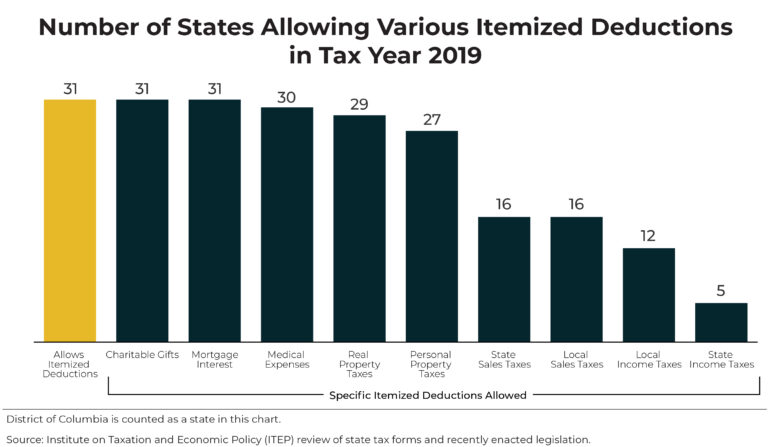
States Can Make Their Tax Systems Less Regressive by Reforming or Repealing Itemized Deductions
• By Carl Davis
Itemized deductions are problematic tax subsidies that need to close. The mortgage interest deduction, for instance, is often lauded as a way to help middle-class families afford homes and charitable deductions are touted as incentivizing gifts to charitable organizations. But the dirty little secret is that itemized deductions primarily benefit higher-income households while largely failing to achieve their purported goals.
State Itemized Deductions: Surveying the Landscape, Exploring Reforms
• By Carl Davis
State itemized deductions are generally patterned after federal law, though nearly every state makes significant changes to the menu of deductions available or the extent to which those deductions are allowed. This report summarizes the key details of each state’s itemized deduction policies and discusses various options for reforming those deductions with a focus on lessening their regressive impact and reducing their cost to state budgets.
Trump Already Did Tax Cuts 2.0… For Corporations
• By Steve Wamhoff
If President Trump puts forth another tax proposal this year, as he is hinting, it will be his third. The second round, already costing the U.S. Treasury billions, was implemented largely out of the public’s view.
Washington Is Finally Having the Right Conversation about Taxes
• By Amy Hanauer
Presidential candidates and some elected officials are finally talking about bold tax policy ideas that would increase taxes and raise revenue. This is a dramatic shift from when a radical, right-wing narrative dominated the public debate. Republicans redefined “fiscal responsibility” as fewer taxes and less government, peddled supply-side economic theories, and denied the clear evidence that tax cuts were adding to our nation’s deficits.

From 0% to 1.2%: Amazon Lauds Its Minuscule Effective Federal Income Tax Rate
• By Matthew Gardner
If we focus on the taxes the company paid in 2019, we see an effective federal income tax rate of just 1.2 percent. And since the company enjoyed federal income tax rebates in 2017 and 2018, this means that over the last three years Amazon has paid zero on $29 billion of U.S. pretax income.
Massachusetts Budget and Policy Center: The Gas Tax: What it is and Who Pays
• By ITEP Staff
Data from the Institute on Taxation and Economic Policy (ITEP) detail how the current system of state and local taxes in Massachusetts is regressive, largely because the state uses a flat income tax rate and relies heavily on sales taxes. The chart above shows how an increase in the gas tax would make Massachusetts taxes […]
Florida Policy Institute: Earned Income Tax Credit Crucial for Working Families
• By ITEP Staff
State EITCs are better targeted to people with low income than blanket tax exemptions, so they help to reduce the disproportionate impact of sales and excise taxes. According to new data from the Institute on Taxation and Economic Policy, a state EITC at 30 percent of the federal credit would reduce the share of income […]
Alabama Arise: End Alabama’s state grocery tax and protect school funding
• By ITEP Staff
How to untax groceries without costing education a dime It’s crucial to replace the grocery tax revenue without hurting the people who would benefit most from the tax’s elimination. Fortunately, Alabama has a way to untax groceries while protecting both struggling families and education funding. That solution would be to end an unusual tax loophole […]

ITEP Urges IRS to End SALT Workaround Scheme for Businesses
• By Carl Davis
A new IRS proposal could once again allow wealthy business owners to use state charitable tax credits–including tax credits for donating to support private and religious K-12 schools–to dodge the federal government’s $10,000 cap on state and local tax (SALT) deductions.
ITEP Comments and Recommendations on REG-107431-19
• By Carl Davis
Comments regarding the possibility that owners of passthrough businesses may be able to circumvent the $10,000 SALT deduction cap of section 164(b)(6) by recharacterizing the nondeductible portion of their state and local income tax payments as deductible expenses associated with carrying on a trade or business.
West Virginia Center on Budget & Policy: Who Pays? Rethinking West Virginia’s Tax System
• By ITEP Staff
To get a sense of a state’s values, one often need look no further than its tax system. What a state spends its tax dollars on and how it acquires those tax dollars typically reveals a lot about the priorities of its people—what they care about and what they stand for. In theory, it’s a […]
New Mexico Voices for Children: Expanding New Mexico’s Best Anti-Poverty Program
• By ITEP Staff
The Working Families Tax Credit (WFTC) is New Mexico’s equivalent of the federal Earned Income Tax Credit (EITC). The WFTC’s eligibility levels and credit amounts are based directly on the EITC, and like most states, the amount is a set percentage of the federal EITC. These tax credits reduce poverty, improve outcomes for children, and […]
Arizona Center for Economic Progress: In Search of a State Budget That Creates Opportunity for All
• By ITEP Staff
While all families in Arizona help pay for health, education and public safety through state and local taxes, low-income and middle-income families pay a larger portion of their income in taxes than do wealthier families. When all types of state and local taxes are combined—income, sales, and property—families with income in the lowest 20 percent […]
The Arizona Center for Economic Progress: In Search 2020
• By ITEP Staff
In Search of State Budget That Creates Opportunity for All When all types of state and local taxes are combined—income, sales, and property—families with income in the lowest 20 percent pay twice what families in the top 1 percent do—$12.95 for every $100 of income and $8.49 for middle income families compared to $5.91 for […]

GOP Legacy on IRS Administration: Auditing Mississippi, not Microsoft
• By Matthew Gardner
Money doesn’t buy happiness—but it can buy immunity from the reach of Uncle Sam. The IRS is outgunned in cases against corporate giants because that’s how Republican leaders want it to be. They have systematically assaulted the agency’s enforcement capacity through decades of funding cuts. Instead of saving money, these cuts have cost billions: each dollar spent on the IRS results in several dollars of tax revenue collected.

• By Amy Hanauer
On the COVID-19 health and economic crisis “The current disaster threatens our health and our economy. Ongoing crises stem from fast-accelerating climate change, skyrocketing inequality, and inadequate federal response to both. We as a country have the resources to address collective problems. But solving them requires that we pull together, raise taxes on those most […]

Why I’ve Joined the Fight for Tax Justice: Amy Hanauer
• By Amy Hanauer
After years of watching tax policy increasingly leave communities behind, at ITEP I’ll have the chance to work with local, state and national partners on policy solutions. I’m prepared to push for a tax system that can better deliver economic, climate and racial justice; for a public sector that can prepare our kids and our grid for 2020 and beyond; and for an America that works for all of us, whether we were born in…
Reforming Connecticut’s Tax System: A Program to Strengthen Working- and Middle-Class Families
• By ITEP Staff
Connecticut Voices for Children released a report that examined the state’s income and wealth inequality and the state’s regressive tax system that exacerbates these inequalities.
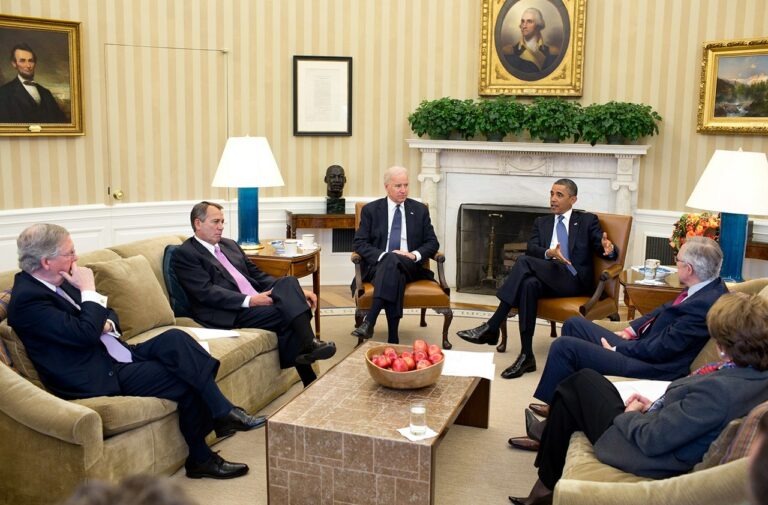
The 2013 Biden-McConnell “Fiscal Cliff” Deal Shows Why the Next President Needs a New Approach to Taxes
• By Steve Wamhoff
Americans have long wanted more progressive tax policies and have told pollsters for years that they want wealthy individuals and big corporations to pay more, not less, in taxes. The only way forward is for lawmakers and the next president to take a dramatically different approach to tax policy.

White House Council of Economic Advisers Crows about Lowest-Income Americans Being Infinitesimally “Wealthier”
• By Matthew Gardner
When the White House Council of Economic Advisors last week tweeted that the poorest 50 percent of Americans’ wealth is growing 3 times faster than the wealth of the top 1 percent, we were skeptical. As it turns out, the CEA’s tweet is a reminder that the poorest 50 percent wealth grew twice as fast during Barack Obama’s second term than it has under Trump, but to this day remains far below its pre-recession share…

Time to Throw Cucumbers
• By Steve Wamhoff
A basic understanding and idea of fairness is a trait we share with intelligent primates, which is precisely why more than two years ago as Congress was debating the Tax Cuts and Jobs Act, the American public disapproved of the tax bill.
Guilty, Not GILTI: Unclear Whether Corps Continue to Lower Their Tax Bills Via Tax Haven Abuse
• By Matthew Gardner
President Trump and GOP lawmakers often cited corporations’ abuse of tax havens, e.g. shifting profits offshore to avoid taxes, as justification for dramatically lowering the federal corporate tax rate under the 2017 Tax Cuts and Jobs Act. By 2016, corporations’ offshore cash haul had grown to $2.6 trillion, representing hundreds of billions in lost federal tax […]

Amy Hanauer
• By ITEP Staff
Amy Hanauer provides vision and leadership to bring accurate research and data to tax policy conversations. As Director, Amy raises resources, guides strategy, and works with the board and staff to make ITEP a critical part of the policy discussion around a stronger tax code. She brings nearly 30 years of experience working to create economic policy that advances social justice.

Institute on Taxation
and Economic Policy
ITEP is a non-profit, non-partisan tax policy organization. We conduct rigorous analyses of tax and economic proposals and provide data-driven recommendations to shape equitable and sustainable tax systems.
Subscribe to ITEP Emails
Tax research and policy news in your inbox.
Promote Fair Tax Policy
Your gift to ITEP promotes tax justice. With your help, we do research that supports taxing millionaires and billionaires, taxing big corporations and raising revenue for the things our people, our communities and our planet need.
Together, we can create a country with more economic justice, more racial justice, more climate justice… and more tax justice.