
ITEP's Research Priorities
- 2025 tax debate
- Blog
- Cannabis Taxes
- Corporate Taxes
- Corporate Taxes
- Earned Income Tax Credit
- Education Tax Breaks
- Estate Tax
- Federal Policy
- Fines and Fees
- Georgia
- Immigration
- Income & Profits
- Income Taxes
- Inequality and the Economy
- ITEP Work in Action
- Local Income Taxes
- Local Policy
- Local Property Taxes
- Local Refundable Tax Credits
- Local Sales Taxes
- Maps
- Media Quotes
- News Releases
- OBBBA
- Other Revenues
- Personal Income Taxes
- Property & Wealth
- Property Taxes
- Property Taxes
- Publications
- Refundable Tax Credits
- Sales & Excise
- Sales, Gas and Excise Taxes
- Sales, Gas and Excise Taxes
- SALT Deduction
- Select Media Mentions
- Social Media
- Staff
- Staff Quotes
- State Corporate Taxes
- State Policy
- State Reports
- States
- Tax Analyses
- Tax Basics
- Tax Credits for Workers and Families
- Tax Credits for Workers and Families
- Tax Guide
- Tax Principles
- Tax Reform Options and Challenges
- Taxing Wealth and Income from Wealth
- Toolkits
- Trump Tax Law
- Trump Tax Policies
- Trump Tax Policies
- Video
- Webinar
- Who Pays?
The New York Times: Wisconsin’s Lavish Lure for Foxconn: $3 Billion in Tax Subsidies
July 28, 2017
Big companies like Foxconn possess leverage to extract concessions from state governments that smaller firms cannot, said Carl Davis, research director at the nonpartisan Institute on Taxation and Economic Policy in Washington. “This is not a comprehensive strategy for economic development,” he said. “If Wisconsin were going to offer this kind of subsidy for every […]
The Atlantic: How Much is Wisconsin Paying for a Taiwanese Manufacturer’s Jobs
July 28, 2017
Plus, states rarely seem to consider whether the money they lavish on corporations might be better spent elsewhere—on public goods like bridges, say, or educational initiatives for their work forces. “If offering more tax incentives requires spending less on public education, congestion-relieving infrastructure projects, workforce development, police and fire protection, or high technology initiatives at […]
The Sacramento Bee: A Jackpot for the 1 Percent, a Pittance for the Rest of Us
July 27, 2017
In California, the bottom line would be even more unfair. The 1 percent with the highest incomes – an average of more than $2.7 million a year – would get nearly two-thirds of the total tax cut, an average of nearly $150,000 each in 2018, the nonpartisan Institute on Taxation and Economic Policy estimated this […]
Trump Touts Tax Cuts for the Wealthy as a Plan for Working People
July 26, 2017 • By Steve Wamhoff
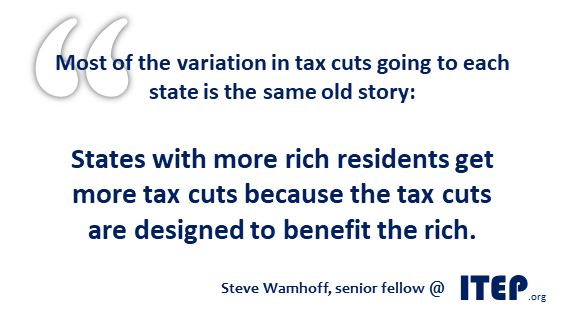
Unless the administration takes a radically different direction on tax reform from what it has already proposed, its tax plan would be a monumental giveaway to the top 1 percent. The wealthiest one percent of households would receive 61 percent of all the Trump tax breaks, and would receive an average of $145,400 in 2018 alone.
Gizmodo: Meet the Shell Company Uber Used to Acquire Otto
July 25, 2017
This kind of patent game has been played best by Pfizer. In its annual report on offshore tax havens used by Fortune 500 companies, the Institute on Taxation and Economic Policy notes that Pfizer hasn’t reported any federal taxable income in eight years, in part because of its effort to offshore its patents. “The company […]
Bloomberg: Americans Say They Back Gas Tax to Fix Crumbling Roads
July 20, 2017
Twenty-six states have raised or updated their gas taxes since 2013, including eight so far this year, according to the Institute on Taxation and Economic Policy, a non-profit research organization in Washington. Read more
Law 360: Wealthy Benefit More Under $5T Trump Tax Plan
July 20, 2017
The Institute on Taxation and Economic Policy on Thursday projected a minimum $4.8 trillion federal revenue reduction over a 10-year period under President Donald Trump’s tax plan that the nonprofit said would give more than three-fifths of all tax cuts to the wealthiest 1 percent of Americans. Based on the broad outlines of the Trump […]
50-State Analysis of Trump’s Tax Outline: Poorer Taxpayers and Poorer States are Disadvantaged
July 20, 2017 • By Alan Essig
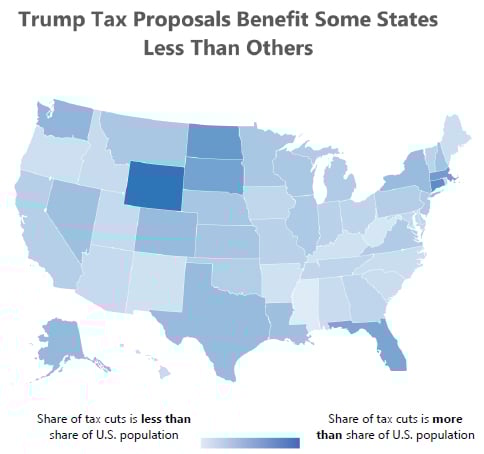
Not only would President Trump’s proposed tax plan fail to deliver on its promise of largely helping middle-class taxpayers, it also would shower a disproportionate share of the total tax cut on taxpayers in some of the richest states while southern and a few other states would receive a smaller share of the tax cut […]
Newsday: Rural America Keeps Rejecting Big Wind
July 19, 2017
Since last October, NextEra Energy, the world’s biggest producer of wind energy, has filed lawsuits in federal and state courts against five rural governments, including the town of Hinton, Oklahoma, population: 3,000. NextEra is funding its courthouse mugging of small-town America with your tax dollars. A recent report by the Institute on Taxation and Economic […]
Louisville Courier-Journal: Fix Kentucky’s Upside Down Tax Code
July 19, 2017
And among other things, the legislation would raise Kentucky’s tax on cigarettes and other tobacco products, including e-cigarettes. This would initially generate about $155 million in revenue, but – more importantly – it would discourage tobacco use and reduce associated costs. Kentucky has one of the highest smoking rates and highest rates of lung cancer […]
The Hill: Tech Groups Voice Support for Tax Reform
July 19, 2017
The U.S. currently taxes companies on their income at home and abroad. Corporations, however, don’t have to pay taxes on their income abroad until they repatriate it back home. Supporters of a territorial system argue it could help bring lost tax dollars back into the U.S. The Institute on Taxation and Economic Policy estimates that […]
Bloomberg BNA: Low Tax Revenue Fuels State Deficits, Budget Battles
July 16, 2017
In more than a dozen other states, legislators fought down to the wire. Maine and New Jersey were forced into brief government shutdowns. Much press was given to New Jersey Gov. Chris Christie’s (R) time at the beach over the July 4th weekend when some stretches of state coastline were closed to beach-goers. “In some […]
MarketWatch: Why Back to School Sales Could Actually Cost You Money
July 14, 2017
Currently 16 states have back-to-school sales tax holidays planned for 2017, with most located in the Southeast. Some states also have sales tax holidays for other products, such as guns and hunting supplies, energy-efficient appliances and hurricane preparedness items. “Sales tax holidays may provide some taxpayers savings on necessary purchases, but they’re a distraction from […]
Richmond Times-Dispatch: Legislator Proposes Exempting Poorest Virginia Localities from Some Taxes
July 14, 2017
Carl Davis, research director at the nonpartisan Institute on Taxation and Economic Policy, says state taxes don’t play that large a role in economic development decisions. Companies search for an ideal location and a trained workforce and balance a host of other factors during site selection. “There’s just so much more than state tax policy […]
Regardless of Political Maneuvers, Tax Cuts for the Rich Remain Tied to Cuts in Health Care
July 13, 2017 • By ITEP Staff

The GOP continues its dogged attempt to unravel the Affordable Care Act under the guise of ‘fixing’ our health system despite multiple Congressional Budget Office reports indicating millions stand to lose health care coverage. It’s is not obvious that this version of the bill is much different from the previous fiasco of a bill in which CBO projected 22 million would lose coverage.
The American Prospect: As Trump Gears Up for Big Tax Cuts, Seattle Opts to Tax Wealthy
July 12, 2017
Currently, Washington is one of the few states that don’t levy a personal or corporate income tax. No cities in Washington levy a tax on income, either. That’s partially why the Institute on Taxation and Economic Policy found in 2015 that the state has most regressive taxation system in the entire country, with low- and […]
Governing: In an Income-Tax Free State, Seattle Hopes to Tax the Rich
July 12, 2017
There were about 11,000 individuals in Seattle with earned annual incomes of at least $250,000 in 2015, according to U.S. Census Bureau data. The Seattle tax would cover both earned and unearned income. “Washington has among the most regressive tax systems in the United States,” the legislation states, citing research by the Institute on Taxation […]
The Hill: Repealing Obamacare Has Always Been about Tax Cuts for the Rich
July 11, 2017
Below is an excerpt of an op-ed by ITEP Senior Fellow Steve Wamhoff that was published in The Hill on July 11, 2017 Does moving a tax cut for the rich out of one bill and into another bill make lawmakers seem more in touch with the middle class? Senators trying to repeal the Affordable […]
Seattle Times: Seattle Council to Vote Today on Income Tax on the Wealthy
July 10, 2017
There were about 11,000 individuals in Seattle with earned annual incomes of at least $250,000 in 2015, according to U.S. Census Bureau data. The Seattle tax would cover both earned and unearned income. “Washington has among the most regressive tax systems in the United States,” the legislation says, citing research by the Institute on Taxation […]
Bloomberg BNA: Private School Tax Credits Transform Charitable Incentive Into Profit Scheme
July 6, 2017
Public schools are funded by taxpayer dollars. School tuition vouchers allow taxpayer dollars to fund private education by paying for private school tuition. Tuition tax credits work in a similar fashion, by allowing a credit for donations to private school voucher funds. In this article, the Institute on Taxation and Economic Policy’s Carl Davis, discusses […]
Reno News and Review: Workers Stuck with the Check
July 5, 2017
According to the Institute on Taxation and Economic Policy, Nevada’s poorest 20 percent of families pay 6.1 percent of their income in sales tax. The wealthiest one percent of Nevada families pay six-tenths of 1 percent. Given the fact that low income people bear a heavier portion of taxation in Nevada than the affluent, the […]
USA Today: Gas Taxes Rise in Seven States As Travelers Hit the Road for July 4 Holiday
June 30, 2017
The urge to hit the road comes as the national average gas price is 4 cents per gallon cheaper than at the same time last year, at $2.28 per gallon, according to AAA. “With gas prices at historically low levels, state lawmakers have decided that now is a good time to ask drivers to pay […]
Huffpost: Why States Are Struggling To Tax Services
June 29, 2017
Another challenge is that taxes on services are regressive, with a disproportionate impact on low-income residents, and are sometimes seen as an unfair way to plug a budget hole or reduce other taxes, prompting opposition from advocates for the poor. “The services that get pulled into these plans … are not necessarily the ones that […]
Senate Health Care Reform Bill Just as “Mean” as the House Version
June 26, 2017 • By Alan Essig
The Congressional Budget Office today released its score of the Senate Health Care proposal and the news is not good. It’s no wonder a narrow group of 13 lawmakers cobbled together the bill behind closed doors. Now that the measure has seen the light of day, we know that it epitomizes Robin Hood in reverse policies by snatching health coverage from 22 million people by 2026 (15 million in 2018) while showering tax cuts on the already wealthy.
Scripps News Service: Money Diverted from Public Schools?
June 26, 2017
All the programs basically work this way: Individuals and businesses make cash or stock donations to scholarship granting organizations. The organizations award scholarships to qualifying families with K-12 students, primarily children in failing public schools or whose families’ income meets the state’s poverty threshold. Students can then attend a private or religious school of their […]

Institute on Taxation
and Economic Policy
ITEP is a non-profit, non-partisan tax policy organization. We conduct rigorous analyses of tax and economic proposals and provide data-driven recommendations to shape equitable and sustainable tax systems.
Subscribe to ITEP Emails
Tax research and policy news in your inbox.
Promote Fair Tax Policy
Your gift to ITEP promotes tax justice. With your help, we do research that supports taxing millionaires and billionaires, taxing big corporations and raising revenue for the things our people, our communities and our planet need.
Together, we can create a country with more economic justice, more racial justice, more climate justice… and more tax justice.