
2,364 posts
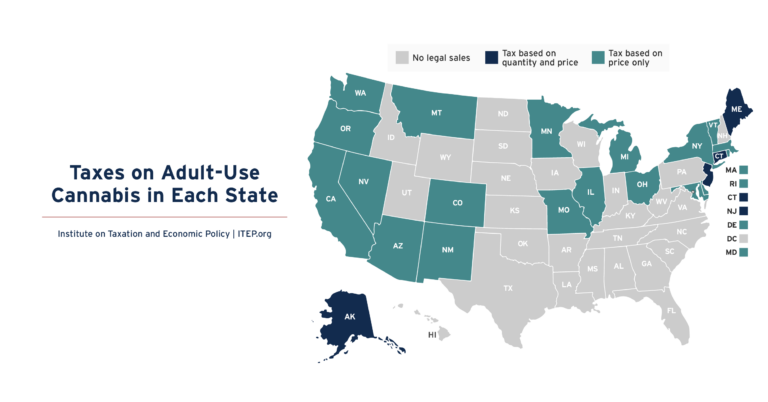
Taxes on Adult-Use Cannabis in Each State
• By Carl Davis
Twenty-three states have legalized the sale of cannabis for general adult use. Every state allowing legal sales applies an excise tax to cannabis based on the product’s quantity, its price, or both. Quantity taxes can be based on either overall product weight or the amount of THC sold. ITEP research indicates that taxes based on […]
Business Insider: Baby Boomers’ Property Tax Revolt
October 30, 2025
“We really do have to deal with the affordability problem of housing in this country at a very basic level in order to get a handle on property taxes. But the way to do that is not to cut property taxes,” [Rita] Jefferson says. Read more.
Americans for Tax Fairness: For Many Families, Trump-GOP Healthcare Premium Hikes Wipe Out Potential Tax Cuts
• By ITEP Staff
An analysis conducted by Americans of Tax Fairness, based on data from the Institute on Taxation & Economic Policy and Center on Budget Policy Priorities, finds that for the tens of millions of families the small benefit of the Trump tax cut would be stolen away through increased health insurance costs. Read more.
The Beacon: Missouri Gives ‘One of the Biggest Millionaire Tax Cuts’ This Year, Report Says
October 28, 2025
This year, Missouri became the first state in the country to tax income but not capital gains. That could present a challenge as the state prepares to face a budget shortfall. Read more.
FACT Coalition: New Report Reveals U.S. Oil and Gas Companies Pay More Tax to Petrostates Than to the U.S. Government
• By Amy Hanauer
Analyzing disclosures from 11 publicly traded U.S. oil and gas companies between 2018 and 2024, the report shows that, despite collectively producing more oil and gas domestically than in all other countries combined, American multinational oil and gas companies only reported owing less than a fifth of their overall taxes in the U.S. Read more.
Bloomberg: Private Jets and Car Washes are the Latest Tax Shields for the Ultrarich
October 27, 2025
President Donald Trump’s signature legislation permanently expands a perk, called bonus depreciation, to 100%, meaning taxpayers can take losses to write off as much as the entire value of qualifying assets from their income… in the hands of tax specialists, the benefit also is a way to scale back what their ultrawealthy clients owe to […]
Stateline: Cities Could Dramatically Cut Childhood Poverty with New Tax Credits, Research Finds
October 27, 2025
Child tax credits are becoming more popular across the country, with more than a dozen states offering them as financial relief toward the cost of raising kids. But new research suggests cities could significantly reduce child poverty by offering child tax credit programs of their own. Read more.
Maine Center for Economic Policy: Missed Opportunities to Advance Tax Fairness and Create a Better State
• By ITEP Staff
The State doesn’t have adequate funding for health care, housing, and many other pressing needs. The fairest way to fix this is by asking the wealthiest people and big businesses to pay more in income taxes. Read more.

America’s Voice: Just Listen To The Experts: You Can’t Have Economic Growth Without Immigrants
• By ITEP Staff
Ignore the ugly rhetoric and just look at the facts: immigration is not only good for our country, it’s necessary to our economic growth and vital to essential industries. Part of that reason is because as U.S.-born workers get older and retire, making immigrant workers even more critical in helping maintain a strong labor force […]
Dogwood: Virginia Republican to Get Big Tax Cut from Bill He Helped Pass
October 16, 2025
Republican US Rep. Rob Wittman of Virginia’s 1st congressional district could save between $19,900 and $59,300 in tax breaks because of President Donald Trump’s “Big Beautiful Bill,” according to an analysis by the nonprofit Institute on Taxation and Economic Policy (ITEP) done for Accountable.US. Read more.
Audio: ITEP’s Spandan Marasini on Corporate Tax Avoidance and What To Do About It
October 16, 2025
ITEP Data Analyst Spandan Marasini appeared on the Oregon Center for Public Policy’s “Policy for the People” podcast, discussing how corporations hide their profits and insights on what can be done to stop it. Listen here.
Los Angeles Times: Corporate Tax Breaks Are Exploding the Federal Deficit, but Who Gets the Benefits?
October 15, 2025
The question is who stands to gain most from the tax policymaking in Washington — corporations, their shareholders and their executives, most of whom don’t have to worry about whether cutting off Obamacare subsidies will leave them unable to afford healthcare, or the millions of Americans for whom the subsidies can often spell the difference […]
The New Republic: The House Republicans Getting Rich Off Trump’s Big Beautiful Bill
October 14, 2025
Why is it taboo for Congress to give itself a tiny raise but fine for it to give itself a huge tax cut? Read more.

JAMA Research Letter: Emergency Medicaid Spending for Undocumented Immigrants in the US
• By ITEP Staff
Proponents of the Budget Reconciliation Law of 2025 state that its trillion-dollar cuts to Medicaid will only affect care for groups whom they argue should not be receiving it, such as undocumented immigrants. Federal law, however, already prohibits undocumented immigrants from qualifying for comprehensive Medicaid, Medicare, and Marketplace options under the Affordable Care Act (ACA). […]
Newsweek: White House Press Secretary Sparks Debate Over Immigrant Health Care Costs
October 9, 2025
Data from the Institute on Taxation and Economic Policy shows undocumented immigrants paid over $96 billion in U.S. taxes in 2022—far exceeding the cost of emergency care they receive. Analysts say the broader health care debate should focus on policy changes that could raise costs for millions of insured Americans. Read more. (To find this […]
Florida Policy Institute: Challenges Ahead: What Census Data Reveals about the Wealth Gap and Uninsured Rate as Florida Braces for H.R. 1
• By ITEP Staff
The Census Bureau’s data provides a baseline for understanding the realities Floridians face. These reports show that while taxes and transfers play a measurable role in reducing inequality and limiting hardship, gains remain uneven — particularly for children. The passage of H.R. 1 threatens to widen these gaps by locking in benefits for the wealthiest […]
Axios Detroit: Experts Offer Insight on Tackling Local Poverty
October 7, 2025
Poverty is a critical and complex issue here. While it’s crucial to draw on longtime local experts, it can also be worthwhile to cast a wider net and see what has worked elsewhere. Read more.

Trump Tax Law Erases Economic, Racial Progress in the Tax Code
• By Brakeyshia Samms
President Trump’s massive tax-and-spending bill continues the administration’s assault on racial and economic justice by prioritizing tax breaks for the top 1% while neglecting the economic well-being of poor and working families of all races, especially people of color.
San Francisco Chronicle: New SALT cap means savings for California homeowners. Here’s how much
October 6, 2025
Steve Wamhoff, director of federal tax policy for the Institute on Taxation and Economic Policy, said his organization’s analysis found less SALT savings for Californians than Redfin reported. He ran the new SALT rules through ITEP’s tax microsimulation model, which uses a database of taxpayer and census records to create a computer model of state […]

Coca-Cola To Shareholders: $18 Billion Tax Bill? What $18 Billion Tax Bill?
• By Matthew Gardner
If Coca-Cola only pays 3% of the $18 billion tax bill it's facing, then the rest of us will have to pick up the remaining 97%.
Governing: Free Child Care for All is Impossible? Don’t Tell New Mexico.
September 30, 2025
The only state with such a program didn’t get there overnight. Years of action at the state Capitol and the ballot box set the stage. It’s a lesson for lawmakers in other states facing the fiscal challenges of providing services families need amid diminishing federal aid. Read more.
Sen. Elizabeth Warren: Letter to Joint Committee on Taxation on Bonus Depreciation
• By ITEP Staff
On July 4, 2025, President Trump signed Republicans’ One Big Beautiful Bill Act (OBBBA) into law. In addition to ripping away health care coverage and food assistance from millions of Americans, this bill enacted numerous massive tax breaks for big corporations, including the permanent extension of 100% bonus depreciation. I write to seek more information […]

State Earned Income Tax Credits Support Families and Workers in 2025
• By Neva Butkus
Nearly two-thirds of states now have an Earned Income Tax Credit (EITC). Momentum continues to build on these credits that boost low-paid workers’ incomes and offset some of the taxes they pay, helping lower-income families achieve greater economic security.

Colorado Lawmakers Help Fill Trump-Induced Shortfall by Tackling Offshore Corporate Tax Avoidance
• By ITEP Staff
As the Trump megabill blows holes in state budgets, Colorado is leading with reforms to curb offshore tax avoidance and roll back wasteful corporate subsidies.

Dismantling Access to the Truth is a Big Deal
• By Erika Frankel
As federal data systems erode, the U.S. risks losing the impartial information needed for sound policymaking and public trust.

Institute on Taxation
and Economic Policy
ITEP is a non-profit, non-partisan tax policy organization. We conduct rigorous analyses of tax and economic proposals and provide data-driven recommendations to shape equitable and sustainable tax systems.
Subscribe to ITEP Emails
Tax research and policy news in your inbox.
Promote Fair Tax Policy
Your gift to ITEP promotes tax justice. With your help, we do research that supports taxing millionaires and billionaires, taxing big corporations and raising revenue for the things our people, our communities and our planet need.
Together, we can create a country with more economic justice, more racial justice, more climate justice… and more tax justice.