
2,364 posts
State Rundown 4/24: States Push Tax Cuts Despite Fiscal Uncertainty
• By ITEP Staff
While some states are preparing for uncertainty – slowing revenue growth, chaos from unpredictable tariffs, cuts to federal programs, etc. – others continue to move forward with plans for deep tax cuts. For instance, Georgia Gov. Brian Kemp signed legislation accelerating the cut to the personal income tax rate, which is currently phasing down. […]

Millions of Citizen Children Would be Harmed by Proposal Billed as Targeting Immigrant Tax Filers
• By Emma Sifre, Joe Hughes
Congressional Republicans have floated a proposal to strip the Child Tax Credit from millions of children who are U.S. citizens and legal residents in situations where their parents do not have Social Security numbers. Approximately 4.5 million citizen children with Social Security numbers would lose access to the credit under this proposal.

The Impact of Trump’s Tariffs
• By ITEP Staff
The tariffs proposed by Donald Trump, which are far larger than any on the books today, would significantly raise the prices faced by American consumers across the income scale.

Ending Direct File Program is a Gift to the Tax-Prep Industry That Will Cost Taxpayers Time and Money
• By Jon Whiten
The Trump administration reportedly plans to shutter the IRS Direct File program before it has a chance to get fully off the ground, taking away a free option for people to file their tax returns directly to the agency. Ending Direct File is another gift from this administration to large corporations, this time to the multibillion-dollar tax prep industry that profits from you filing your taxes.
Trump Administration’s Decision to End Direct File is Another Gift to Big Corporations
• By ITEP Staff
Contact: Jon Whiten (jon@itep.org) According to multiple reports, the Trump administration plans to eliminate the IRS Direct File program, a free electronic system for filing tax returns directly to the agency. Statement from ITEP Executive Director Amy Hanauer “The tax preparation industry has for years lobbied to prevent the IRS from providing a tool to […]

Sharp Turn in Federal Policy Brings Significant Risks for State Tax Revenues
• By Carl Davis
Summary The new presidential administration and Congress have indicated that they intend to bring about a dramatic federal retreat in funding for health care, food assistance, education, and other services that will push more of the responsibility for providing these essential services to the states. Meeting these new obligations would be a challenging task for […]

A Windfall for the Wealthy: A Distributional Analysis of Mississippi HB 1
• By Aidan Davis, Dylan Grundman O'Neill, Neva Butkus
Mississippi lawmakers have approved the most radical and costly change to the state’s personal income tax system to date. House Bill 1 ultimately eliminates the state's personal income tax and cuts state revenues by nearly $2.7 billion a year when fully implemented. This deeply regressive legislation will create a windfall for the wealthiest residents of the poorest state in the nation while simultaneously jeopardizing the state’s ability to fund public services that support Mississippians and…
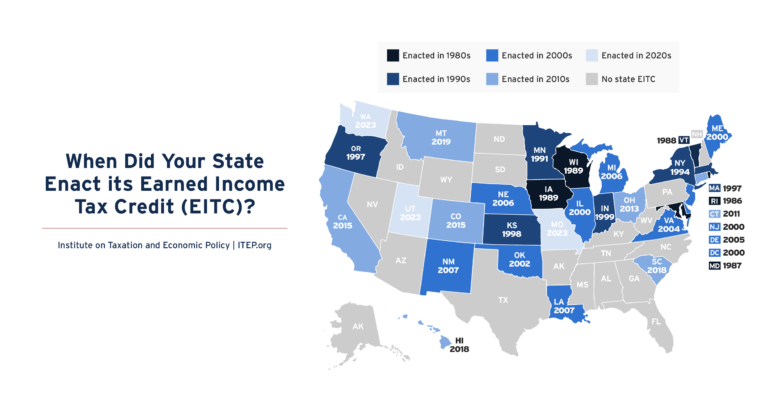
When Did Your State Enact an Earned Income Tax Credit (EITC)?
• By ITEP Staff
The Earned Income Tax Credit (EITC) supports millions of workers and families and continues to grow in states and localities across the country. Today, 31 states plus the District of Columbia and Puerto Rico offer EITCs. Local EITCs can also now be found in Montgomery County, Maryland, New York City, and San Francisco, where they benefited 700,000 households in 2023.

Celebrating 50 Years of the Earned Income Tax Credit
• By Neva Butkus
This week, we celebrate 50 years of the federal Earned Income Tax Credit (EITC) and the impact it's had on millions of workers and families. In 2023 alone, the latest year of available data, the federal EITC alongside the refundable portion of the Child Tax Credit lifted 6.4 million people and 3.4 million children out of poverty.

Advantaging Affluence: A Distributional Analysis of Missouri HB 798’s Uneven Tax Cuts for Wealth and Work
• By Aidan Davis, Carl Davis, Dylan Grundman O'Neill, Eli Byerly-Duke, Matthew Gardner
Missouri House Bill 798 would reduce personal and corporate income tax rates, fully eliminate taxes on capital gains income from sale of assets, and eliminates the state’s modest Earned Income Tax Credit that assists many working people in lower-paid jobs. HB 798 would radically transform Missouri’s income tax code into a system that privileges income from wealth over income from work, leaving many middle-income families to pay a higher income tax rate than wealthy people…

Ben Coll
• By ITEP Staff
Ben joined ITEP as a developer in 2025 and builds internal and external tools to advance ITEP’s mission. Prior to joining ITEP, Ben spent over 10 years working as the web and IT project manager for a national non-profit in the health and beauty industry.

Federal Tax Policy: What Should It Accomplish?
• By Steve Wamhoff
The U.S. needs a tax code that is more adequate, meaning any major tax legislation should increase revenue, not reduce it. The U.S. also needs a tax code that is more progressive, meaning any significant tax legislation should require more, not less, from those most able to pay.

Jessica Vela
• By ITEP Staff
Jessica is a Federal Policy Analyst who supports ITEP with research and analysis of progressive tax priorities. Prior to joining ITEP in 2025, Jessica worked for the Center for American Progress, where she researched federal tax and budget policies. She graduated from Middlebury College with a degree in International Politics and Economics.

Shelter Skelter: How the Educational Choice for Children Act Would Use Tax Avoidance to Fuel School Privatization
• By Carl Davis
The Educational Choice for Children Act of 2025 would ostensibly provide a tax break on charitable donations to organizations that give out private K-12 school vouchers. Most of the so-called “contributions,” however, would be made by wealthy people solely for the tax savings, as those savings would typically be larger than their contributions.

A Revenue Impact Analysis of the Educational Choice for Children Act of 2025
• By Carl Davis
The Educational Choice for Children Act of 2025 would provide donors to nonprofit groups that distribute private K-12 school vouchers with a dollar-for-dollar federal tax credit in exchange for their contributions. In total, the ECCA would reduce federal and state tax revenues by $10.6 billion in 2026 and by $136.3 billion over the next 10 years. Federal tax revenues would decline by $134 billion over 10 years while state revenues would decline by $2.3 billion.
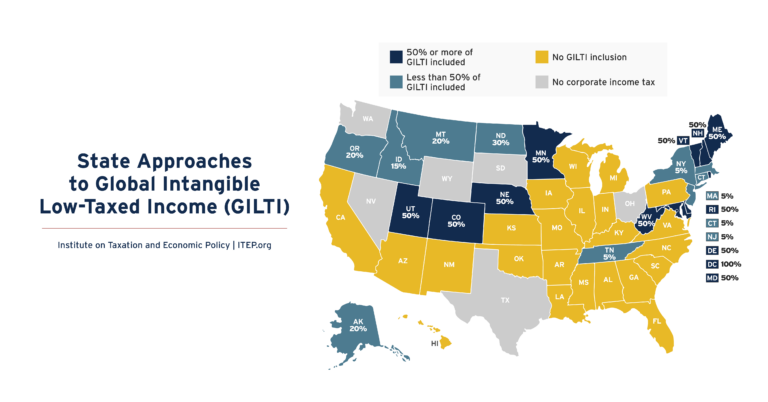
State Approaches to Global Intangible Low-Taxed Income (GILTI)
• By ITEP Staff
Many states with corporate income taxes include some amount of federally defined Global Intangible Low-Taxed Income (GILTI) in their tax bases. Twenty-one states plus D.C. include some amount of GILTI in their tax calculations in 2025.

Proposed Missouri Tax Shelter Would Aid the Wealthy, Anti-Abortion Centers Alike
• By Carl Davis
In Missouri, donations to anti-abortion pregnancy resource centers come with state tax credits valued at 70 cents on the dollar. One bill currently being debated in the state would increase that matching rate to 100 percent—that is a full, state-funded reimbursement of gifts to anti-abortion groups.

Trump’s Address to Congress Obscures His Actual Tax Agenda
• By Amy Hanauer
In last night’s address to Congress, President Trump spent more time insulting Americans, lying, and bragging than he did talking about taxes. But regardless of what President Trump and Elon Musk talk about most loudly and angrily, there is one clear policy that they and the corporations and billionaires that support them will try hardest […]

House Budget Resolution Tees Up Damaging Trump Tax Agenda
• By Steve Wamhoff
The budget resolution passed by House Republicans will enrich the richest, blow up the deficit, and decimate vital public services. The budget resolution allows Congress to pass reconciliation legislation with $4.5 trillion in tax cuts that would mostly flow to the wealthiest families in the country. Congressional Republicans have no way to pay for the massive tax cuts promised by President Trump during his campaign other than to dismantle fundamental parts of the government and…

Sarah Austin
• By ITEP Staff
Sarah is a Senior Analyst at ITEP. She focuses her research on progressive revenue-raising options for states. Before joining ITEP in 2025, Sarah served as senior policy advisor to the Speaker of the Maine House of Representatives. Prior to that, she served as the research and policy director at the Maine Center for Economic Policy […]
Revenue Effect of Mandatory Worldwide Combined Reporting by State
• By ITEP Staff
Universal adoption of mandatory worldwide combined reporting (WWCR) in states with corporate income taxes would boost state tax revenue by $18.7 billion per year. The revenue effects of mandatory WWCR would vary across states. We estimate that 38 states and the District of Columbia would experience revenue increases totaling $19.1 billion. The top 10 states […]
Corporate Income Tax Filing Methods: States with Water’s Edge or Worldwide Combined Reporting
• By ITEP Staff
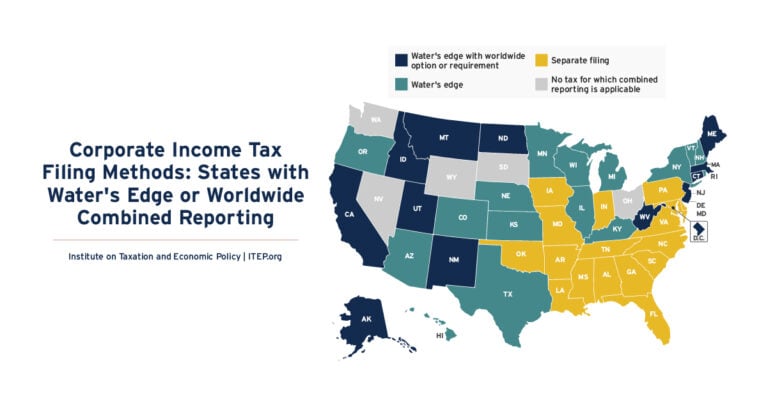
The purpose of state corporate income taxes is to tax the profit, or net income, an incorporated business earns in each state. Ascertaining the state where profits are earned is, however, complicated for companies that conduct business in multiple jurisdictions. Twenty-eight states plus D.C. now require a limited version of combined reporting called “water’s edge” […]

Michael Mazerov
• By ITEP Staff
Michael Mazerov is a member of ITEP’s Board of Directors. He previously served as a Senior Fellow at the Center on Budget and Policy Priorities and as Director of Policy Research at the Multistate Tax Commission.

A Revenue Analysis of Worldwide Combined Reporting in the States
• By Carl Davis, Matthew Gardner, Michael Mazerov
Universal adoption of mandatory worldwide combined reporting would boost state corporate income tax revenues by roughly 14 percent. Thirty-eight states and the District of Columbia would experience revenue increases totaling $19.1 billion.
Turning IRS Agents to Deportation Will Reduce Public Revenues
• By Carl Davis, Jon Whiten
The Trump Administration’s plan to turn IRS agents into deportation agents will result in lower tax collections in addition to the harm done to the families and communities directly affected by deportations.

Institute on Taxation
and Economic Policy
ITEP is a non-profit, non-partisan tax policy organization. We conduct rigorous analyses of tax and economic proposals and provide data-driven recommendations to shape equitable and sustainable tax systems.
Subscribe to ITEP Emails
Tax research and policy news in your inbox.
Promote Fair Tax Policy
Your gift to ITEP promotes tax justice. With your help, we do research that supports taxing millionaires and billionaires, taxing big corporations and raising revenue for the things our people, our communities and our planet need.
Together, we can create a country with more economic justice, more racial justice, more climate justice… and more tax justice.