
2,364 posts

Options to Reduce the Revenue Loss from Adjusting the SALT Cap
• By Carl Davis, ITEP Staff, Matthew Gardner, Steve Wamhoff
If lawmakers are unwilling to replace the SALT cap with a new limit on tax breaks that raises revenue, then any modification they make to the cap in the current environment will lose revenue and make the federal tax code less progressive. Given this, lawmakers should choose a policy option that loses as little revenue as possible and that does the smallest amount of damage possible to the progressivity of the federal tax code.

The One Thing Missing From the Qualified Business Income Deduction Conversation: Racial Equity
• By Marco Guzman
When crafting tax policy, lawmakers and bill authors often work backward, using a patchwork of changes to help achieve their stated goal. One important consideration that is routinely left out is what impact the change will have on racial equity. Such is the case with the qualified business income deduction, which is helping to further enrich wealthy business owners, the overwhelming majority of whom are white. At present, white Americans own 88 percent of private…

Eliminating the State Income Tax Would Wreak Havoc on Mississippi
• By Kamolika Das
History has repeatedly shown that such policies harm state economies, dismantle basic public services, and exacerbate tax inequities.
State Rundown 8/18: End of Summer Tax Update
• By ITEP Staff
Summer is quickly (and sadly) coming to an end and if you’ve been away enjoying the great outdoors or off the grid, we’re here to help keep you up to date on what’s been happening on the tax front around the country...
One Voice: Who Pays, Mississippi? An Overview of State Tax Policy and Racial Equity Impacts
• By ITEP Staff
Historic and current injustices, both in public policy and in society more broadly, have resulted in vast disparities in income across race and ethnicity in Mississippi. State and local tax codes are not the sole contributors to, nor will they be the sole solution to, racial economic inequities. However, the state’s tax system is playing […]
North Carolina Policy Watch: NC House Tax Plan Isn’t Good for Our State (And These Graphs Explain Why This Is the Case)
• By ITEP Staff
The House tax plan would deliver the greatest share of the net tax cut to the richest North Carolinians. Fifty-six percent of the net tax cut would go to the richest 20 percent in North Carolina. During the House Finance debate, proponents of the tax plan suggested that North Carolinians with poverty-level incomes would see […]

State Experimentation with Sales Tax Holidays Magnifies Their Flaws
• By Dylan Grundman O'Neill
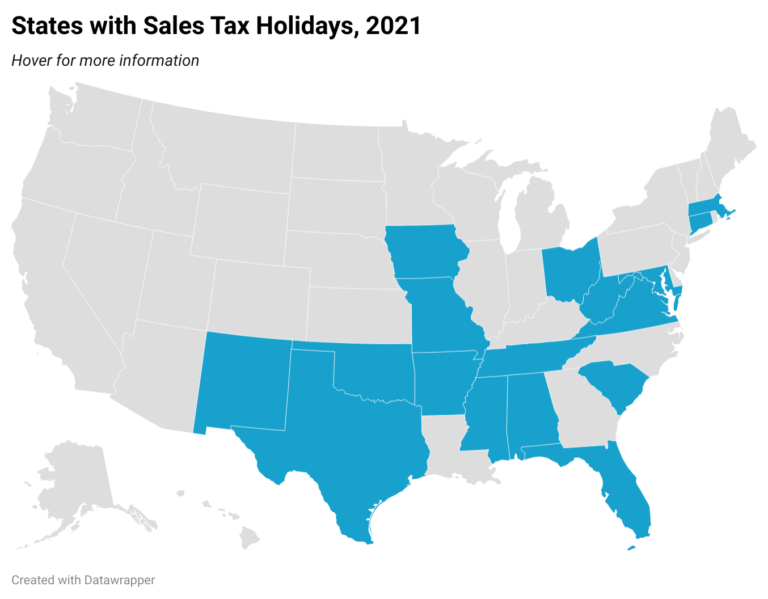
It’s back-to-school shopping season, so…everyone who buys a cell phone in Arkansas this weekend will do so sales-tax-free. For this whole week in Connecticut, and for the entire spring in New Mexico, the corporate owners of highly profitable multinational restaurant chains had the option to pocket their customers’ taxes rather than remit them to the state to fund vital public services, pass along those savings to their customers, or give a much-needed boost to their…
Sales Tax Holidays: An Ineffective Alternative to Real Sales Tax Reform
• By Dylan Grundman O'Neill
Policymakers tout sales tax holidays as a way for families to save money while shopping for “essential” goods. On the surface, this sounds good. However, a two- to three-day sales tax holiday for selected items does nothing to reduce taxes for low- and moderate-income taxpayers during the other 362 days of the year. Sales taxes are inherently regressive. In the long run, sales tax holidays leave a regressive tax system unchanged, and the benefits of…

Good Climate Policy Is Good Economic Policy, Too
• By Ian Berlin
Congress is proving that there does not need to be a trade-off between good climate policy and good economic policy. Direct hires aside, an even bolder government-backed effort to secure the future of our planet could create as many as 25 million net new jobs at its peak, as well as 5 million permanent jobs, many of which deal directly with domestic infrastructure and cannot be outsourced. With the U.S. economy still down 5.7 million…

Why Local Governments Need an Anti-Racist Approach to Property Assessments
• By Ambika Sinha
Property taxes are among the oldest and most relied upon form of local taxes. Revenue raised from these taxes funds education, firefighting, law enforcement, street and infrastructure maintenance, and other essential services. Though all members of the community enjoy these public goods, homeowners of color, especially Black families, pay more as a share of home value in property taxes than their white counterparts.
State Rundown 8/4: Tis the Season…for Unnecessary Sales Tax Holidays
• By ITEP Staff
It’s beginning to look a lot like that time of year again. That’s right, it’s sales tax holiday season and states across the country are doing their best to induce spending that would probably occur regardless...

• By Aidan Davis
Child Tax Credit Expansion Acknowledges There Is More We Can Do for Children “Decades of public policies have built inequities into our economic system, yet some political leaders and public figures continue to perpetuate the myth of a level playing field in which anyone who works hard enough can have it all.”
North Carolina Policy Watch: NC’s Tax Code Reinforces Racial Exclusion; Senate’s Proposed Budget Would Make Matters Worse
• By ITEP Staff
When one applies a unique tool developed by the Institute on Taxation and Economic Policy to assess the racial and ethnic impact of the budget proposal approved by the state Senate in June (SB 105), it becomes clear that the proposed income tax reductions will worsen the state’s exclusionary tax code. This analysis should serve […]
Fortune: Newsletters, Bull Sheet
July 29, 2021
39. That’s the number of profitable S&P 500 and/or Fortune 500 companies who paid no federal income tax from 2018 through 2020—the first three years that the Trump administration’s Tax Cuts and Jobs Act was in effect—per a new report from the Institute on Taxation and Economic Policy (ITEP) think tank. Read more
Common Dreams: 73 Major Corporations Paid Just 5.3% Federal Tax Rate Between 2018 and 2020: Report
July 29, 2021
Thirty-nine U.S. corporations reaping over $120 billion in profits between 2018 and 2020—the first three years of the so-called “GOP tax scam”—paid no net federal income tax, or claimed refunds during that period, a report published Thursday by the Institution on Taxation and Economic Policy revealed. Read more

Corporate Tax Avoidance Under the Tax Cuts and Jobs Act
• By ITEP Staff, Matthew Gardner, Steve Wamhoff
Thirty-nine profitable corporations in the S&P 500 or Fortune 500 paid no federal income tax from 2018 through 2020, the first three years that the Tax Cuts and Jobs Act (TCJA) was in effect. Besides the 39 companies that paid nothing over three years, an additional 73 profitable corporations paid less than half the statutory corporate income tax rate of 21 percent established under TCJA. As a group, these 73 corporations paid an effective federal…
The Case for Biden’s Tax Agenda
• By ITEP Staff
President Joe Biden’s “Build Back Better” plan is the most ambitious economic and social agenda since Lyndon B. Johnson’s Great Society. It would redirect policy priorities to create educational and economic opportunities for low- and middle-income people and require corporations and wealthy people to pay a fairer share of taxes.
State Rundown 7/21: States Go for Tax Policy Gold This Olympics Season
• By ITEP Staff
It’s Olympics season! As countries around the globe battle for first place in a plethora of sports and contests it’s as good a time as any to look around America to see which states deserve a gold medal in the ‘Equitable Tax Policy’ event...

Child Tax Credit Expansion Acknowledges There Is More We Can Do for Children
• By Aidan Davis
For the next six months, low-, middle- and upper-middle-income families with children are eligible to receive part of their 2021 Child Tax Credit (CTC) in advanced monthly payments. More than putting money in people’s pockets, this policy recognizes “the dignity of working-class families and middle-class families,” as President Biden said last week.

Opposition to Biden’s Tax Plan Has Nothing to Do with Small Businesses or Family Farms
• By Steve Wamhoff
Special interests lobbying against President Joe Biden’s tax agenda claim that his proposed corporate income tax rate hike will harm small businesses and that his proposed capital gains tax reforms will hurt family farms. Both claims are absurd attempts by powerful interests to pretend they are defending the little guy.
Washington Post Confirms that Corporations Are Bolder than Ever in Claiming Dubious Tax Breaks
• By Steve Wamhoff
IRS budget cuts starting in 2010 have forced the agency to reduce its audit rate for corporations with $20 billion or more in assets from 98 percent to 50 percent. The Washington Post found that during the decade, the amount of “uncertain tax benefits” claimed by corporations increased 43 percent, from $164 billion in 2010 to $235 billion in 2020.

The Last Dance for Billionaire Sports Owners?
• By Reggie Rucker
Comparing athletes to inanimate objects, of course, is incredibly degrading. It’s also standard fare in the sports talk world to compare athletes to stocks in which you want to buy low and trade high to maximize your returns—the greatest return usually being championship trophies. It wasn’t until ProPublica released its latest report, The Billionaire Playbook: How Sports Owners Use Their Teams to Avoid Millions in Taxes, that we were able to see so clearly how…

Experts Weigh in on the Payoffs of Advanced Child Tax Credit Payments
• By Jenice R. Robinson
During a Tuesday webinar (The Child Tax Credit in Practice: What We Know about the Payoffs of Payments) hosted by ITEP and the Economic Security Project, panelists explained why the expanded Child Tax Credit is a transformative policy that should be extended beyond 2021. They highlighted tax policy and anti-poverty research and discussed lessons learned from demonstration projects that have provided a guaranteed income to low-income families.

A Divided and Insufficiently Taxed House Cannot Stand
• By Guest Blogger
“It’s not just condominium buildings that are showing their age,” Peter Coy writes in a piece critiquing the condominium form of ownership for underinvesting in maintenance. Coy just as easily could have been describing American democracy that is showing its age in similar ways.

DC Fiscal Policy Institute: NEW VIDEOS: Why DC’s Wealthiest Should Pay their Fair Share
• By ITEP Staff
The highest income residents in DC pay less as a share of their income than the rest of us. At the same time, low-income Black and brown DC residents have been economically devastated by the pandemic. Watch videos

Institute on Taxation
and Economic Policy
ITEP is a non-profit, non-partisan tax policy organization. We conduct rigorous analyses of tax and economic proposals and provide data-driven recommendations to shape equitable and sustainable tax systems.
Subscribe to ITEP Emails
Tax research and policy news in your inbox.
Promote Fair Tax Policy
Your gift to ITEP promotes tax justice. With your help, we do research that supports taxing millionaires and billionaires, taxing big corporations and raising revenue for the things our people, our communities and our planet need.
Together, we can create a country with more economic justice, more racial justice, more climate justice… and more tax justice.