
2,364 posts

Treasury Secretary Mnuchin to Unemployed Workers: Don’t Worry, Get a Bank Loan
• By Jenice R. Robinson
In an explanation that can only be called richsplaining, Treasury Secretary Steve Mnuchin on Thursday suggested that Congress’s delay in approving expanded unemployment benefits was no problem because banks would extend loans to people in the meantime.

Republican COVID Relief Plan Doesn’t Rise to the Moment
• By Amy Hanauer
Media contact Following is a statement by Amy Hanauer, executive director of the Institute on Taxation and Economic Policy (ITEP), regarding the pending Republican plan for phase IV COVID-19 relief. Details are emerging about the plan, which Senate leadership has not formally released. “Republicans are struggling to agree on the next round of COVID relief […]

Biden Proposes to Fund Child Care and Elder Care by Shutting Down Tax Breaks for Real Estate Investors
• By Steve Wamhoff
On Tuesday, Democratic presidential candidate Joe Biden announced a $775 billion proposal to expand care options for children and elderly people, suggesting that the cost would be at least partly offset by paring back tax breaks for real estate investors. Bigtime real estate investors are simply unaccustomed to operating without government subsidies provided through the tax code.
New ITEP Report on Trump’s Payroll Tax Holiday
• By Steve Wamhoff
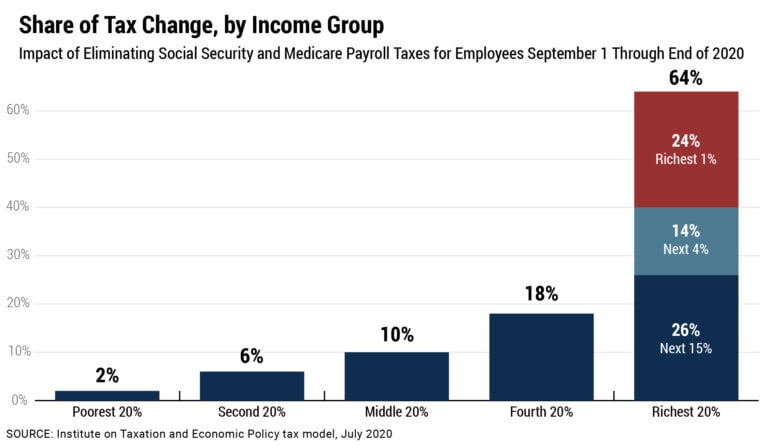
While the White House hasn’t clarified what it is proposing, we know that a payroll tax cut would not be well-targeted. In a new report, ITEP estimates the effects of suspending Social Security and Medicare payroll taxes for employees and employers from September 1 through the end of the year. We find that 64 percent of the benefits would go to the richest 20 percent of Americans while 24 percent of the benefits would go…

New Analysis: Payroll Tax Cut Would Cost $336 Billion, Benefit Top 1 Percent Most
• By Steve Wamhoff
Media contact Temporarily eliminating all federal payroll taxes through the end of the year would cost $336 billion, deliver 64 percent of its benefits to the richest 20 percent of households and fail to provide help to unemployed workers who are struggling most due to the economic downturn, the Institute on Taxation and Economic Policy […]
An Updated Analysis of a Potential Payroll Tax Holiday
• By Jessica Schieder, Matthew Gardner, Steve Wamhoff
ITEP estimates that if Congress and the president eliminated all Social Security and Medicare payroll taxes paid by employers and employees from Sept. 1 through the end of the year, 64 percent of the benefits would go the richest 20 percent of taxpayers and 24 percent of the benefits would go to the richest 1 percent of taxpayers, as illustrated in the table below. The total cost of this hypothetical proposal would be $336 billion.
Bloomberg: Virus Surge Hits Budgets of States Most Vulnerable to Shutdowns
July 17, 2020
As the two states have each surpassed nearly 600,000 confirmed cases combined, with daily new cases in the tens of thousands, governors in Florida and Texas are considering scaling back their economies amid enormous pressure. Their initial hesitancy to shut down may have fueled the recent surges according to some reports. Yet, experts say that […]

SALT Cap Repeal Has No Place in COVID-19 Legislation: National and State-by-State Data
• By Steve Wamhoff
The Trump-GOP tax law enacted at the end of 2017 includes a $10,000 cap on the amount of state and local taxes (SALT) that people can deduct on their federal tax returns, and this is one of the few limits the law places on tax breaks for high-income people. Unfortunately, it is also the provision that some Democrats are most determined to remove.
New Prosperity Now Report Identifies Upside-Down Tax Incentives
• By Jessica Schieder
Ahead of this year’s delayed Tax Day, our partners at Prosperity Now released a powerful report providing a comprehensive overview of many of the ways our federal tax system privileges wealth over work, while also lifting up several provisions which could serve as a template for improving progressivity within the tax code. The report makes […]
Salon: “Stunningly Tone-Deaf”: Ivanka Trump Criticized for Urging Jobless Americans to “Find Something New”
July 14, 2020
Roughly two-thirds of the temporary payroll tax cut would flow to the richest 20% of Americans, while the poorest 40% would get only 6% of the benefit, according to the Institute for Taxation and Economic Policy. Such tax breaks are “insufficiently targeted and largely meaningless to those who’ve lost their jobs and are no longer […]
The Epoch Times: Biden’s Progressive Tax Proposal Raises Rates on Wealthy and Corporations
July 14, 2020
“It’s probably one of the most progressive tax plans we’ve seen from a presidential nominee from one of the two major parties in many, many years,” Steve Wamhoff, director of federal tax policy at the Institute on Taxation and Economic Policy told the Epoch Times. Unlike Sens. Bernie Sanders and Elizabeth Warren, Biden has not advocated for […]
Law 360: State And Local Tax Policy To Watch In The 2nd Half Of 2020
July 14, 2020
As states grapple with refilling their coffers in response to the COVID-19 pandemic, tax policy debates in the second half of 2020 could center on revisiting conformity to the federal code and a consideration of broad-based tax proposals. Additionally, some states are contemplating wading into untested legal waters by taxing digital advertising, while practitioners are […]
Urban Milwaukee: Labor Leaders Slam Trump for Betraying Working People
July 14, 2020
By Democratic Party of Wisconsin The tax law Trump pushed through was a boon for large corporations, including those in Wisconsin like Kimberly Clark, that used the handout to shutter their facilities, issue stock buybacks, and lay off workers instead of creating jobs and increasing wages. Read more
The Moneyist: ‘I’m Having a Hard Time Understanding How Earning Over $200K/year Is Too Much to Qualify for a Decent Stimulus Check’
July 14, 2020
According to the Institute on Taxation and Economic Policy, the majority of state tax systems are regressive. “Those in the highest-income quintile pay a smaller share of all state and local taxes than their share of all income while the bottom 80% pay more. In other words, not only do the rich, on average, pay […]
Who Pays Taxes in America in 2020?
• By ITEP Staff, Matthew Gardner, Steve Wamhoff
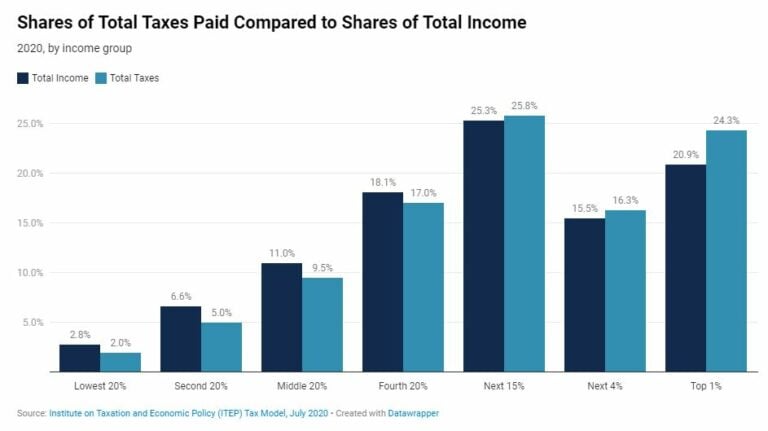
Having a sound understanding of who pays taxes and how much is a particularly relevant question now as the nation grapples with a health and economic crisis that is devastating lower-income families and requiring all levels of government to invest more in keeping individuals, families and communities afloat. This year, the share of all taxes paid by the richest 1 percent of Americans (24.3 percent) will be just a bit higher than the share of…

ITEP: Tax Cuts for the Rich Will Exacerbate Inequality, Fail to Address Current Economic Crisis
• By Amy Hanauer
Following is a statement by Amy Hanauer, executive director of the Institute on Taxation and Economic Policy, regarding White House Advisor Larry Kudlow’s statement on priorities for the next economic relief package.

Adequately Funding the IRS Would Be One Small Step Toward Racial Equity in the Tax Code
• By Jenice R. Robinson
IRS Commissioner Charles Rettig vowed to work with Congress to explore how the federal tax system contributes to the racial wealth gap. There are at least two ways this can happen: tax policies enacted by Congress and IRS enforcement of these policies.
Wall Street Journal Opinion: Payroll-Tax Cuts Mostly Go to the Well Off
July 9, 2020
Contrary to the authors’ claim, a payroll tax cut wouldn’t “disproportionately benefit” lower-income workers. According to the Institute on Taxation and Economic Policy, nearly half of the benefit from a payroll-tax cut would go to the richest 20% of taxpayers, and would be a boon to big corporations that are under no obligation to rehire […]
Jacobin: The 1 Percent Are Cheating Us Out of a Quarter-Trillion Dollars in Taxes Every Year
July 9, 2020
On the international front, Trump’s 2017 tax cut bill included several provisions that “encourage American-based corporations to shift profits offshore,” according to the Institute for Taxation and Economic Policy. The administration has also recently moved to roll back rules designed to crack down on so-called corporate inversions, whereby companies incorporate offshore in order to avoid […]
Yahoo Finance: This GOP Proposal May Slash Taxes for Big Tech: ITEP
July 9, 2020
Matthew Gardner, Senior Fellow at the Institute on Taxation and Economic Policy, joins Yahoo Finance’s Zack Guzman to discuss how a possible Republican tax credit proposal could provide new breaks to tax avoiders like Netflix and ITEP. Watch here (video)
MedPage Today: Tenet Gets Big Federal $$$ but Still Cuts Employees
July 9, 2020
Many companies, including Tenet, delayed paying their 2017 tax liabilities at the rate then (35%) to follow whatever the rate is when they decide to pay (21% for 2019), said Matthew Gardner, a senior fellow with the Institute on Taxation and Economic Policy. “That’s certainly an incentive created by the tax cut,” Gardner told MedPage […]
Gothamist: Undocumented Immigrants In Need Finally Get Promised Pandemic Cash Assistance
July 9, 2020
Most workers who lost their jobs during the COVID-19 pandemic started receiving unemployment and federal stimulus checks in March and April. But undocumented immigrants don’t qualify, even though the Institute on Taxation and Economic Policy found more than half pay taxes (including over $1 billion in New York alone). U.S. citizens married to undocumented immigrants […]
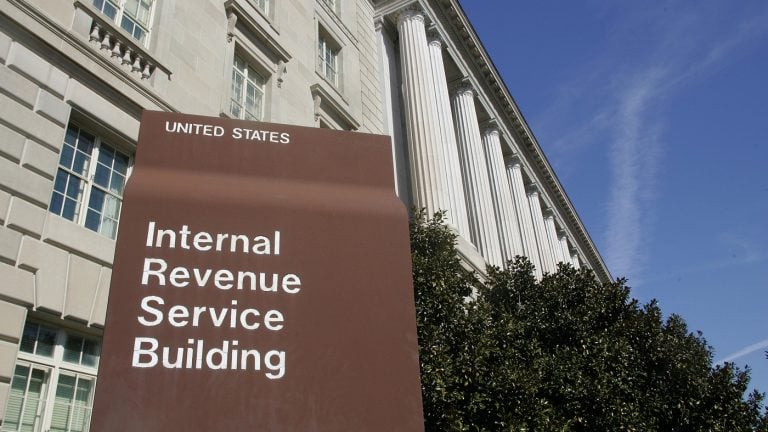
Congressional Budget Office Confirms That IRS Budget Cuts Lose Money and Benefit the Rich
• By Steve Wamhoff
Lawmakers often claim that they are “saving” taxpayers money by slashing federal spending, but the truth is that these cuts often are counterproductive and costly in the long-term. One type of budget-cutting has costs that are immediate and obvious—cuts to the IRS, the agency that collects the revenue that pays for federal spending. A new report from the Congressional Budget Office (CBO) confirms that lawmakers’ anti-government, IRS funding-cuts zeal has increased the deficit.
Business Insider: Trump Wants Tax Breaks to Encourage People to Watch Sports Games and Travel Around the US. Here’s Why That Could Backfire as the Pandemic Rages.
July 8, 2020
The McSally proposal also drew fire from economists who argued it would mainly benefit wealthier taxpayers and not be well targeted. “Low and most middle-income families will receive no or minimal benefit as you can’t claim the maximum credit until you’re pretty well off,” Matthew Gardner, a senior fellow at the left-leaning Institute on Taxation […]
Financial Times: ‘It’s a Matter of Fairness’: Squeezing More Tax From Multinationals
July 8, 2020
Since the late 1980s, there has been a complete change in mindset, one pioneered and taken to its extreme by General Electric, America’s biggest manufacturer by market capitalisation for most of the past 40 years. Under the late Jack Welch, who ran the company from 1981 to 2001, a tiny corporate tax team was transformed […]

Institute on Taxation
and Economic Policy
ITEP is a non-profit, non-partisan tax policy organization. We conduct rigorous analyses of tax and economic proposals and provide data-driven recommendations to shape equitable and sustainable tax systems.
Subscribe to ITEP Emails
Tax research and policy news in your inbox.
Promote Fair Tax Policy
Your gift to ITEP promotes tax justice. With your help, we do research that supports taxing millionaires and billionaires, taxing big corporations and raising revenue for the things our people, our communities and our planet need.
Together, we can create a country with more economic justice, more racial justice, more climate justice… and more tax justice.