
2,364 posts
Trends We’re Watching in 2019: The Use of Targeted Tax Breaks to Help Address Poverty and Inequality
• By Aidan Davis
Continuing to build upon the momentum of previous years, states are taking steps to create and improve targeted tax breaks meant to lift their most in-need state residents up and out of poverty. Most notably, a range of states are exploring ways to restore, enhance or create state Earned Income Tax Credits (EITC). EITCs are an effective tool to help struggling families with low wages make ends meet and provide necessities for their children. The…
Maine Center for Economic Policy: To Fund Shared Prosperity, We Must End LePage-Era Tax Cuts for the Wealthiest
• By ITEP Staff
For years under Gov. Paul LePage, budget-busting tax cuts robbed our state of the revenue we need to build a stronger, fairer economy. Tax cuts delivered windfalls to the wealthiest households in our state, making it harder for our schools and communities to make ends meet. Read more
Shared Prosperity: A Progressive Approach to Marginal Tax Rates
• By Steve Wamhoff
Panel: In recent years, economists have been engaged in robust academic debate over the top marginal tax rate, with leading researchers estimating the optimal rate to be 73 percent or even higher. Yet despite widespread public support for raising the rate from its current level of 37 percent, many policymakers and media figures have demonstrated misunderstandings over what marginal tax rates are and how they work.

New ITEP Report Shows How Congress Can Meet Public Demand for Progressive Taxes
• By Steve Wamhoff
A recent headline tells us that bold tax plans proposed by lawmakers today reflect a “profound shift in public mood.” But, in fact, the public’s mood has not changed at all. Americans have long wanted progressive taxes but few, if any, lawmakers publicly backed this view. What’s happening now isn’t a shift in public opinion, rather it’s Washington finally catching up with the American people.
Wrong Priorities: It Doesn’t Make Sense to Give a Tax Cut to the Rich While Arizona Asks Children in Public Schools to Wait
• By ITEP Staff
Arizona stands to gain $130 million to $230 million in General Fund revenues if it conforms the Arizona tax code to the federal tax changes enacted in 2017. Rather than directing those additional revenues to better prepare for the next economic downturn or toward increased investments in our public schools, SB1143 and HB2522 will direct the additional revenues toward a tax cut that will benefit the wealthiest Arizonans.
Montana Budget & Policy Center: House Bill 300: Sales Tax Proposal Makes Montana’s Taxes More Regressive and Reduces State Revenue
• By ITEP Staff
Replacing property taxes with a sales tax is both impractical and unfair for Montana families. HB 300 would make Montana’s tax system more regressive, increasing the taxes paid by families living on lower- and middle-incomes in the state while decreasing the taxes paid by the wealthy. Read more here
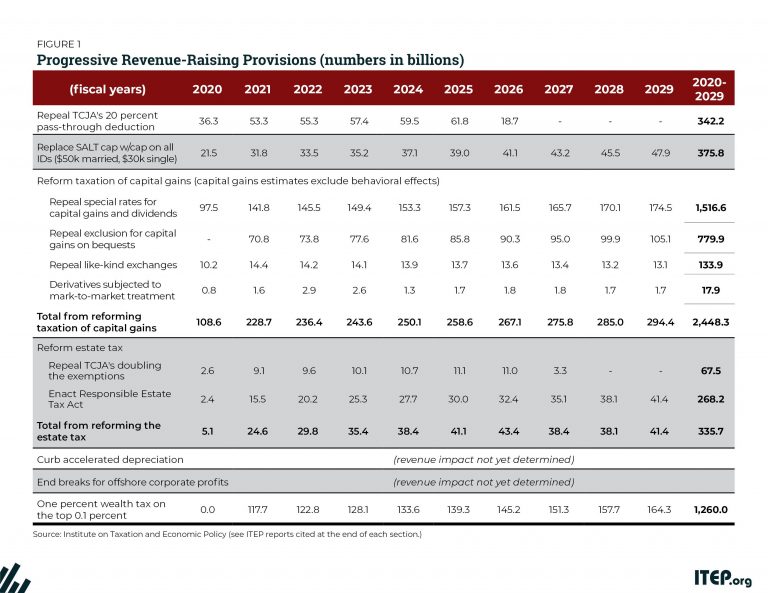
Progressive Revenue-Raising Options
• By Matthew Gardner, Steve Wamhoff
America has long needed a more equitable tax code that raises enough revenue to invest in building shared prosperity. The Tax Cuts and Jobs Act (TCJA), enacted at the end of 2017, moved the federal tax code in the opposite direction, reducing revenue by $1.9 trillion over a decade, opening new loopholes, and providing its most significant benefits to the well-off. The law cut taxes on the wealthy directly by reducing their personal income taxes…

Senator Sanders Proposes to Reform the Estate Tax
• By Alan Essig
Progressive tax proposals are finally being discussed with the urgency and seriousness they deserve. Following Rep. Alexandria Ocasio-Cortez’s call for a much higher marginal tax rate for multi-millionaires and Sen. Elizabeth Warren’s proposal to introduce a wealth tax for those at the very top, Sen. Bernie Sanders has introduced a revised version of his proposal to reform the federal estate tax.
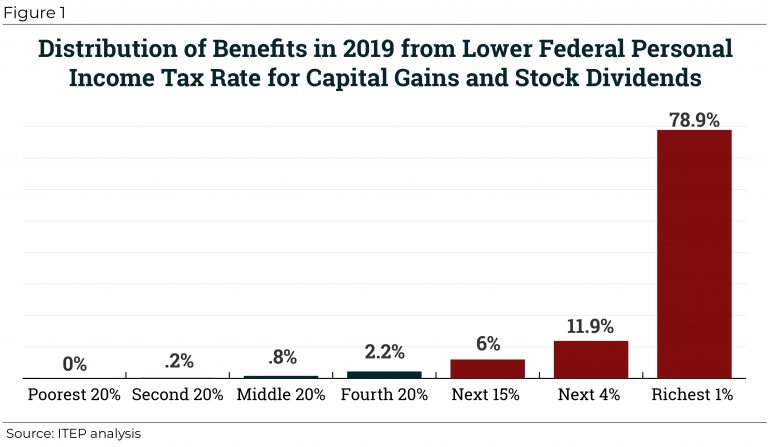
Congress Should Reduce, Not Expand, Tax Breaks for Capital Gains
• By Steve Wamhoff
Even though income derived from capital gains receives a special lower tax rate and is therefore undertaxed, some proponents of lower taxes on the wealthy claim that capital gains are overtaxed due to the effects of inflation. But existing tax breaks for capital gains more than compensate for any problem related to inflation. Congress should repeal or restrict special tax provisions for capital gains rather than creating even more breaks.
Arkansas Advocates for Children and Families: Tax Cut Bill Filed: Plan Revised But Not Fixed
• By ITEP Staff
An analysis by the Institute on Taxation and Economic Policy (ITEP) shows that the benefits of this proposal are even more heavily skewed towards the richest taxpayers than the previous version. That’s because there are no changes to the standard deduction, and all the significant changes in marginal tax rates only affect taxpayers with more […]
Data for the Win: Advocating for Equitable State and Local Tax Policy (Webinar)
• By Aidan Davis, Dylan Grundman O'Neill, ITEP Staff, Meg Wiehe
Watch the video recording below for discussion on how ITEP’s distributional data can be part of an advocacy and communications strategy for securing state tax policies that raise enough revenue to fund various priorities. Outline includes a brief overview of findings from the sixth edition of Who Pays? A Distributional Analysis of the Tax Systems in All 50 States as well as insight from state advocates who use Who Pays? and other tax policy analyses research…

Yes, It’s Time to Talk about Progressive Taxes, Even a Wealth Tax
• By Alan Essig
Earlier today, several news organizations reported that Sen. Elizabeth Warren is set to formally propose a federal wealth tax. Immediately after, social media was atwitter with comments that ranged from praise to predictable outcries of how will the wealthy cope if forced to pay more in taxes.
West Virginia Center on Budget & Policy: Fixing the Social Security Tax Bill with a Bottom-Up Tax Cut for Working Families
• By ITEP Staff
The fact that so few West Virginians pay income tax on their Social Security benefits should tell us that this is not a middle-class tax cut. As the graph and analysis by the Institute on Taxation and Economic Policy (ITEP) below shows, the average tax change from eliminating the state income tax on Social Security […]

Law360: Montana Mulls Statewide Sales Tax To Replace Property Taxes
• By Meg Wiehe
Montana could become the first state in the nation to eliminate residential and commercial property taxes in exchange for creating a new 2.5 percent statewide sales tax...
NC Policy Watch: Report: Corporations Are Stiffing North Carolina on $373 Million in State Taxes
• By ITEP Staff
It turns out that state leaders can ensure that companies pay the proper amount of taxes on income generated from business conducted in their jurisdictions, but existing tax codes at the state level often allow loopholes for smart corporate tax lawyers to exploit. Corporations often use accounting sleights of hand to move income around within […]

The U.S. Needs a Federal Wealth Tax
• By Steve Wamhoff
A federal wealth tax on the richest 0.1 percent of Americans is a viable approach for Congress to raise revenue and is one of the few approaches that could truly address rising inequality. As this report explains, an annual federal tax of only 1 percent on the portion of any taxpayer’s net worth exceeding the threshold for belonging to the wealthiest 0.1 percent (likely to be about $32.2 million in 2020) could raise $1.3 trillion…
Thoughts about a Federal Wealth Tax and How It Could Raise Revenue, Address Income Inequality
• By Steve Wamhoff
Wealth inequality is much greater than income inequality. The 1 percent of Americans with the highest incomes receive about a fifth of the total income in the United States. In contrast, the top 1 percent of wealth holders in the United States own 42 percent of the nation’s wealth, according to estimates from University of California at Berkley economists Emmanuel Saez and Gabriel Zucman.
New Report Makes the Case for a Wealth Tax; Analysis Finds Such a Tax Could Raise More Than $1 Trillion Over a Decade
• By ITEP Staff
A federal wealth tax on the top 0.1 percent of households could raise significant tax revenue, curb growing economic inequality and help make the tax system fairer, a new report released today by the Institute on Taxation and Economic Policy (ITEP) finds.

Five Years in, Cannabis Tax Haul Rivals or Exceeds Alcohol Taxes in Many States
• By ITEP Staff
A first-of-its-kind look at state excise taxes on legal cannabis sales finds that taxing the substance can be a meaningful source of state revenue but cautions that achieving sustainable revenues over time will be difficult under the price-based tax structures adopted in most states thus far.
Taxing Cannabis
• By Carl Davis, Misha Hill, Richard Phillips
State policy toward cannabis is evolving rapidly. While much of the debate around legalization has rightly focused on potential health and criminal justice impacts, legalization also has revenue implications for state and local governments that choose to regulate and tax cannabis sales. This report describes the various options for structuring state and local taxes on cannabis and identifies approaches currently in use. It also undertakes an in-depth exploration of state cannabis tax revenue performance and…
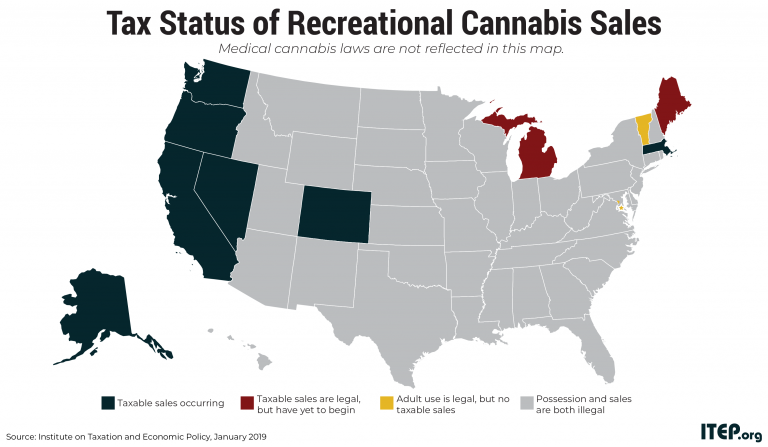
Cannabis Tax Debates are Ramping Up; Here’s What We’ve Learned from Five Years of Cannabis Taxation Thus Far
• By Carl Davis
This year lawmakers in Connecticut, Delaware, Hawaii, Illinois, New Jersey, New York, Rhode Island, and Vermont will all be debating the taxation of recreational cannabis. A new ITEP report reviews the track record of recreational cannabis taxes thus far and offers recommendations for structuring cannabis taxes to achieve stable revenue growth over the long haul.
Time to restore fairness to the personal income tax and break the boom-or-bust cycle
• By ITEP Staff
Our citizen legislators have lots of choices to make when they meet for the annual legislative session every January – how to prioritize spending on public services like education, health care and public safety, which laws to enact, and whether to make changes to our state’s tax code.
Beacon Journal/Ohio.com Editorial Board: How Ohio’s Tax System Puts a Heavier Burden on the Poor
• By ITEP Staff
The Institute for Taxation & Economic Policy performed the analysis for Policy Matters. Consider that those Ohio families with annual incomes below $19,000 paid an average 12.3 percent of their income in state and local taxes. For those in the middle three quintiles, with incomes from $19,000 to $91,800 a year, the burden holds steady, […]
A Simple Fix for a $17 Billion Loophole: How States Can Reclaim Revenue Lost to Tax Havens
• By Richard Phillips
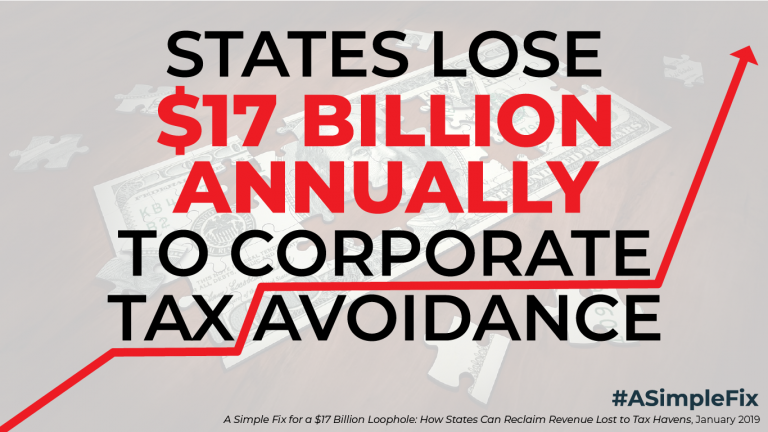
Enacting Worldwide Combined Reporting or Complete Reporting in all states, this report calculates, would increase state tax revenue by $17.04 billion dollars. Of that total, $2.85 billion would be raised through domestic Combined Reporting improvements, and $14.19 billion would be raised by addressing offshore tax dodging (see Table 1). Enacting Combined Reporting and including known tax havens would result in $7.75 billion in annual tax revenue, $4.9 billion from income booked offshore.
How States Can Help Shut Down Tax Havens by Cracking Down on Profit Shifting
• By Richard Phillips
A core problem with our corporate income tax laws at the federal and state levels is that they allow companies to use accounting gimmicks to shift significant amounts of their profits into low or zero-tax jurisdictions. Federal lawmakers had an opportunity to address this with the 2017 tax law, but they failed to do so, and, in fact, the law may incentivize more offshore tax avoidance. State lawmakers, however, can buck the federal trend and…

Institute on Taxation
and Economic Policy
ITEP is a non-profit, non-partisan tax policy organization. We conduct rigorous analyses of tax and economic proposals and provide data-driven recommendations to shape equitable and sustainable tax systems.
Subscribe to ITEP Emails
Tax research and policy news in your inbox.
Promote Fair Tax Policy
Your gift to ITEP promotes tax justice. With your help, we do research that supports taxing millionaires and billionaires, taxing big corporations and raising revenue for the things our people, our communities and our planet need.
Together, we can create a country with more economic justice, more racial justice, more climate justice… and more tax justice.